Meeting the Host Family
Conociendo a la familia anfitriona
Emma arrives at the family home and meets Grace and Jack. They help her feel welcome and show her where she will stay.
Emma llega a la casa de la familia y conoce a Grace y Jack. Ellos la hacen sentir bienvenida y le muestran dónde se alojará.
Diálogo8
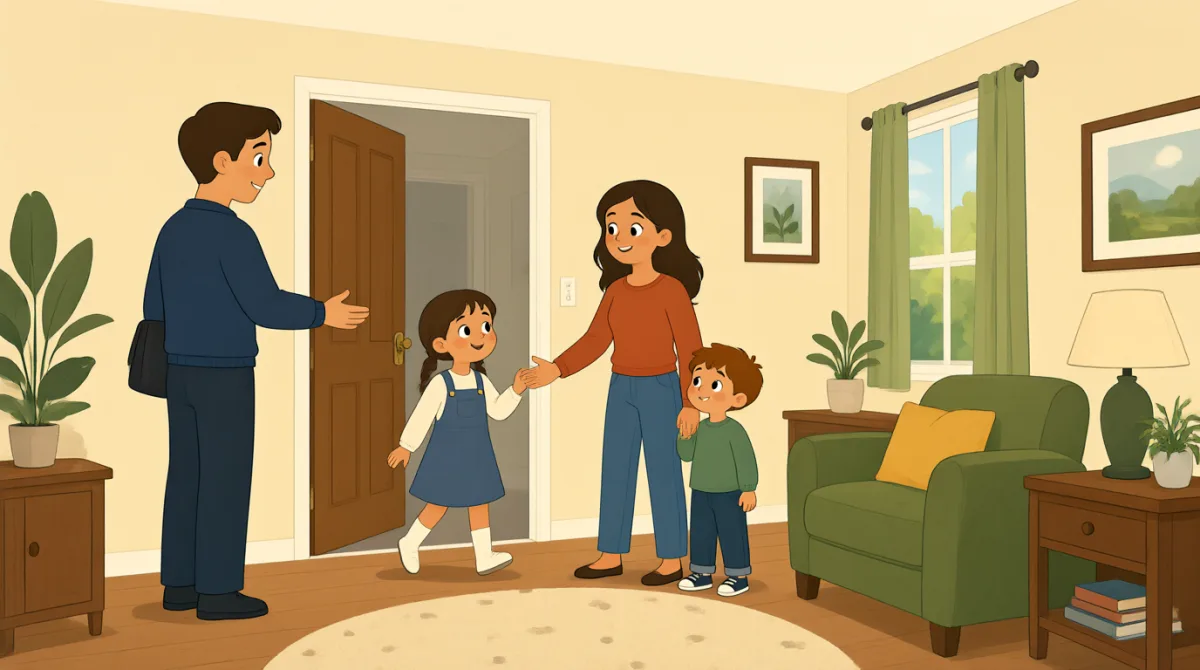

Hi, I’m Emma. Thanks for having me. It’s nice to meet you!
Hola, soy Emma. Gracias por recibirme. ¡Qué gusto conocerlos!

Welcome, Emma! I’m Grace, and this is my son, Jack. Come on in.
¡Bienvenida, Emma! Soy Grace y este es mi hijo, Jack. Pasa.

Hi, Emma! Let me take your bag. Was your trip okay?
¡Hola, Emma! Déjame llevarte el bolso. ¿Qué tal estuvo el viaje?
Thanks! Yes, it was good, but I’m a little tired.
¡Gracias! Sí, estuvo bien, pero estoy un poco cansada.
That’s understandable. Your room is upstairs. I’ll show you the way.
Es comprensible. Tu habitación está arriba. Te muestro el camino.
Great, thank you. Is there a bathroom near my room?
Genial, gracias. ¿Hay un baño cerca de mi habitación?
Yes, there is. It’s at the end of the hall, next to your room.
Sí. Está al final del pasillo, al lado de tu habitación.
Here we are! You can unpack and rest. We’ll have dinner at seven.
¡Aquí estamos! Puedes deshacer la maleta y descansar. Cenaremos a las siete.
Vocabulario8
- Thanks for having me.Gracias por recibirme.
This is a polite way to thank someone for inviting you to stay or visit.
Es una forma amable de agradecerle a alguien que te haya invitado a quedarte en su casa o a visitarlo.
- Come on in.Pasa.
This friendly phrase invites someone to enter a home. You can also say it to welcome a visitor inside.
Esta frase cordial invita a alguien a entrar en una casa. También puedes usarla para darle la bienvenida a una visita.
- Let me take your bag.Déjame llevarte el bolso.
Use this to offer to carry someone’s bag. You can also say, “Let me take your coat.”
Usa esta frase para ofrecerte a llevar el bolso de alguien. También puedes decir: “Let me take your coat.”
- a little tiredun poco cansado/a
This means slightly tired, but not very tired. You can use “a little” before other describing words, such as “a little hungry.”
Significa que estás algo cansado, pero no mucho. Puedes usar “a little” antes de otras palabras que describen cómo te sientes, como en “a little hungry.”
- That’s understandable.Es comprensible.
Say this to show that you understand why someone feels a certain way. For example, you can say it when someone is tired after a long trip.
Di esto para mostrar que entiendes por qué alguien se siente de cierta manera. Por ejemplo, puedes decirlo si alguien está cansado después de un viaje largo.
- at the end of the hallal final del pasillo
This describes a place at the far end of a hallway. You can use it to explain where a room or bathroom is.
Describe un lugar que está en el extremo más alejado de un pasillo. Puedes usarlo para explicar dónde está una habitación o un baño.
- unpack and restdeshacer la maleta y descansar
“Unpack” means to take your things out of your bag. “Rest” means to relax after doing something tiring.
“Unpack” significa sacar tus cosas de la maleta. “Rest” significa relajarte después de hacer algo que te cansó.
- have dinner at sevencenar a las siete
This tells someone the time of a meal. You can change the meal or time, as in “We’ll have lunch at one.”
Esta frase le indica a alguien a qué hora será una comida. Puedes cambiar la comida o la hora, como en “We’ll have lunch at one.”
Frases clave8
- 1
Thanks for having me.
Gracias por recibirme.
This is a polite way to thank a host for welcoming you. You can use it when you arrive at someone’s home or stay with them.
Es una forma amable de agradecerle a quien te recibe en su casa. Puedes usarla al llegar a la casa de alguien o cuando te alojas allí.
- 2
Was your trip okay?
¿Qué tal estuvo el viaje?
This is a friendly question to ask someone after they travel. You can replace “trip” with “flight” or “train ride.”
Es una pregunta cordial para hacerle a alguien después de un viaje. Puedes cambiar “trip” por “flight” o “train ride.”
- 3
I’m a little tired.
Estoy un poco cansada.
Use this sentence to say that you feel slightly tired. You can replace “tired” with another feeling, such as “hungry” or “nervous.”
Usa esta frase para decir que estás algo cansado. Puedes cambiar “tired” por otra emoción o sensación, como “hungry” o “nervous.”
- 4
Your room is upstairs.
Tu habitación está arriba.
This gives someone simple information about where their room is. You can replace “upstairs” with a place like “down the hall.”
Esta frase da información sencilla sobre dónde está la habitación de alguien. Puedes cambiar “upstairs” por un lugar como “down the hall.”
- 5
Is there a bathroom near my room?
¿Hay un baño cerca de mi habitación?
This is a polite way to ask if a bathroom is close to a place. You can use the same question pattern to ask about other places, such as “Is there a bus stop near the house?”
Es una forma amable de preguntar si hay un baño cerca de un lugar. Puedes usar el mismo patrón para preguntar por otros sitios, como en “Is there a bus stop near the house?”
- 6
It’s at the end of the hall, next to your room.
Está al final del pasillo, al lado de tu habitación.
This sentence explains where something is by giving two location details. You can use it to describe where a room or other place is.
Esta frase explica dónde está algo dando dos detalles sobre su ubicación. Puedes usarla para describir dónde está una habitación u otro lugar.
- 7
You can unpack and rest.
Puedes deshacer la maleta y descansar.
This is a kind way to tell someone they can settle in and relax. You can replace the actions with other helpful suggestions, such as “You can sit and have some water.”
Es una forma amable de decirle a alguien que puede instalarse y relajarse. Puedes cambiar las acciones por otras sugerencias útiles, como “You can sit and have some water.”
- 8
We’ll have dinner at seven.
Cenaremos a las siete.
Use this sentence to tell someone a future meal time. You can change the meal and time, as in “We’ll have breakfast at eight.”
Usa esta frase para decirle a alguien a qué hora será una comida más adelante. Puedes cambiar la comida y la hora, como en “We’ll have breakfast at eight.”