Finding an Exhibit
Trouver une exposition
Emma and Jack ask a museum worker where to find the ancient pottery exhibit. The worker gives them simple directions.
Emma et Jack demandent à un employé du musée où se trouve l’exposition de poteries anciennes. L’employé leur indique le chemin simplement.
Dialogue9
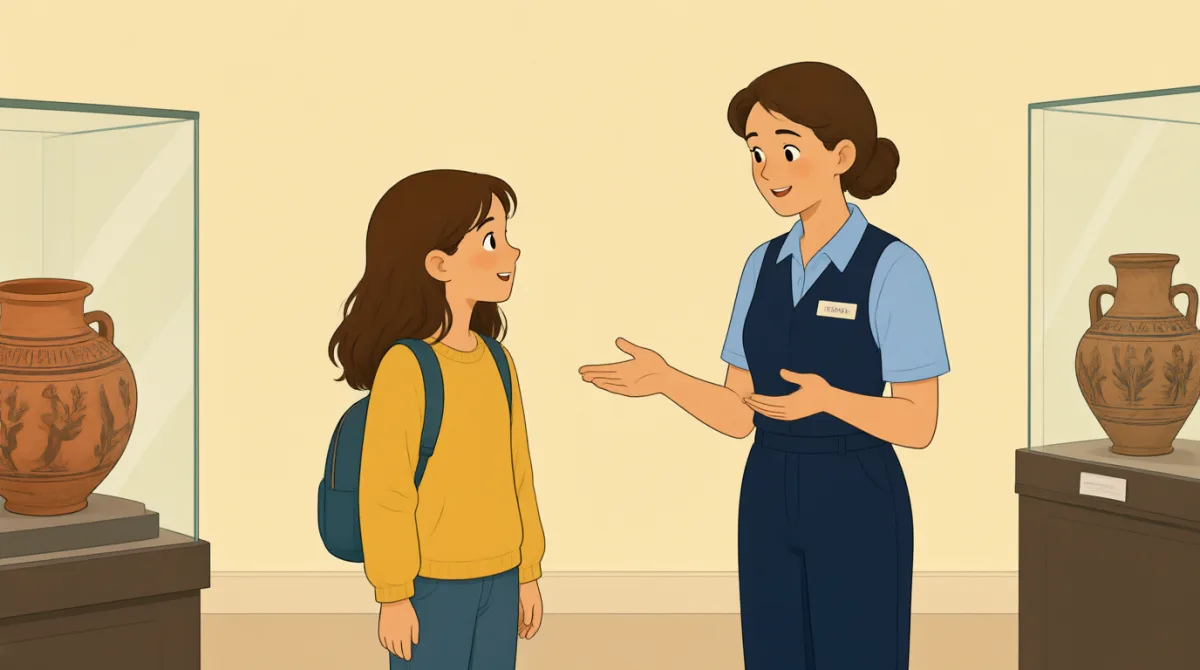

Excuse me, where can we find the ancient pottery exhibit?
Excusez-moi, où se trouve l’exposition de poteries anciennes ?

It’s on the second floor, at the end of the hall.
Elle se trouve au deuxième étage, au bout du couloir.

Should we take the stairs or the elevator?
On devrait prendre l’escalier ou l’ascenseur ?
The elevator is just around the corner, next to the map.
L’ascenseur est juste au coin, à côté du plan.
Great. When we get upstairs, which way should we go?
Super. Une fois à l’étage, on va par où ?
Turn left, then follow the signs for ancient pottery.
Tournez à gauche, puis suivez les panneaux indiquant les poteries anciennes.
How long will it take to get there?
Combien de temps faut-il pour y aller ?
Only a few minutes. You’ll see the gallery on your right.
Seulement quelques minutes. Vous verrez la galerie sur votre droite.
Thanks! We’re excited to see the pottery.
Merci ! On a hâte de voir les poteries.
Vocabulaire8
- Excuse meExcusez-moi
A polite way to get someone’s attention before asking a question. You can use it when speaking to a museum worker or another stranger.
Une formule polie pour attirer l’attention de quelqu’un avant de lui poser une question. Vous pouvez l’utiliser pour vous adresser à un employé du musée ou à une autre personne que vous ne connaissez pas.
- on the second floorau deuxième étage
This tells you which level of a building something is on. Replace “second” with another floor number to give or ask for directions.
Cette expression indique à quel niveau d’un bâtiment se trouve quelque chose. Remplacez « second » par le numéro d’un autre étage pour indiquer un chemin ou demander votre chemin.
- at the end of the hallau bout du couloir
This means the place is where the hallway finishes. Use it to describe where a room or exhibit is.
Cela signifie que l’endroit se trouve là où le couloir se termine. Utilisez cette expression pour indiquer où se trouve une salle ou une exposition.
- around the cornerau coin
This means you need to go around the nearby corner to find something. It is often used when giving directions.
Cela signifie qu’il faut contourner le coin tout proche pour trouver quelque chose. Cette expression est souvent utilisée pour indiquer un chemin.
- next to the mapà côté du plan
This means something is beside the map. Use “next to” to explain where one place or object is in relation to another.
Cela signifie que quelque chose se trouve près du plan. Utilisez « next to » pour préciser où se trouve un endroit ou un objet par rapport à un autre.
- Turn leftTournez à gauche
This is a simple direction telling someone to go to the left. You can also say “Turn right” to give the opposite direction.
C’est une indication simple qui demande à quelqu’un d’aller à gauche. Vous pouvez aussi dire « Turn right » pour indiquer la direction opposée.
- follow the signssuivez les panneaux
This means to look for and go in the direction shown by signs. It is useful when finding your way around a large building.
Cela signifie qu’il faut repérer les panneaux et aller dans la direction qu’ils indiquent. C’est pratique pour s’orienter dans un grand bâtiment.
- on your rightsur votre droite
This means the place will be on the right-hand side as you move forward. You can say “on your left” for the other side.
Cela signifie que l’endroit se trouvera à droite lorsque vous avancerez. Vous pouvez dire « on your left » pour indiquer l’autre côté.
Phrases clés8
- 1
Excuse me, where can we find the ancient pottery exhibit?
Excusez-moi, où se trouve l’exposition de poteries anciennes ?
Use this polite question to ask where something is. You can replace “the ancient pottery exhibit” with another place or attraction.
Utilisez cette question polie pour demander où se trouve quelque chose. Vous pouvez remplacer « the ancient pottery exhibit » par un autre lieu ou une autre attraction.
- 2
It’s on the second floor, at the end of the hall.
Elle se trouve au deuxième étage, au bout du couloir.
This sentence gives two details about a location: the floor and where to find it in the hallway. You can change the floor or location to give different directions.
Cette phrase donne deux précisions sur un lieu : l’étage et son emplacement dans le couloir. Vous pouvez changer l’étage ou l’emplacement pour donner d’autres indications.
- 3
Should we take the stairs or the elevator?
On devrait prendre l’escalier ou l’ascenseur ?
Use this question to ask which of two ways to go is better. Replace “the stairs” and “the elevator” with other choices.
Utilisez cette question pour demander laquelle de deux options est préférable. Remplacez « the stairs » et « the elevator » par d’autres choix.
- 4
The elevator is just around the corner, next to the map.
L’ascenseur est juste au coin, à côté du plan.
This sentence explains where to find the elevator using two nearby landmarks. You can use the same pattern to describe another place.
Cette phrase indique où trouver l’ascenseur en s’appuyant sur deux repères proches. Vous pouvez reprendre la même structure pour décrire un autre endroit.
- 5
When we get upstairs, which way should we go?
Une fois à l’étage, on va par où ?
Use this question to ask for the next direction after reaching a place. Replace “upstairs” with a destination such as “outside” or “to the lobby.”
Utilisez cette question pour demander quelle direction prendre après être arrivé quelque part. Remplacez « upstairs » par une destination comme « outside » ou « to the lobby ».
- 6
Turn left, then follow the signs for ancient pottery.
Tournez à gauche, puis suivez les panneaux indiquant les poteries anciennes.
This gives two clear steps for finding the exhibit. You can replace “Turn left” and “ancient pottery” to give different directions.
Cette phrase donne deux étapes claires pour trouver l’exposition. Vous pouvez remplacer « Turn left » et « ancient pottery » pour indiquer un autre chemin.
- 7
How long will it take to get there?
Combien de temps faut-il pour y aller ?
Use this question to ask how much time it takes to reach a place. Replace “there” with a specific destination if needed.
Utilisez cette question pour demander combien de temps il faut pour arriver à un endroit. Si nécessaire, remplacez « there » par une destination précise.
- 8
You’ll see the gallery on your right.
Vous verrez la galerie sur votre droite.
This tells someone what they will see and where it will be. You can replace “the gallery” with another place or object.
Cette phrase indique ce que la personne verra et où cela se trouvera. Vous pouvez remplacer « the gallery » par un autre lieu ou objet.