Finding an Exhibit
Cómo encontrar una exposición
Emma and Jack ask a museum worker where to find the ancient pottery exhibit. The worker gives them simple directions.
Emma y Jack le preguntan a una empleada del museo dónde está la exposición de cerámica antigua. Ella les da indicaciones sencillas.
Diálogo9
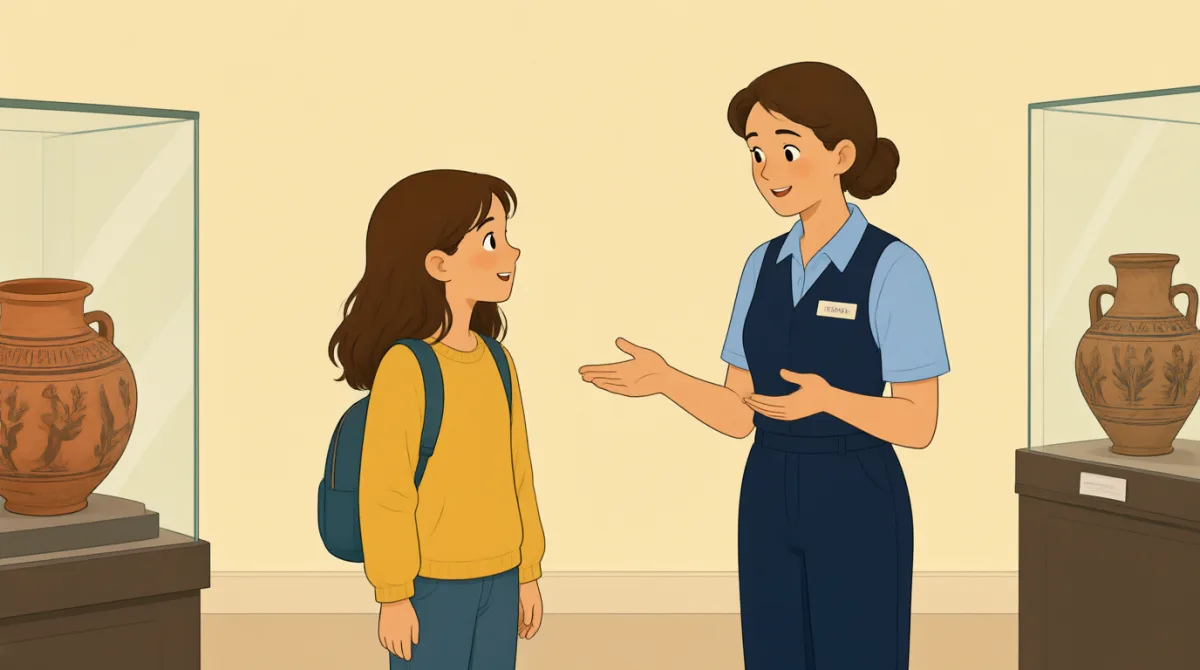

Excuse me, where can we find the ancient pottery exhibit?
Disculpe, ¿dónde podemos encontrar la exposición de cerámica antigua?

It’s on the second floor, at the end of the hall.
Está en el segundo piso, al final del pasillo.

Should we take the stairs or the elevator?
¿Tomamos las escaleras o el ascensor?
The elevator is just around the corner, next to the map.
El ascensor está a la vuelta de la esquina, junto al mapa.
Great. When we get upstairs, which way should we go?
Genial. Cuando lleguemos arriba, ¿hacia dónde vamos?
Turn left, then follow the signs for ancient pottery.
Giren a la izquierda y luego sigan los letreros que indican dónde está la cerámica antigua.
How long will it take to get there?
¿Cuánto tardaremos en llegar?
Only a few minutes. You’ll see the gallery on your right.
Solo unos minutos. Verán la galería a su derecha.
Thanks! We’re excited to see the pottery.
¡Gracias! Tenemos muchas ganas de ver la cerámica.
Vocabulario8
- Excuse meDisculpe
A polite way to get someone’s attention before asking a question. You can use it when speaking to a museum worker or another stranger.
Es una forma educada de llamar la atención de alguien antes de hacerle una pregunta. Puedes usarla al hablar con un empleado del museo o con otra persona que no conozcas.
- on the second flooren el segundo piso
This tells you which level of a building something is on. Replace “second” with another floor number to give or ask for directions.
Esta expresión indica en qué nivel de un edificio está algo. Cambia “second” por el número de otro piso para dar o pedir indicaciones.
- at the end of the hallal final del pasillo
This means the place is where the hallway finishes. Use it to describe where a room or exhibit is.
Significa que el lugar está donde termina el pasillo. Úsala para explicar dónde está una sala o una exposición.
- around the cornera la vuelta de la esquina
This means you need to go around the nearby corner to find something. It is often used when giving directions.
Significa que tienes que doblar la esquina cercana para encontrar algo. Se usa a menudo para dar indicaciones.
- next to the mapjunto al mapa
This means something is beside the map. Use “next to” to explain where one place or object is in relation to another.
Significa que algo está al lado del mapa. Usa “next to” para explicar dónde está un lugar u objeto en relación con otro.
- Turn leftGira a la izquierda
This is a simple direction telling someone to go to the left. You can also say “Turn right” to give the opposite direction.
Es una indicación sencilla que le dice a alguien que vaya hacia la izquierda. También puedes decir “Turn right” para indicar la dirección opuesta.
- follow the signssigue los letreros
This means to look for and go in the direction shown by signs. It is useful when finding your way around a large building.
Significa que debes buscar los letreros y avanzar en la dirección que indican. Es útil para orientarte en un edificio grande.
- on your righta tu derecha
This means the place will be on the right-hand side as you move forward. You can say “on your left” for the other side.
Significa que el lugar estará a la derecha mientras avanzas. Puedes decir “on your left” para indicar el otro lado.
Frases clave8
- 1
Excuse me, where can we find the ancient pottery exhibit?
Disculpe, ¿dónde podemos encontrar la exposición de cerámica antigua?
Use this polite question to ask where something is. You can replace “the ancient pottery exhibit” with another place or attraction.
Usa esta pregunta cortés para preguntar dónde está algo. Puedes sustituir “the ancient pottery exhibit” por otro lugar o atractivo.
- 2
It’s on the second floor, at the end of the hall.
Está en el segundo piso, al final del pasillo.
This sentence gives two details about a location: the floor and where to find it in the hallway. You can change the floor or location to give different directions.
Esta frase da dos detalles sobre un lugar: en qué piso está y dónde encontrarlo en el pasillo. Puedes cambiar el piso o el lugar para dar otras indicaciones.
- 3
Should we take the stairs or the elevator?
¿Tomamos las escaleras o el ascensor?
Use this question to ask which of two ways to go is better. Replace “the stairs” and “the elevator” with other choices.
Usa esta pregunta para averiguar cuál de dos opciones es mejor. Sustituye “the stairs” y “the elevator” por otras opciones.
- 4
The elevator is just around the corner, next to the map.
El ascensor está a la vuelta de la esquina, junto al mapa.
This sentence explains where to find the elevator using two nearby landmarks. You can use the same pattern to describe another place.
Esta frase explica dónde encontrar el ascensor usando dos puntos de referencia cercanos. Puedes usar el mismo patrón para describir otro lugar.
- 5
When we get upstairs, which way should we go?
Cuando lleguemos arriba, ¿hacia dónde vamos?
Use this question to ask for the next direction after reaching a place. Replace “upstairs” with a destination such as “outside” or “to the lobby.”
Usa esta pregunta para pedir la siguiente indicación después de llegar a un lugar. Sustituye “upstairs” por un destino como “outside” o “to the lobby.”
- 6
Turn left, then follow the signs for ancient pottery.
Gira a la izquierda y luego sigue los letreros que indican dónde está la cerámica antigua.
This gives two clear steps for finding the exhibit. You can replace “Turn left” and “ancient pottery” to give different directions.
Esta frase da dos pasos claros para encontrar la exposición. Puedes sustituir “Turn left” y “ancient pottery” para dar otras indicaciones.
- 7
How long will it take to get there?
¿Cuánto tardaremos en llegar?
Use this question to ask how much time it takes to reach a place. Replace “there” with a specific destination if needed.
Usa esta pregunta para preguntar cuánto tiempo se tarda en llegar a un lugar. Si hace falta, sustituye “there” por un destino concreto.
- 8
You’ll see the gallery on your right.
Verán la galería a su derecha.
This tells someone what they will see and where it will be. You can replace “the gallery” with another place or object.
Esta frase le dice a alguien qué verá y dónde estará. Puedes sustituir “the gallery” por otro lugar u objeto.