Finding an Exhibit
전시관 찾기
Emma and Jack ask a museum worker where to find the ancient pottery exhibit. The worker gives them simple directions.
에마와 잭이 박물관 직원에게 고대 도자기 전시관이 어디 있는지 물어봐요. 직원은 간단하게 길을 알려 줘요.
대화9
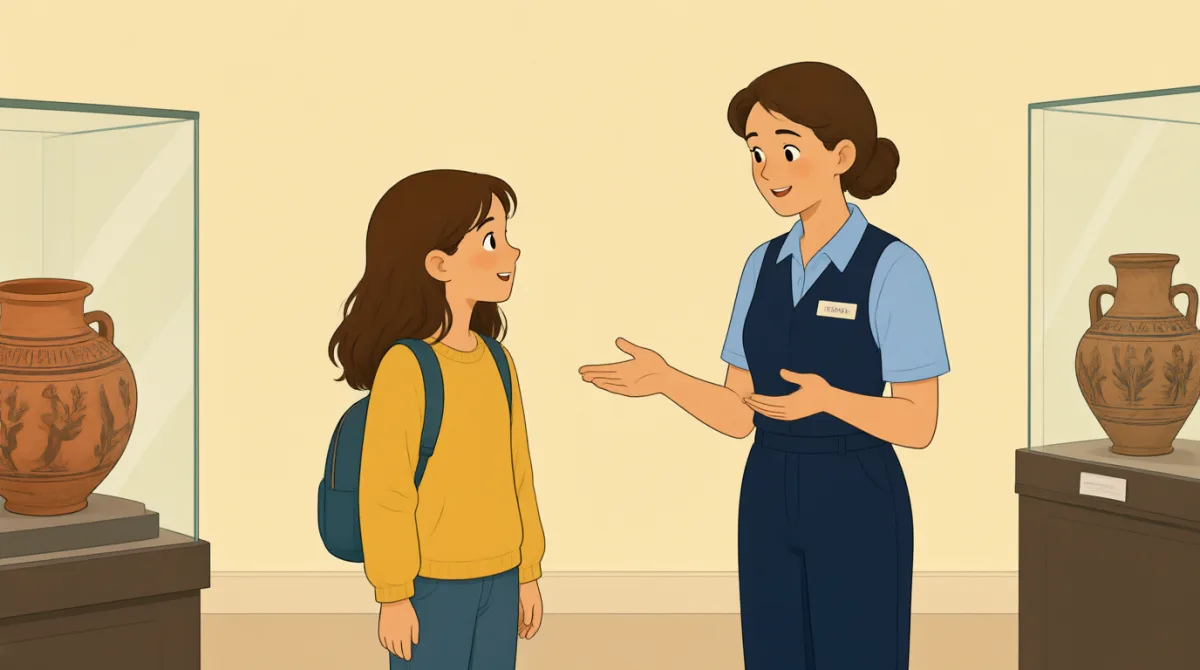

Excuse me, where can we find the ancient pottery exhibit?
실례합니다. 고대 도자기 전시관은 어디에 있나요?

It’s on the second floor, at the end of the hall.
2층 복도 끝에 있어요.

Should we take the stairs or the elevator?
계단으로 갈까요, 엘리베이터를 탈까요?
The elevator is just around the corner, next to the map.
엘리베이터는 모퉁이를 돌면 바로 있어요. 지도 옆이에요.
Great. When we get upstairs, which way should we go?
좋아요. 위층에 도착하면 어느 쪽으로 가야 해요?
Turn left, then follow the signs for ancient pottery.
왼쪽으로 도신 다음, 고대 도자기 안내 표지판을 따라가세요.
How long will it take to get there?
거기까지 가는 데 얼마나 걸려요?
Only a few minutes. You’ll see the gallery on your right.
몇 분밖에 안 걸려요. 오른쪽에 전시실이 보일 거예요.
Thanks! We’re excited to see the pottery.
감사합니다! 도자기를 볼 생각에 기대돼요.
어휘8
- Excuse me실례합니다
A polite way to get someone’s attention before asking a question. You can use it when speaking to a museum worker or another stranger.
질문하기 전에 상대의 주의를 끌 때 쓰는 공손한 표현이에요. 박물관 직원이나 모르는 사람에게 말을 걸 때 사용할 수 있어요.
- on the second floor2층에
This tells you which level of a building something is on. Replace “second” with another floor number to give or ask for directions.
건물의 어느 층에 무언가가 있는지 알려 주는 표현이에요. 길을 알려 주거나 물어볼 때 “second”를 다른 층수로 바꿔 말할 수 있어요.
- at the end of the hall복도 끝에
This means the place is where the hallway finishes. Use it to describe where a room or exhibit is.
복도가 끝나는 지점에 장소가 있다는 뜻이에요. 방이나 전시관이 어디 있는지 설명할 때 사용해요.
- around the corner모퉁이를 돌면
This means you need to go around the nearby corner to find something. It is often used when giving directions.
가까운 모퉁이를 돌아가면 무언가를 찾을 수 있다는 뜻이에요. 길을 안내할 때 자주 쓰는 표현이에요.
- next to the map지도 옆에
This means something is beside the map. Use “next to” to explain where one place or object is in relation to another.
지도 바로 옆에 있다는 뜻이에요. “next to”를 사용하면 한 장소나 물건이 다른 것과 어떤 위치 관계인지 설명할 수 있어요.
- Turn left왼쪽으로 도세요
This is a simple direction telling someone to go to the left. You can also say “Turn right” to give the opposite direction.
왼쪽으로 가라고 알려 주는 간단한 길 안내 표현이에요. 반대 방향을 알려 줄 때는 “Turn right”라고 할 수 있어요.
- follow the signs안내 표지판을 따라가세요
This means to look for and go in the direction shown by signs. It is useful when finding your way around a large building.
표지판을 찾아 그 표지판이 가리키는 방향으로 가라는 뜻이에요. 큰 건물 안에서 길을 찾을 때 유용해요.
- on your right오른쪽에
This means the place will be on the right-hand side as you move forward. You can say “on your left” for the other side.
앞으로 가다 보면 오른쪽에 장소가 있다는 뜻이에요. 반대편을 말하려면 “on your left”라고 할 수 있어요.
핵심 문장8
- 1
Excuse me, where can we find the ancient pottery exhibit?
실례합니다. 고대 도자기 전시관은 어디에 있나요?
Use this polite question to ask where something is. You can replace “the ancient pottery exhibit” with another place or attraction.
어떤 장소가 어디 있는지 물을 때 쓰는 공손한 질문이에요. “the ancient pottery exhibit” 대신 다른 장소나 볼거리를 넣을 수 있어요.
- 2
It’s on the second floor, at the end of the hall.
2층 복도 끝에 있어요.
This sentence gives two details about a location: the floor and where to find it in the hallway. You can change the floor or location to give different directions.
이 문장은 장소에 관한 두 가지 정보를 알려 줘요. 몇 층인지, 그리고 복도 어디에 있는지 말해요. 층이나 위치를 바꾸면 다른 길을 안내할 수 있어요.
- 3
Should we take the stairs or the elevator?
계단으로 갈까요, 엘리베이터를 탈까요?
Use this question to ask which of two ways to go is better. Replace “the stairs” and “the elevator” with other choices.
두 가지 이동 방법 중 어느 쪽이 나은지 물을 때 쓰는 질문이에요. “the stairs”와 “the elevator”를 다른 선택지로 바꿔 말할 수 있어요.
- 4
The elevator is just around the corner, next to the map.
엘리베이터는 모퉁이를 돌면 바로 있어요. 지도 옆이에요.
This sentence explains where to find the elevator using two nearby landmarks. You can use the same pattern to describe another place.
이 문장은 가까운 위치를 알려 주는 두 가지 기준점을 이용해 엘리베이터가 어디 있는지 설명해요. 같은 문장 형태로 다른 장소의 위치도 안내할 수 있어요.
- 5
When we get upstairs, which way should we go?
위층에 도착하면 어느 쪽으로 가야 해요?
Use this question to ask for the next direction after reaching a place. Replace “upstairs” with a destination such as “outside” or “to the lobby.”
어떤 장소에 도착한 다음 어디로 가야 하는지 물을 때 쓰는 질문이에요. “upstairs” 대신 “outside”나 “to the lobby”처럼 목적지를 넣을 수 있어요.
- 6
Turn left, then follow the signs for ancient pottery.
왼쪽으로 도신 다음, 고대 도자기 안내 표지판을 따라가세요.
This gives two clear steps for finding the exhibit. You can replace “Turn left” and “ancient pottery” to give different directions.
전시관을 찾는 데 필요한 두 가지 단계를 알려 주는 문장이에요. “Turn left”와 “ancient pottery”를 바꾸면 다른 길을 안내할 수 있어요.
- 7
How long will it take to get there?
거기까지 가는 데 얼마나 걸려요?
Use this question to ask how much time it takes to reach a place. Replace “there” with a specific destination if needed.
어떤 장소에 도착하는 데 시간이 얼마나 걸리는지 물을 때 쓰는 질문이에요. 필요하면 “there” 대신 구체적인 목적지를 넣을 수 있어요.
- 8
You’ll see the gallery on your right.
오른쪽에 전시실이 보일 거예요.
This tells someone what they will see and where it will be. You can replace “the gallery” with another place or object.
상대방이 무엇을 보게 될지, 그리고 그것이 어디에 있을지 알려 주는 문장이에요. “the gallery” 대신 다른 장소나 물건을 넣을 수 있어요.