Finding an Exhibit
尋找展覽
Emma and Jack ask a museum worker where to find the ancient pottery exhibit. The worker gives them simple directions.
艾瑪和傑克詢問博物館工作人員古代陶器展在哪裡。工作人員為他們指明瞭方向。
對話9
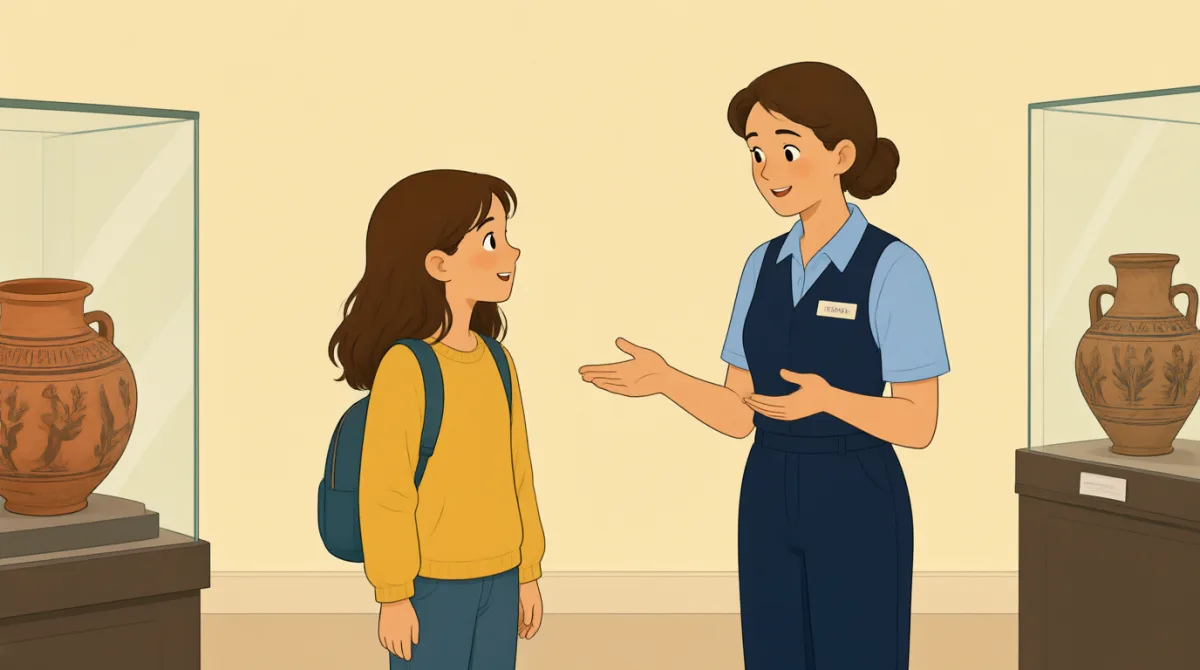

Excuse me, where can we find the ancient pottery exhibit?
打擾一下,請問古代陶器展在哪裡?

It’s on the second floor, at the end of the hall.
在二樓,走廊盡頭就是。

Should we take the stairs or the elevator?
我們走樓梯還是乘電梯?
The elevator is just around the corner, next to the map.
電梯就在拐角處,地圖旁邊。
Great. When we get upstairs, which way should we go?
太好了。我們上樓後應該往哪邊走?
Turn left, then follow the signs for ancient pottery.
向左轉,然後沿著古代陶器展的指示牌走。
How long will it take to get there?
到那裡要走多久?
Only a few minutes. You’ll see the gallery on your right.
只要幾分鐘。你們會在右手邊看到展廳。
Thanks! We’re excited to see the pottery.
謝謝!我們很期待看這些陶器。
詞彙8
- Excuse me打擾一下
A polite way to get someone’s attention before asking a question. You can use it when speaking to a museum worker or another stranger.
在提問前,用來禮貌地引起別人的注意。和博物館工作人員或其他陌生人說話時,可以這樣開口。
- on the second floor在二樓
This tells you which level of a building something is on. Replace “second” with another floor number to give or ask for directions.
這個短語用來說明某個地方在建築物的哪一層。給別人指路或詢問方向時,可以把“second”換成其他樓層。
- at the end of the hall在走廊盡頭
This means the place is where the hallway finishes. Use it to describe where a room or exhibit is.
這個短語表示地點在走廊的盡頭。可以用來說明房間或展覽的位置。
- around the corner拐角處
This means you need to go around the nearby corner to find something. It is often used when giving directions.
這個短語表示要繞過附近的拐角才能找到某樣東西。指路時經常會用到。
- next to the map在地圖旁邊
This means something is beside the map. Use “next to” to explain where one place or object is in relation to another.
這個短語表示某樣東西在地圖旁邊。可以用“next to”說明一個地點或物品相對於另一個地點或物品的位置。
- Turn left向左轉
This is a simple direction telling someone to go to the left. You can also say “Turn right” to give the opposite direction.
這是一個簡單的指路用語,告訴別人往左走。要指相反的方向,也可以說“Turn right”。
- follow the signs沿著指示牌走
This means to look for and go in the direction shown by signs. It is useful when finding your way around a large building.
這個短語表示留意指示牌,並按照牌上指示的方向走。在大型建築物裡找路時很實用。
- on your right在你的右手邊
This means the place will be on the right-hand side as you move forward. You can say “on your left” for the other side.
這個短語表示你往前走時,某個地方會在右手邊。要說另一側,可以說“on your left”。
關鍵句8
- 1
Excuse me, where can we find the ancient pottery exhibit?
打擾一下,請問我們在哪裡能找到古代陶器展?
Use this polite question to ask where something is. You can replace “the ancient pottery exhibit” with another place or attraction.
用這個禮貌的問句詢問某個地方在哪裡。你可以把“the ancient pottery exhibit”換成其他地點或景點。
- 2
It’s on the second floor, at the end of the hall.
在二樓,走廊盡頭就是。
This sentence gives two details about a location: the floor and where to find it in the hallway. You can change the floor or location to give different directions.
這個句子從兩個方面說明地點:它在哪一層,以及在走廊的什麼位置。你可以換成其他樓層或位置來指路。
- 3
Should we take the stairs or the elevator?
我們走樓梯還是乘電梯?
Use this question to ask which of two ways to go is better. Replace “the stairs” and “the elevator” with other choices.
用這個問句詢問兩種走法中哪一種更合適。你可以把“the stairs”和“the elevator”換成其他選項。
- 4
The elevator is just around the corner, next to the map.
電梯就在拐角處,地圖旁邊。
This sentence explains where to find the elevator using two nearby landmarks. You can use the same pattern to describe another place.
這個句子用兩個附近的參照物說明電梯在哪裡。你也可以用相同的句型描述其他地方的位置。
- 5
When we get upstairs, which way should we go?
我們上樓後應該往哪邊走?
Use this question to ask for the next direction after reaching a place. Replace “upstairs” with a destination such as “outside” or “to the lobby.”
到達一個地方後,用這個問句詢問接下來該怎麼走。你可以把“upstairs”換成“outside”或“to the lobby”等目的地。
- 6
Turn left, then follow the signs for ancient pottery.
向左轉,然後沿著古代陶器展的指示牌走。
This gives two clear steps for finding the exhibit. You can replace “Turn left” and “ancient pottery” to give different directions.
這個句子用兩個清楚的步驟告訴你怎麼找到展覽。你可以替換“Turn left”和“ancient pottery”,來說明其他路線。
- 7
How long will it take to get there?
到那裡要走多久?
Use this question to ask how much time it takes to reach a place. Replace “there” with a specific destination if needed.
用這個問句詢問到達某個地方需要多長時間。需要時,可以把“there”換成具體的目的地。
- 8
You’ll see the gallery on your right.
你會在右手邊看到展廳。
This tells someone what they will see and where it will be. You can replace “the gallery” with another place or object.
這個句子告訴別人會看到什麼,以及它在哪裡。你可以把“the gallery”換成其他地點或物品。