Talking About a Favorite Painting
Parler de son tableau préféré
After seeing the exhibits, Emma and Jack talk about their favorite painting. They share what they liked about it.
Après avoir vu les expositions, Emma et Jack parlent de leur tableau préféré. Ils racontent ce qui leur a plu.
Dialogue8
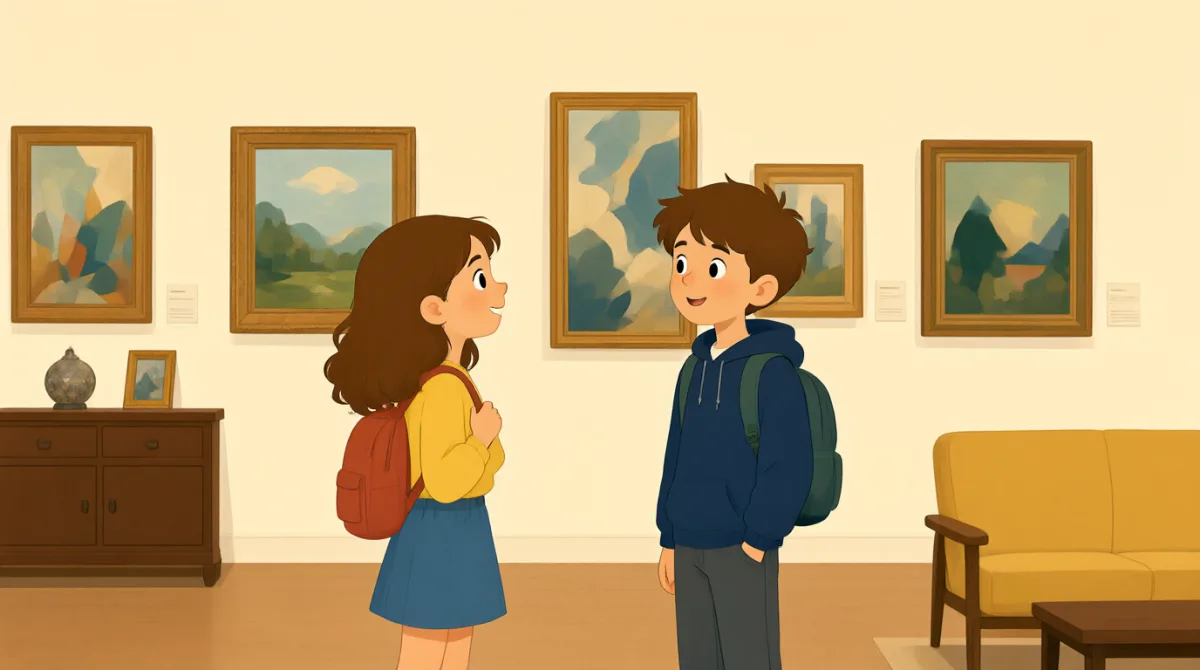

That blue painting was my favorite. The little boat looked so real.
Ce tableau bleu, c’était mon préféré. Le petit bateau avait l’air tellement réel.

I liked it too. The colors were bright, but the scene felt peaceful.
Moi aussi, je l’ai aimé. Les couleurs étaient vives, mais la scène était apaisante.
Yes, and I noticed the waves near the boat. They looked like they were moving.
Oui, et j’ai remarqué les vagues près du bateau. On aurait dit qu’elles bougeaient.
The artist did a great job. I wanted to look at it for a long time.
L’artiste a fait du très bon travail. J’avais envie de le regarder longtemps.
Did you see the small house on the hill? I almost missed it.
Tu as vu la petite maison sur la colline ? J’ai failli ne pas la voir.
I saw it. It made me wonder who lived there.
Oui, je l’ai vue. Je me suis demandé qui pouvait bien y habiter.
I wish we knew the story behind the painting. Maybe the sign said more.
J’aimerais bien connaître l’histoire derrière ce tableau. Peut-être que le panneau en disait plus.
Maybe. We can read about it online later. I took a photo of the sign.
Peut-être. On pourra se renseigner en ligne plus tard. J’ai pris une photo du panneau.
Vocabulaire8
- my favoritemon préféré
This means the one you like best. Use it to say which painting or other thing you enjoyed most.
“my favorite” signifie la chose que tu aimes le plus. Utilise cette expression pour dire quel tableau ou quel autre objet tu as préféré.
- looked so realavait l’air tellement réel
This means something seemed very lifelike. Use it to describe a picture or object that looks true to life.
“looked so real” signifie que quelque chose semblait très réaliste. Utilise cette expression pour décrire une image ou un objet qui paraît vrai.
- felt peacefulétait apaisant
This means it gave you a calm feeling. Use it to describe a place, picture, or moment.
“felt peaceful” signifie que quelque chose t’a donné une sensation de calme. Utilise cette expression pour décrire un lieu, une image ou un moment.
- did a great joba fait du très bon travail
This means someone did something very well. Use it to praise an artist or another person's work.
“did a great job” signifie que quelqu’un a très bien fait quelque chose. Utilise cette expression pour féliciter un artiste ou quelqu’un pour son travail.
- for a long timelongtemps
This means for a long period. Use it to say how long you looked at or did something.
“for a long time” signifie pendant une longue période. Utilise cette expression pour dire combien de temps tu as regardé ou fait quelque chose.
- almost missed itj’ai failli ne pas le/la voir
This means you nearly did not notice or see something. Use it when a detail is easy to overlook.
“almost missed it” signifie que tu as failli ne pas remarquer ou voir quelque chose. Utilise cette expression quand un détail est facile à manquer.
- the story behindl’histoire derrière
This means the background or events connected to something. Use it to ask about the meaning or history of a painting.
“the story behind” désigne le contexte ou les événements liés à quelque chose. Utilise cette expression pour poser des questions sur le sens ou l’histoire d’un tableau.
- read about itse renseigner à son sujet
This means to find information about something by reading. Use it when you want to learn more about a place, person, or artwork.
“read about it” signifie chercher des informations sur quelque chose en lisant. Utilise cette expression quand tu veux en apprendre davantage sur un lieu, une personne ou une œuvre d’art.
Phrases clés8
- 1
That blue painting was my favorite.
Ce tableau bleu, c’était mon préféré.
Use this sentence to say which artwork you liked best. You can replace “blue painting” with another thing, such as “that sculpture” or “the landscape.”
Utilise cette phrase pour dire quelle œuvre tu as préférée. Tu peux remplacer “blue painting” par autre chose, comme “that sculpture” ou “the landscape”.
- 2
The colors were bright, but the scene felt peaceful.
Les couleurs étaient vives, mais la scène était apaisante.
This sentence describes two different qualities of a painting. Use “but” to connect a contrast, such as bright colors and a calm feeling.
Cette phrase décrit deux caractéristiques différentes d’un tableau. Utilise “but” pour exprimer un contraste, par exemple entre des couleurs vives et une impression de calme.
- 3
I noticed the waves near the boat.
J’ai remarqué les vagues près du bateau.
Use this sentence to point out a detail you saw. Replace “the waves near the boat” with another feature or object.
Utilise cette phrase pour attirer l’attention sur un détail que tu as vu. Remplace “the waves near the boat” par un autre élément ou objet.
- 4
The artist did a great job.
L’artiste a fait du très bon travail.
This is a simple way to praise an artist's work. You can also use it to praise someone who did something well.
C’est une façon simple de féliciter un artiste pour son travail. Tu peux aussi l’utiliser pour féliciter quelqu’un qui a bien fait quelque chose.
- 5
I almost missed it.
J’ai failli ne pas le voir.
Use this sentence when you nearly failed to see or notice something. It is useful for talking about small or hidden details.
Utilise cette phrase quand tu as failli ne pas voir ou remarquer quelque chose. Elle est utile pour parler de petits détails ou de détails cachés.
- 6
It made me wonder who lived there.
Ça m’a donné envie de savoir qui y habitait.
Use this sentence to say that something made you curious. You can change “who lived there” to another question, such as “what happened there.”
Utilise cette phrase pour dire que quelque chose a éveillé ta curiosité. Tu peux remplacer “who lived there” par une autre question, comme “what happened there”.
- 7
I wish we knew the story behind the painting.
J’aimerais bien connaître l’histoire derrière ce tableau.
Use “I wish we knew” to express that you would like to have information you do not have. You can replace “the story behind the painting” with another unknown detail.
Utilise “I wish we knew” pour exprimer que tu aimerais avoir une information que tu n’as pas. Tu peux remplacer “the story behind the painting” par un autre détail inconnu.
- 8
We can read about it online later.
On pourra se renseigner à son sujet en ligne plus tard.
Use this sentence to suggest finding information on the internet at a later time. Replace “it” with the subject you want to learn about.
Utilise cette phrase pour proposer de chercher des informations sur Internet plus tard. Remplace “it” par le sujet que tu veux découvrir.