Finding an Exhibit
Encontrando uma exposição
Emma and Jack ask a museum worker where to find the ancient pottery exhibit. The worker gives them simple directions.
Emma e Jack perguntam a uma funcionária do museu onde fica a exposição de cerâmica antiga. Ela dá orientações simples.
Diálogo9
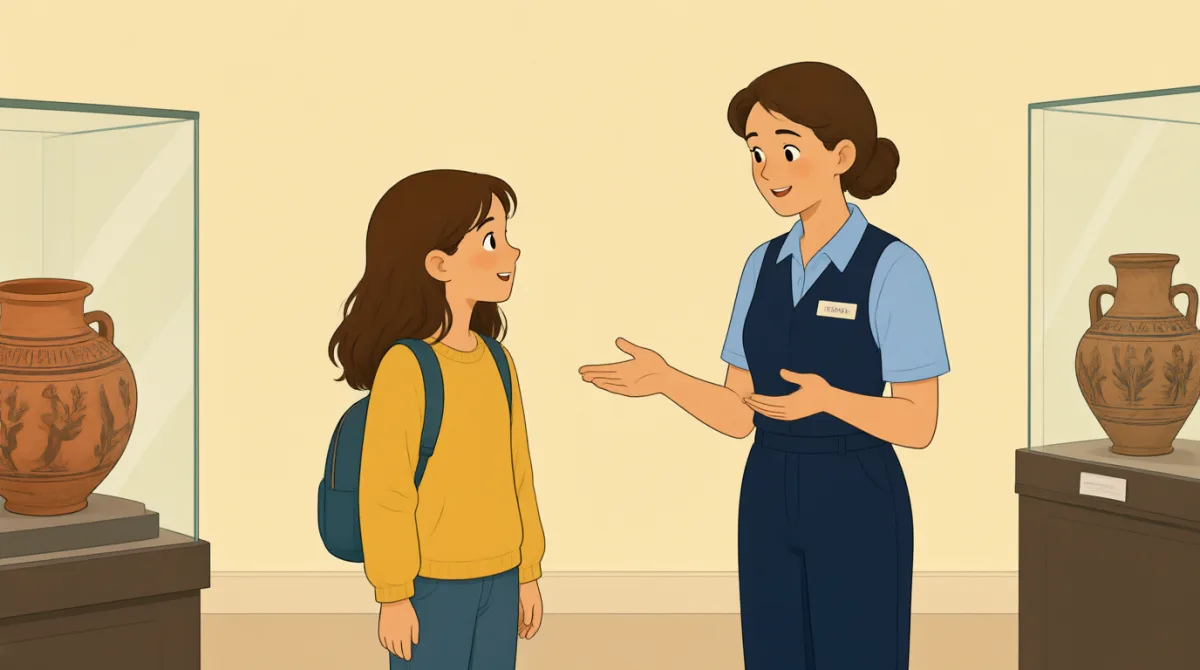

Excuse me, where can we find the ancient pottery exhibit?
Com licença, onde fica a exposição de cerâmica antiga?

It’s on the second floor, at the end of the hall.
Fica no segundo andar, no fim do corredor.

Should we take the stairs or the elevator?
Devemos subir pelas escadas ou pegar o elevador?
The elevator is just around the corner, next to the map.
O elevador fica logo ali na esquina, ao lado do mapa.
Great. When we get upstairs, which way should we go?
Ótimo. Quando chegarmos lá em cima, para que lado devemos ir?
Turn left, then follow the signs for ancient pottery.
Virem à esquerda e sigam as placas para a exposição de cerâmica antiga.
How long will it take to get there?
Quanto tempo leva para chegar lá?
Only a few minutes. You’ll see the gallery on your right.
Só alguns minutos. Vocês vão ver a galeria à direita.
Thanks! We’re excited to see the pottery.
Obrigada! Estamos animadas para ver a cerâmica.
Vocabulário8
- Excuse meCom licença
A polite way to get someone’s attention before asking a question. You can use it when speaking to a museum worker or another stranger.
Uma forma educada de chamar a atenção de alguém antes de fazer uma pergunta. Você pode usar essa expressão ao falar com um funcionário do museu ou com outra pessoa desconhecida.
- on the second floorno segundo andar
This tells you which level of a building something is on. Replace “second” with another floor number to give or ask for directions.
Essa expressão indica em que andar de um prédio algo fica. Troque “second” por outro número de andar para dar ou pedir informações.
- at the end of the hallno fim do corredor
This means the place is where the hallway finishes. Use it to describe where a room or exhibit is.
Isso significa que o lugar fica onde o corredor termina. Use essa expressão para dizer onde fica uma sala ou exposição.
- around the cornerlogo ali na esquina
This means you need to go around the nearby corner to find something. It is often used when giving directions.
Isso significa que você precisa contornar a esquina ali perto para encontrar algo. Essa expressão é muito usada para dar direções.
- next to the mapao lado do mapa
This means something is beside the map. Use “next to” to explain where one place or object is in relation to another.
Isso significa que algo fica junto ao mapa. Use “next to” para explicar onde um lugar ou objeto fica em relação a outro.
- Turn leftVire à esquerda
This is a simple direction telling someone to go to the left. You can also say “Turn right” to give the opposite direction.
Essa é uma orientação simples que diz para alguém ir para a esquerda. Você também pode dizer “Turn right” para indicar a direção oposta.
- follow the signssiga as placas
This means to look for and go in the direction shown by signs. It is useful when finding your way around a large building.
Isso significa procurar as placas e ir na direção indicada por elas. É útil para se orientar em um prédio grande.
- on your rightà sua direita
This means the place will be on the right-hand side as you move forward. You can say “on your left” for the other side.
Isso significa que o lugar estará do lado direito enquanto você segue em frente. Você pode dizer “on your left” para indicar o outro lado.
Frases-chave8
- 1
Excuse me, where can we find the ancient pottery exhibit?
Com licença, onde fica a exposição de cerâmica antiga?
Use this polite question to ask where something is. You can replace “the ancient pottery exhibit” with another place or attraction.
Use essa pergunta educada para saber onde fica alguma coisa. Você pode substituir “the ancient pottery exhibit” por outro lugar ou atração.
- 2
It’s on the second floor, at the end of the hall.
Fica no segundo andar, no fim do corredor.
This sentence gives two details about a location: the floor and where to find it in the hallway. You can change the floor or location to give different directions.
Esta frase dá duas informações sobre um lugar: em que andar fica e onde encontrá-lo no corredor. Você pode mudar o andar ou o local para dar outras orientações.
- 3
Should we take the stairs or the elevator?
Devemos subir pelas escadas ou pegar o elevador?
Use this question to ask which of two ways to go is better. Replace “the stairs” and “the elevator” with other choices.
Use essa pergunta para saber qual de duas opções é melhor. Substitua “the stairs” e “the elevator” por outras opções.
- 4
The elevator is just around the corner, next to the map.
O elevador fica logo ali na esquina, ao lado do mapa.
This sentence explains where to find the elevator using two nearby landmarks. You can use the same pattern to describe another place.
Esta frase explica onde encontrar o elevador usando dois pontos de referência próximos. Você pode usar o mesmo padrão para descrever outro lugar.
- 5
When we get upstairs, which way should we go?
Quando chegarmos lá em cima, para que lado devemos ir?
Use this question to ask for the next direction after reaching a place. Replace “upstairs” with a destination such as “outside” or “to the lobby.”
Use essa pergunta para pedir a próxima orientação depois de chegar a um lugar. Substitua “upstairs” por um destino como “outside” ou “to the lobby.”
- 6
Turn left, then follow the signs for ancient pottery.
Vire à esquerda e siga as placas para a exposição de cerâmica antiga.
This gives two clear steps for finding the exhibit. You can replace “Turn left” and “ancient pottery” to give different directions.
Esta frase dá duas instruções claras para encontrar a exposição. Você pode substituir “Turn left” e “ancient pottery” para dar outras orientações.
- 7
How long will it take to get there?
Quanto tempo leva para chegar lá?
Use this question to ask how much time it takes to reach a place. Replace “there” with a specific destination if needed.
Use essa pergunta para saber quanto tempo leva para chegar a um lugar. Se necessário, substitua “there” pelo destino específico.
- 8
You’ll see the gallery on your right.
Vocês vão ver a galeria à direita.
This tells someone what they will see and where it will be. You can replace “the gallery” with another place or object.
Esta frase diz a alguém o que vai ver e onde estará. Você pode substituir “the gallery” por outro lugar ou objeto.