Finding an Exhibit
展示を探す
Emma and Jack ask a museum worker where to find the ancient pottery exhibit. The worker gives them simple directions.
エマとジャックは、古代の陶器の展示がどこにあるか、博物館のスタッフに尋ねます。スタッフは簡単な道順を教えてくれます。
会話9
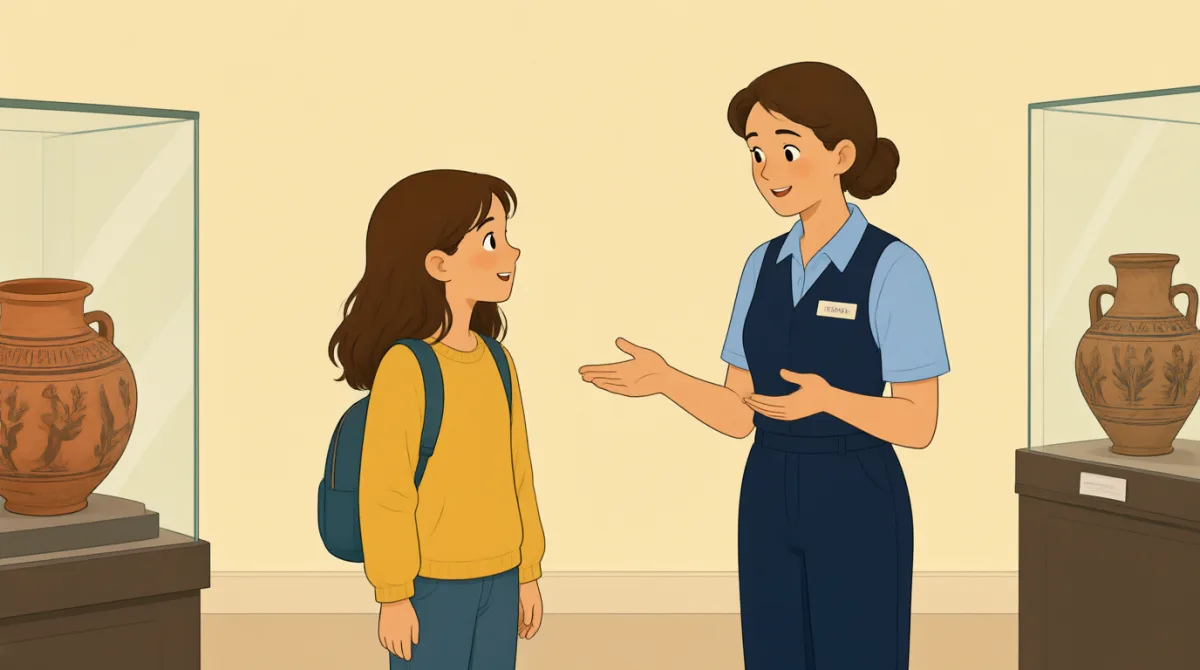

Excuse me, where can we find the ancient pottery exhibit?
すみません、古代の陶器の展示はどこにありますか?

It’s on the second floor, at the end of the hall.
2階の廊下の突き当たりにあります。

Should we take the stairs or the elevator?
階段とエレベーター、どちらで行けばいいですか?
The elevator is just around the corner, next to the map.
エレベーターは角を曲がってすぐ、地図の隣にあります。
Great. When we get upstairs, which way should we go?
ありがとうございます。上の階に着いたら、どちらへ行けばいいですか?
Turn left, then follow the signs for ancient pottery.
左に曲がって、それから古代の陶器の案内表示に沿って進んでください。
How long will it take to get there?
そこまでどのくらいかかりますか?
Only a few minutes. You’ll see the gallery on your right.
ほんの数分です。右手に展示室が見えますよ。
Thanks! We’re excited to see the pottery.
ありがとうございます!陶器を見るのが楽しみです。
語彙8
- Excuse meすみません
A polite way to get someone’s attention before asking a question. You can use it when speaking to a museum worker or another stranger.
質問する前に、相手の注意を引くための丁寧な表現です。博物館のスタッフや知らない人に話しかけるときに使えます。
- on the second floor2階に
This tells you which level of a building something is on. Replace “second” with another floor number to give or ask for directions.
建物の何階にあるかを伝える表現です。道順を教えたり尋ねたりするときは、「second」を別の階数に置き換えられます。
- at the end of the hall廊下の突き当たりに
This means the place is where the hallway finishes. Use it to describe where a room or exhibit is.
廊下が終わる場所にある、という意味です。部屋や展示の場所を説明するときに使えます。
- around the corner角を曲がったところに
This means you need to go around the nearby corner to find something. It is often used when giving directions.
近くの角を曲がったところに何かがある、という意味です。道順を教えるときによく使います。
- next to the map地図の隣に
This means something is beside the map. Use “next to” to explain where one place or object is in relation to another.
地図の横に何かがある、という意味です。「next to」を使うと、ある場所や物が別のものとの位置関係でどこにあるかを説明できます。
- Turn left左に曲がって
This is a simple direction telling someone to go to the left. You can also say “Turn right” to give the opposite direction.
左へ進むよう伝える、簡単な道案内です。反対の方向を伝えるときは、「Turn right」と言えます。
- follow the signs案内表示に沿って進む
This means to look for and go in the direction shown by signs. It is useful when finding your way around a large building.
案内表示を探し、表示が示す方向へ進むという意味です。大きな建物の中で目的地を探すときに便利な表現です。
- on your right右手に
This means the place will be on the right-hand side as you move forward. You can say “on your left” for the other side.
前に進んでいくと、右側にあるという意味です。反対側を表すには、「on your left」と言えます。
重要な文8
- 1
Excuse me, where can we find the ancient pottery exhibit?
すみません、古代の陶器の展示はどこにありますか?
Use this polite question to ask where something is. You can replace “the ancient pottery exhibit” with another place or attraction.
場所を尋ねるときに使う丁寧な質問です。「the ancient pottery exhibit」を別の場所や見どころに置き換えられます。
- 2
It’s on the second floor, at the end of the hall.
2階の廊下の突き当たりにあります。
This sentence gives two details about a location: the floor and where to find it in the hallway. You can change the floor or location to give different directions.
場所について、階数と廊下のどこにあるかの2つを伝える文です。別の道順を説明するときは、階数や場所を変えられます。
- 3
Should we take the stairs or the elevator?
階段とエレベーター、どちらで行けばいいですか?
Use this question to ask which of two ways to go is better. Replace “the stairs” and “the elevator” with other choices.
2つの行き方のうち、どちらがよいか尋ねるときに使います。「the stairs」と「the elevator」をほかの選択肢に置き換えられます。
- 4
The elevator is just around the corner, next to the map.
エレベーターは角を曲がってすぐ、地図の隣にあります。
This sentence explains where to find the elevator using two nearby landmarks. You can use the same pattern to describe another place.
近くにある目印を2つ使って、エレベーターの場所を説明する文です。同じ形を使って、別の場所を説明することもできます。
- 5
When we get upstairs, which way should we go?
上の階に着いたら、どちらへ行けばいいですか?
Use this question to ask for the next direction after reaching a place. Replace “upstairs” with a destination such as “outside” or “to the lobby.”
ある場所に着いたあと、次の道順を尋ねるときに使います。「upstairs」を「outside」や「to the lobby」などの行き先に置き換えられます。
- 6
Turn left, then follow the signs for ancient pottery.
左に曲がって、それから古代の陶器の案内表示に沿って進んでください。
This gives two clear steps for finding the exhibit. You can replace “Turn left” and “ancient pottery” to give different directions.
展示を見つけるための手順を2つ、わかりやすく伝えています。別の道順を教えるときは、「Turn left」と「ancient pottery」を置き換えられます。
- 7
How long will it take to get there?
そこまでどのくらいかかりますか?
Use this question to ask how much time it takes to reach a place. Replace “there” with a specific destination if needed.
ある場所に着くまでにどれくらい時間がかかるか尋ねるときに使います。必要に応じて、「there」を具体的な行き先に置き換えられます。
- 8
You’ll see the gallery on your right.
右手に展示室が見えますよ。
This tells someone what they will see and where it will be. You can replace “the gallery” with another place or object.
何がどこに見えるかを相手に伝える文です。「the gallery」を別の場所や物に置き換えられます。