Finding an Exhibit
Znaleźć wystawę
Emma and Jack ask a museum worker where to find the ancient pottery exhibit. The worker gives them simple directions.
Emma i Jack pytają pracownicę muzeum, gdzie znaleźć wystawę starożytnej ceramiki. Pracownica udziela im prostych wskazówek.
Dialog9
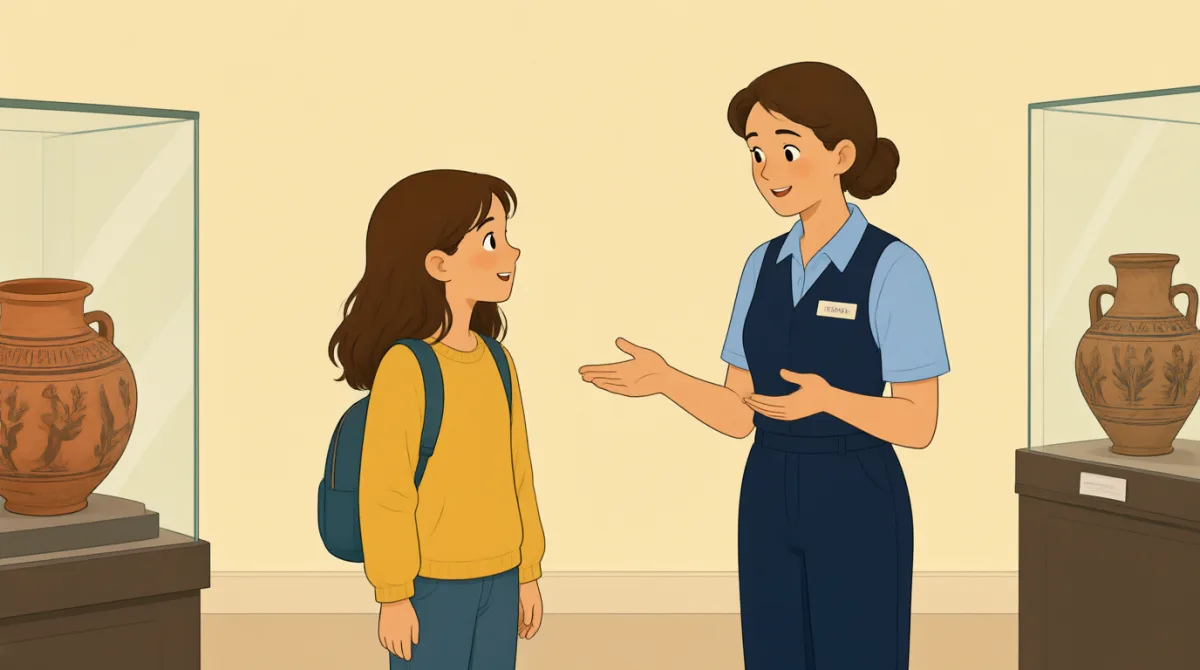

Excuse me, where can we find the ancient pottery exhibit?
Przepraszam, gdzie znajdziemy wystawę starożytnej ceramiki?

It’s on the second floor, at the end of the hall.
Jest na drugim piętrze, na końcu korytarza.

Should we take the stairs or the elevator?
Powinniśmy iść schodami czy jechać windą?
The elevator is just around the corner, next to the map.
Winda jest tuż za rogiem, obok mapy.
Great. When we get upstairs, which way should we go?
Świetnie. Kiedy wejdziemy na górę, w którą stronę mamy iść?
Turn left, then follow the signs for ancient pottery.
Skręćcie w lewo, a potem kierujcie się za znakami do wystawy starożytnej ceramiki.
How long will it take to get there?
Ile czasu zajmie nam dotarcie na miejsce?
Only a few minutes. You’ll see the gallery on your right.
Tylko kilka minut. Galerię zobaczycie po prawej stronie.
Thanks! We’re excited to see the pottery.
Dziękujemy! Nie możemy się doczekać, żeby zobaczyć tę ceramikę.
Słownictwo8
- Excuse mePrzepraszam
A polite way to get someone’s attention before asking a question. You can use it when speaking to a museum worker or another stranger.
To uprzejmy sposób, by zwrócić czyjąś uwagę przed zadaniem pytania. Możesz tak powiedzieć do pracownika muzeum lub innej nieznajomej osoby.
- on the second floorna drugim piętrze
This tells you which level of a building something is on. Replace “second” with another floor number to give or ask for directions.
To informacja o tym, na którym poziomie budynku coś się znajduje. Zastąp “second” (drugi) numerem innego piętra, jeśli chcesz wskazać drogę lub o nią zapytać.
- at the end of the hallna końcu korytarza
This means the place is where the hallway finishes. Use it to describe where a room or exhibit is.
To znaczy, że dane miejsce znajduje się tam, gdzie kończy się korytarz. Użyj tego wyrażenia, by opisać położenie sali lub wystawy.
- around the cornerza rogiem
This means you need to go around the nearby corner to find something. It is often used when giving directions.
To znaczy, że trzeba obejść pobliski róg, by coś znaleźć. Tego wyrażenia często używa się przy wskazywaniu drogi.
- next to the mapobok mapy
This means something is beside the map. Use “next to” to explain where one place or object is in relation to another.
To znaczy, że coś znajduje się przy mapie. Użyj “next to”, by wyjaśnić, gdzie znajduje się jedno miejsce lub przedmiot względem drugiego.
- Turn leftSkręć w lewo
This is a simple direction telling someone to go to the left. You can also say “Turn right” to give the opposite direction.
To prosta wskazówka, która mówi, żeby skręcić w lewą stronę. Możesz też powiedzieć “Turn right”, by wskazać przeciwny kierunek.
- follow the signskieruj się za znakami
This means to look for and go in the direction shown by signs. It is useful when finding your way around a large building.
To znaczy, żeby szukać znaków i iść w kierunku, który wskazują. To przydatne, gdy próbujesz znaleźć drogę w dużym budynku.
- on your rightpo prawej stronie
This means the place will be on the right-hand side as you move forward. You can say “on your left” for the other side.
To znaczy, że dane miejsce będzie po prawej stronie, gdy będziesz iść naprzód. Po przeciwnej stronie możesz powiedzieć “on your left”.
Kluczowe zdania8
- 1
Excuse me, where can we find the ancient pottery exhibit?
Przepraszam, gdzie znajdziemy wystawę starożytnej ceramiki?
Use this polite question to ask where something is. You can replace “the ancient pottery exhibit” with another place or attraction.
Użyj tego uprzejmego pytania, by zapytać, gdzie coś się znajduje. Możesz zastąpić “the ancient pottery exhibit” nazwą innego miejsca lub atrakcji.
- 2
It’s on the second floor, at the end of the hall.
Jest na drugim piętrze, na końcu korytarza.
This sentence gives two details about a location: the floor and where to find it in the hallway. You can change the floor or location to give different directions.
To zdanie zawiera dwie informacje o położeniu: piętro oraz miejsce w korytarzu. Możesz zmienić piętro lub położenie, by inaczej wskazać drogę.
- 3
Should we take the stairs or the elevator?
Powinniśmy iść schodami czy jechać windą?
Use this question to ask which of two ways to go is better. Replace “the stairs” and “the elevator” with other choices.
Użyj tego pytania, by zapytać, którą z dwóch dróg najlepiej wybrać. Zastąp “the stairs” i “the elevator” innymi możliwościami.
- 4
The elevator is just around the corner, next to the map.
Winda jest tuż za rogiem, obok mapy.
This sentence explains where to find the elevator using two nearby landmarks. You can use the same pattern to describe another place.
To zdanie wyjaśnia, gdzie znaleźć windę, używając dwóch pobliskich punktów orientacyjnych. Możesz użyć tego samego wzoru, by opisać położenie innego miejsca.
- 5
When we get upstairs, which way should we go?
Kiedy wejdziemy na górę, w którą stronę mamy iść?
Use this question to ask for the next direction after reaching a place. Replace “upstairs” with a destination such as “outside” or “to the lobby.”
Użyj tego pytania, by poprosić o kolejną wskazówkę po dotarciu na miejsce. Zastąp “upstairs” innym celem, na przykład “outside” lub “to the lobby”.
- 6
Turn left, then follow the signs for ancient pottery.
Skręćcie w lewo, a potem kierujcie się za znakami do wystawy starożytnej ceramiki.
This gives two clear steps for finding the exhibit. You can replace “Turn left” and “ancient pottery” to give different directions.
To dwie jasne wskazówki, jak znaleźć wystawę. Możesz zastąpić “Turn left” i “ancient pottery”, by wskazać inną drogę.
- 7
How long will it take to get there?
Ile czasu zajmie nam dotarcie na miejsce?
Use this question to ask how much time it takes to reach a place. Replace “there” with a specific destination if needed.
Użyj tego pytania, by dowiedzieć się, ile czasu zajmuje dotarcie do jakiegoś miejsca. W razie potrzeby zastąp “there” nazwą konkretnego celu.
- 8
You’ll see the gallery on your right.
Galerię zobaczycie po prawej stronie.
This tells someone what they will see and where it will be. You can replace “the gallery” with another place or object.
To zdanie informuje kogoś, co zobaczy i gdzie to będzie. Możesz zastąpić “the gallery” nazwą innego miejsca lub przedmiotu.