Shopping at the Gift Shop
Faire des achats à la boutique du musée
Emma and Jack look for a small souvenir in the museum gift shop. They ask about the price and choose something to take home.
Emma et Jack cherchent un petit souvenir à la boutique du musée. Ils demandent le prix et choisissent quelque chose à rapporter chez eux.
Dialogue7
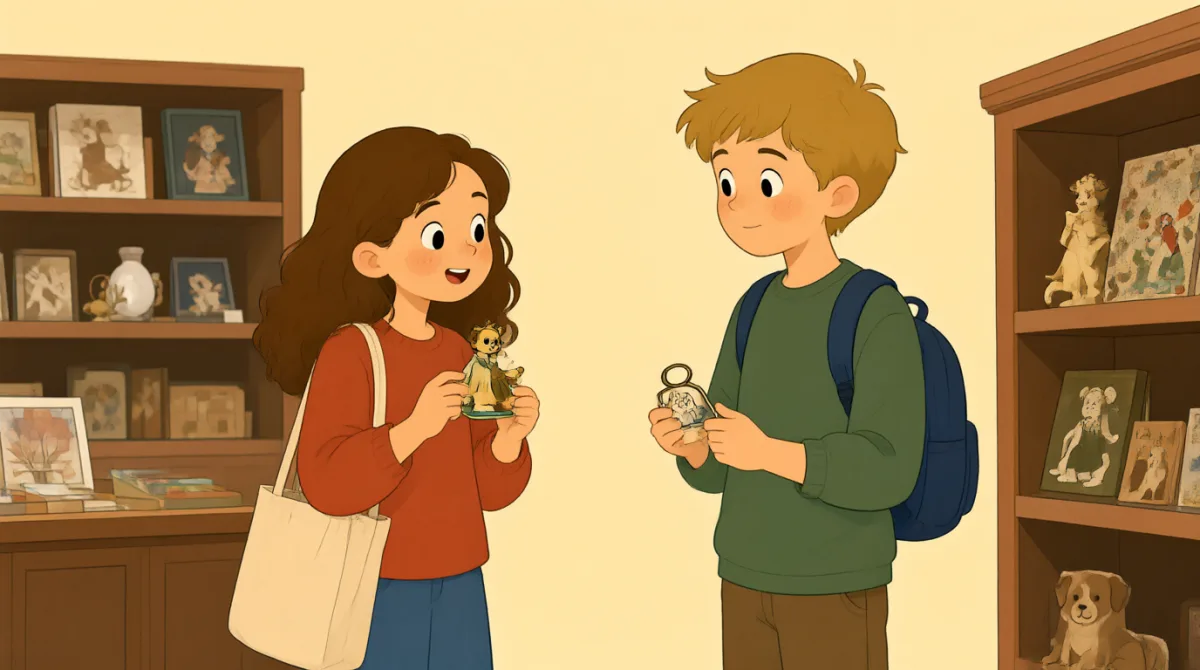

This gift shop has so many things. I want a small souvenir to take home.
Il y a tellement de choses dans cette boutique. J’aimerais trouver un petit souvenir à rapporter chez moi.

How about this little museum postcard? It’s easy to carry.
Et cette petite carte postale du musée ? Elle est facile à transporter.
That’s nice. How much is it?
Elle est sympa. Elle coûte combien ?
The price tag says two dollars. That’s not bad.
L’étiquette indique deux dollars. Ce n’est pas mal.
I’d like to get one. I can put it on my desk at home.
J’aimerais en prendre une. Je pourrai la poser sur mon bureau, chez moi.
Good choice. I’ll get a small magnet for my sister.
Bon choix. Je vais prendre un petit aimant pour ma sœur.
Let’s pay at the counter, then. I’m ready to go.
Alors, allons payer à la caisse. Je suis prête à partir.
Vocabulaire8
- gift shopboutique de souvenirs
A shop that sells souvenirs and other items, often in a museum. You can buy something to remember your visit.
Une boutique qui vend des souvenirs et d’autres articles, souvent dans un musée. On peut y acheter quelque chose pour se rappeler sa visite.
- souvenirsouvenir
A small item you buy to remember a place or trip. In this dialogue, Emma wants to take one home.
Un petit objet qu’on achète pour se rappeler un lieu ou un voyage. Dans ce dialogue, Emma veut en rapporter un chez elle.
- How about this little museum postcard?Et cette petite carte postale du musée ?
A friendly way to suggest something. You can use “How about this…?” when offering an idea or choice.
Une façon amicale de proposer quelque chose. Vous pouvez utiliser “How about this…?” pour suggérer une idée ou un choix.
- price tagétiquette de prix
A small label that shows how much something costs. You can check the price tag before you buy an item.
Une petite étiquette qui indique le prix d’un article. Vous pouvez vérifier l’étiquette de prix avant d’acheter quelque chose.
- That’s not bad.Ce n’est pas mal.
A casual way to say that something is reasonable or acceptable. It is useful when you think a price is okay.
Une façon familière de dire que quelque chose est raisonnable ou acceptable. C’est pratique quand vous trouvez qu’un prix est correct.
- I’d like to get one.J’aimerais en prendre une.
A polite way to say you want to buy or have something. You can use “I’d like to get…” when choosing an item.
Une façon polie de dire que vous voulez acheter ou avoir quelque chose. Vous pouvez utiliser “I’d like to get…” quand vous choisissez un article.
- pay at the counterpayer à la caisse
To give money for something at the shop’s checkout desk. You can use this phrase when asking where to pay.
Donner de l’argent pour un article au comptoir de paiement du magasin. Vous pouvez utiliser cette expression pour demander où payer.
- I’m ready to go.Je suis prête à partir.
A common way to say that you are prepared to leave. You can use it when you have finished an activity or visit.
Une expression courante pour dire que vous êtes prête à partir. Vous pouvez l’utiliser lorsque vous avez terminé une activité ou une visite.
Phrases clés8
- 1
I want a small souvenir to take home.
J’aimerais trouver un petit souvenir à rapporter chez moi.
This sentence tells someone what you are looking for. You can replace “a small souvenir” with another item you want to bring home.
Cette phrase indique à quelqu’un ce que vous cherchez. Vous pouvez remplacer “a small souvenir” par un autre article que vous voulez rapporter chez vous.
- 2
How about this little museum postcard?
Et cette petite carte postale du musée ?
Use this question to suggest an item or idea. You can replace “this little museum postcard” with another choice.
Utilisez cette question pour suggérer un article ou une idée. Vous pouvez remplacer “this little museum postcard” par une autre proposition.
- 3
How much is it?
Elle coûte combien ?
This is a simple, common way to ask the price of one item. You can point to the item or name it when asking.
C’est une façon simple et courante de demander le prix d’un article. Vous pouvez montrer l’article du doigt ou le nommer en posant la question.
- 4
The price tag says two dollars.
L’étiquette indique deux dollars.
This sentence explains where the price is shown and tells someone the cost. You can change “two dollars” to the price you see.
Cette phrase indique où le prix est affiché et précise son montant. Vous pouvez remplacer “two dollars” par le prix que vous voyez.
- 5
I’d like to get one.
J’aimerais en prendre une.
This is a polite way to say you want to buy an item. Use “I’d like to get…” followed by the item you want.
C’est une façon polie de dire que vous voulez acheter un article. Utilisez “I’d like to get…” suivi de l’article que vous voulez.
- 6
I can put it on my desk at home.
Je pourrai la poser sur mon bureau, chez moi.
This sentence explains how you plan to use or display something. You can replace “on my desk” with another place.
Cette phrase explique comment vous comptez utiliser ou exposer quelque chose. Vous pouvez remplacer “on my desk” par un autre endroit.
- 7
Let’s pay at the counter, then.
Alors, allons payer à la caisse.
Use “Let’s…” to suggest doing something together. You can replace “pay at the counter” with another next step.
Utilisez “Let’s…” pour proposer de faire quelque chose ensemble. Vous pouvez remplacer “pay at the counter” par une autre étape à suivre.
- 8
I’m ready to go.
Je suis prête à partir.
This sentence tells someone you are prepared to leave. It is useful after you have finished shopping or visiting a place.
Cette phrase indique à quelqu’un que vous êtes prête à partir. Elle est utile après avoir terminé vos achats ou votre visite.