Finding an Exhibit
การหานิทรรศการ
Emma and Jack ask a museum worker where to find the ancient pottery exhibit. The worker gives them simple directions.
เอ็มมาและแจ็กถามเจ้าหน้าที่พิพิธภัณฑ์ว่านิทรรศการเครื่องปั้นดินเผาโบราณอยู่ที่ไหน เจ้าหน้าที่บอกทางให้พวกเขาอย่างง่าย ๆ
บทสนทนา9
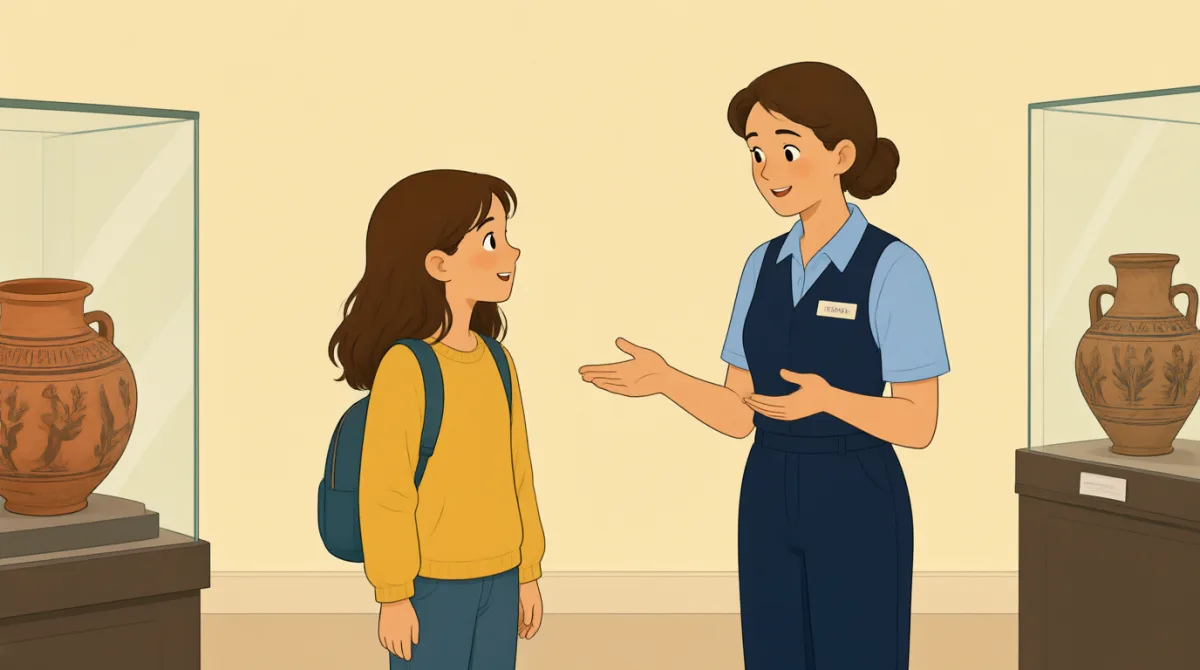

Excuse me, where can we find the ancient pottery exhibit?
ขอโทษนะคะ นิทรรศการเครื่องปั้นดินเผาโบราณอยู่ที่ไหนคะ

It’s on the second floor, at the end of the hall.
อยู่ชั้นสองค่ะ สุดทางเดินเลยค่ะ

Should we take the stairs or the elevator?
เราควรขึ้นบันไดหรือลิฟต์ดีครับ
The elevator is just around the corner, next to the map.
ลิฟต์อยู่ตรงหัวมุมถัดไป ข้างแผนที่ค่ะ
Great. When we get upstairs, which way should we go?
เยี่ยมเลยค่ะ พอขึ้นไปชั้นบนแล้ว เราควรไปทางไหนคะ
Turn left, then follow the signs for ancient pottery.
เลี้ยวซ้าย แล้วตามป้ายไปยังนิทรรศการเครื่องปั้นดินเผาโบราณค่ะ
How long will it take to get there?
เดินไปถึงใช้เวลานานแค่ไหนครับ
Only a few minutes. You’ll see the gallery on your right.
แค่ไม่กี่นาทีค่ะ คุณจะเห็นห้องจัดแสดงอยู่ทางขวามือค่ะ
Thanks! We’re excited to see the pottery.
ขอบคุณค่ะ! พวกเราตื่นเต้นที่จะได้ชมเครื่องปั้นดินเผาค่ะ
คำศัพท์8
- Excuse meขอโทษนะคะ/ครับ
A polite way to get someone’s attention before asking a question. You can use it when speaking to a museum worker or another stranger.
เป็นคำพูดสุภาพที่ใช้เรียกความสนใจก่อนถามคำถาม ใช้ได้เมื่อพูดกับเจ้าหน้าที่พิพิธภัณฑ์หรือคนแปลกหน้า
- on the second floorอยู่ชั้นสอง
This tells you which level of a building something is on. Replace “second” with another floor number to give or ask for directions.
วลีนี้บอกว่าสิ่งนั้นอยู่บนชั้นไหนของอาคาร คุณเปลี่ยน “second” เป็นเลขชั้นอื่นเพื่อบอกทางหรือถามทางได้
- at the end of the hallสุดทางเดิน
This means the place is where the hallway finishes. Use it to describe where a room or exhibit is.
หมายถึงสถานที่นั้นอยู่ตรงปลายทางเดิน ใช้บอกตำแหน่งของห้องหรือนิทรรศการได้
- around the cornerตรงหัวมุมถัดไป
This means you need to go around the nearby corner to find something. It is often used when giving directions.
หมายถึงต้องเดินอ้อมหัวมุมที่อยู่ใกล้ ๆ เพื่อไปหาสิ่งนั้น มักใช้เมื่อต้องบอกทาง
- next to the mapข้างแผนที่
This means something is beside the map. Use “next to” to explain where one place or object is in relation to another.
หมายถึงสิ่งหนึ่งอยู่ติดกับแผนที่ ใช้ “next to” เพื่ออธิบายตำแหน่งของสถานที่หรือสิ่งของเมื่อเทียบกับอีกสิ่งหนึ่ง
- Turn leftเลี้ยวซ้าย
This is a simple direction telling someone to go to the left. You can also say “Turn right” to give the opposite direction.
เป็นคำบอกทางง่าย ๆ ให้ใครสักคนไปทางซ้าย ส่วนทิศทางตรงข้ามพูดได้ว่า “Turn right”
- follow the signsตามป้ายไป
This means to look for and go in the direction shown by signs. It is useful when finding your way around a large building.
หมายถึงมองหาป้ายแล้วเดินไปตามทิศทางที่ป้ายบอก มีประโยชน์เมื่อต้องหาทางในอาคารขนาดใหญ่
- on your rightอยู่ทางขวามือของคุณ
This means the place will be on the right-hand side as you move forward. You can say “on your left” for the other side.
หมายถึงสถานที่นั้นจะอยู่ทางขวามือขณะที่คุณเดินไปข้างหน้า ถ้าอยู่ฝั่งตรงข้าม พูดได้ว่า “on your left”
ประโยคสำคัญ8
- 1
Excuse me, where can we find the ancient pottery exhibit?
ขอโทษนะคะ นิทรรศการเครื่องปั้นดินเผาโบราณอยู่ที่ไหนคะ
Use this polite question to ask where something is. You can replace “the ancient pottery exhibit” with another place or attraction.
ใช้คำถามสุภาพนี้เพื่อถามว่าสิ่งหนึ่งอยู่ที่ไหน คุณเปลี่ยน “the ancient pottery exhibit” เป็นสถานที่หรือแหล่งท่องเที่ยวอื่นได้
- 2
It’s on the second floor, at the end of the hall.
อยู่ชั้นสองค่ะ สุดทางเดินเลยค่ะ
This sentence gives two details about a location: the floor and where to find it in the hallway. You can change the floor or location to give different directions.
ประโยคนี้บอกรายละเอียดของตำแหน่งสองอย่าง คือชั้นที่อยู่และจุดที่หาได้ในทางเดิน คุณเปลี่ยนชั้นหรือสถานที่เพื่อบอกทางแบบอื่นได้
- 3
Should we take the stairs or the elevator?
เราควรขึ้นบันไดหรือลิฟต์ดีครับ
Use this question to ask which of two ways to go is better. Replace “the stairs” and “the elevator” with other choices.
ใช้คำถามนี้เพื่อถามว่าควรเลือกเดินทางแบบไหนจากสองทาง คุณเปลี่ยน “the stairs” และ “the elevator” เป็นตัวเลือกอื่นได้
- 4
The elevator is just around the corner, next to the map.
ลิฟต์อยู่ตรงหัวมุมถัดไป ข้างแผนที่ค่ะ
This sentence explains where to find the elevator using two nearby landmarks. You can use the same pattern to describe another place.
ประโยคนี้บอกตำแหน่งของลิฟต์โดยใช้จุดสังเกตใกล้ ๆ สองอย่าง คุณใช้รูปแบบเดียวกันเพื่อบอกตำแหน่งของสถานที่อื่นได้
- 5
When we get upstairs, which way should we go?
พอขึ้นไปชั้นบนแล้ว เราควรไปทางไหนคะ
Use this question to ask for the next direction after reaching a place. Replace “upstairs” with a destination such as “outside” or “to the lobby.”
ใช้คำถามนี้เพื่อขอคำบอกทางขั้นต่อไปเมื่อไปถึงสถานที่หนึ่งแล้ว คุณเปลี่ยน “upstairs” เป็นจุดหมาย เช่น “outside” หรือ “to the lobby” ได้
- 6
Turn left, then follow the signs for ancient pottery.
เลี้ยวซ้าย แล้วตามป้ายไปยังนิทรรศการเครื่องปั้นดินเผาโบราณค่ะ
This gives two clear steps for finding the exhibit. You can replace “Turn left” and “ancient pottery” to give different directions.
ประโยคนี้บอกขั้นตอนชัดเจนสองขั้นเพื่อไปยังนิทรรศการ คุณเปลี่ยน “Turn left” และ “ancient pottery” เพื่อบอกทางไปที่อื่นได้
- 7
How long will it take to get there?
เดินไปถึงใช้เวลานานแค่ไหนครับ
Use this question to ask how much time it takes to reach a place. Replace “there” with a specific destination if needed.
ใช้คำถามนี้เพื่อถามว่าต้องใช้เวลาเท่าไรจึงจะไปถึงที่หนึ่ง หากต้องการ คุณเปลี่ยน “there” เป็นจุดหมายที่เจาะจงได้
- 8
You’ll see the gallery on your right.
คุณจะเห็นห้องจัดแสดงอยู่ทางขวามือค่ะ
This tells someone what they will see and where it will be. You can replace “the gallery” with another place or object.
ประโยคนี้บอกว่าอีกฝ่ายจะเห็นอะไรและสิ่งนั้นอยู่ตรงไหน คุณเปลี่ยน “the gallery” เป็นสถานที่หรือสิ่งของอื่นได้