Finding Your Seat
Deinen Sitzplatz finden
Emma gets on the bus and checks her ticket number. She asks Mia for help finding her seat and puts her small bag nearby.
Emma steigt in den Bus und überprüft ihre Sitzplatznummer auf dem Ticket. Sie bittet Mia, ihr bei der Suche nach ihrem Platz zu helfen, und legt ihre kleine Tasche in die Nähe.
Dialog8
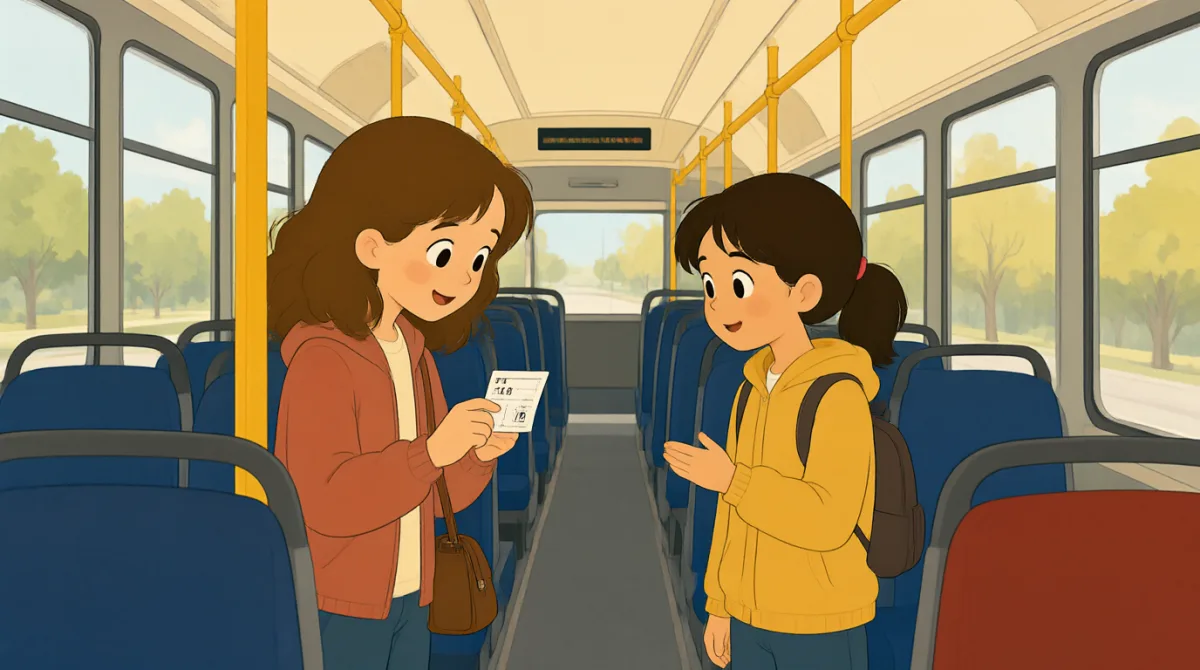

Excuse me, my ticket says seat 14. Is that on this bus?
Entschuldigung, auf meinem Ticket steht Sitzplatz 14. Ist der in diesem Bus?

Yes, it is. Your seat is by the window, about halfway down.
Ja. Dein Platz ist am Fenster, ungefähr auf halber Strecke.
Thanks! Could you help me find it? The numbers are hard to see.
Danke! Kannst du mir helfen, ihn zu finden? Die Nummern sind schwer zu erkennen.
Sure. Follow me. Look for the number above each seat.
Klar. Folge mir. Schau nach der Nummer über jedem Sitz.
Oh, there it is. Can I put my small bag here?
Ah, da ist er ja. Kann ich meine kleine Tasche hier abstellen?
Yes, you can put it under the seat in front of you.
Ja, du kannst sie unter den Sitz vor dir stellen.
Great. I don't want it to block the aisle.
Super. Ich möchte nicht, dass sie den Gang blockiert.
Good idea. Keep your ticket with you, and enjoy the ride!
Gute Idee. Behalte dein Ticket bei dir und gute Fahrt!
Wortschatz8
- Excuse meEntschuldigung
Use this polite phrase to get someone's attention or ask a question.
Mit dieser höflichen Wendung kannst du die Aufmerksamkeit einer Person auf dich lenken oder eine Frage stellen.
- ticket saysauf dem Ticket steht
This means the information is written on your ticket. You can use it to talk about details on a ticket or other document.
Das bedeutet, dass die Information auf deinem Ticket steht. Du kannst die Wendung verwenden, wenn du Angaben auf einem Ticket oder einem anderen Dokument erwähnst.
- by the windowam Fenster
This describes a seat next to the window. You can use “by the” to say that something is next to a place or object.
Damit beschreibst du einen Sitzplatz direkt neben dem Fenster. Mit “by the” kannst du sagen, dass sich etwas neben einem Ort oder Gegenstand befindet.
- halfway downauf halber Strecke
This means partway along something, not near the beginning or the end. It helps describe where a seat is on the bus.
Das bedeutet, dass sich etwas etwa in der Mitte befindet, also weder am Anfang noch am Ende. So kannst du beschreiben, wo ein Sitzplatz im Bus ist.
- Follow meFolge mir
Use this phrase to ask someone to come with you while you show them the way.
Mit dieser Wendung kannst du jemanden bitten, mitzukommen, während du ihm oder ihr den Weg zeigst.
- under the seat in front of youunter den Sitz vor dir
This tells someone where to put a bag or other item. You can use “under the” to describe a place below something.
Damit sagst du jemandem, wo er oder sie eine Tasche oder einen anderen Gegenstand verstauen soll. Mit “under the” beschreibst du einen Platz unter etwas.
- block the aisleden Gang blockieren
This means to stop people from walking along the aisle. You can use “block” when something is in the way.
Das bedeutet, anderen den Weg durch den Gang zu versperren. “Block” kannst du verwenden, wenn etwas im Weg steht.
- Keep your ticket with youBehalte dein Ticket bei dir
This means to carry your ticket and not leave it behind. You can use “keep [something] with you” for important items.
Das bedeutet, dass du dein Ticket mitnimmst und nicht liegen lässt. “Keep [something] with you” kannst du für wichtige Dinge verwenden, die jemand bei sich behalten soll.
Wichtige Sätze8
- 1
Excuse me, my ticket says seat 14. Is that on this bus?
Entschuldigung, auf meinem Ticket steht Sitzplatz 14. Ist der in diesem Bus?
Use this to politely check whether your ticket is for the bus you are on. You can replace “seat 14” with your own seat number.
Mit diesem Satz kannst du höflich nachfragen, ob dein Ticket für den Bus gilt, in dem du gerade sitzt. Du kannst “seat 14” durch deine eigene Sitzplatznummer ersetzen.
- 2
Your seat is by the window, about halfway down.
Dein Platz ist am Fenster, ungefähr auf halber Strecke.
This is a useful way to describe where a seat is. You can change “by the window” and “halfway down” to give other location details.
So kannst du gut beschreiben, wo sich ein Sitzplatz befindet. Du kannst “by the window” und “halfway down” durch andere Ortsangaben ersetzen.
- 3
Could you help me find it?
Kannst du mir helfen, ihn zu finden?
Use this polite question when you need help locating something. Replace “it” with the item or place you are looking for.
Mit dieser höflichen Frage kannst du um Hilfe bitten, wenn du etwas suchst. Ersetze “it” durch den Gegenstand oder Ort, den du suchst.
- 4
Follow me.
Folge mir.
Use this short phrase to show someone the way. It is useful when you are guiding someone to a place.
Mit dieser kurzen Wendung kannst du jemandem den Weg zeigen. Sie ist nützlich, wenn du jemanden zu einem Ort führst.
- 5
Can I put my small bag here?
Kann ich meine kleine Tasche hier abstellen?
Use this to ask permission to put something in a particular place. You can replace “my small bag” with another item.
Mit diesem Satz kannst du um Erlaubnis bitten, etwas an einem bestimmten Ort abzustellen. Du kannst “my small bag” durch einen anderen Gegenstand ersetzen.
- 6
You can put it under the seat in front of you.
Du kannst sie unter den Sitz vor dir stellen.
This gives a clear instruction about where to place something. You can change the location phrase to suggest a different spot.
Damit gibst du eine klare Anweisung, wo etwas hingestellt werden soll. Du kannst die Ortsangabe ändern, um einen anderen Platz vorzuschlagen.
- 7
I don't want it to block the aisle.
Ich möchte nicht, dass sie den Gang blockiert.
Use this to explain that you do not want an item to get in people's way. You can replace “the aisle” with another walkway or space.
Mit diesem Satz erklärst du, dass ein Gegenstand niemandem im Weg stehen soll. Du kannst “the aisle” durch einen anderen Durchgang oder Bereich ersetzen.
- 8
Keep your ticket with you, and enjoy the ride!
Behalte dein Ticket bei dir und gute Fahrt!
This is a friendly reminder to hold on to your ticket, followed by a warm wish for the trip. You can use “Keep your [item] with you” to remind someone to carry something important.
Das ist eine freundliche Erinnerung, das Ticket nicht zu verlieren, verbunden mit einem herzlichen Reisewunsch. Mit “Keep your [item] with you” kannst du jemanden daran erinnern, einen wichtigen Gegenstand bei sich zu behalten.