Finding Your Seat
Znajdowanie swojego miejsca
Emma gets on the bus and checks her ticket number. She asks Mia for help finding her seat and puts her small bag nearby.
Emma wsiada do autobusu i sprawdza numer miejsca na bilecie. Prosi Mię o pomoc w znalezieniu swojego miejsca i kładzie obok małą torbę.
Dialog8
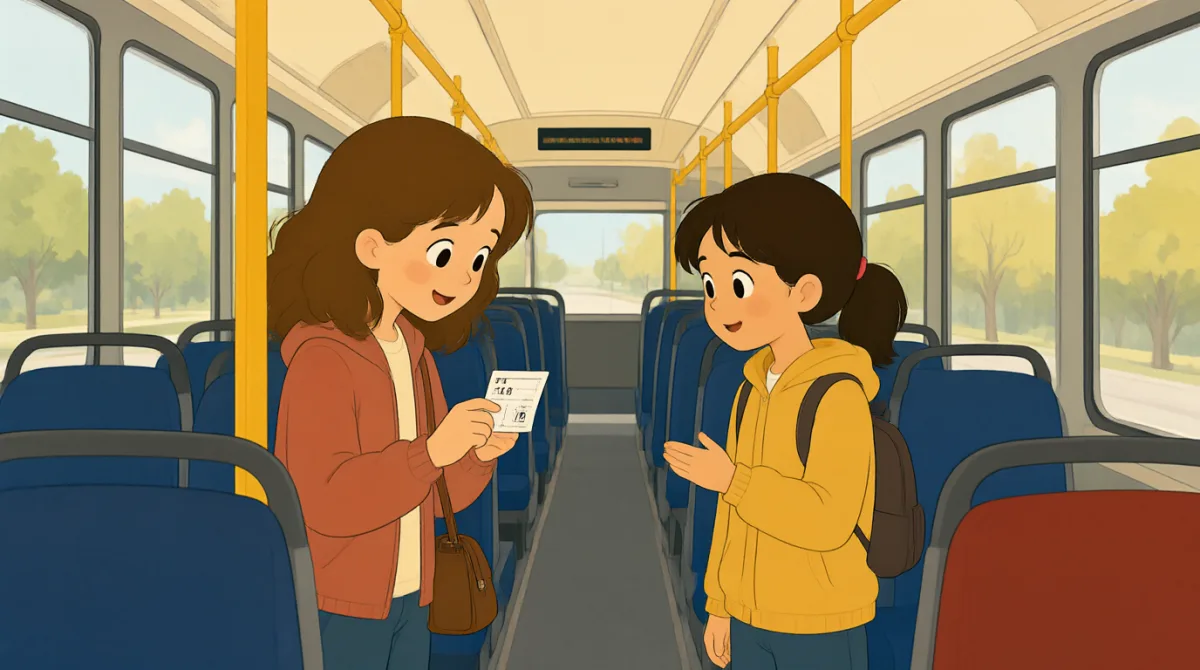

Excuse me, my ticket says seat 14. Is that on this bus?
Przepraszam, na moim bilecie jest napisane, że mam miejsce 14. Czy to miejsce jest w tym autobusie?

Yes, it is. Your seat is by the window, about halfway down.
Tak. Twoje miejsce jest przy oknie, mniej więcej w połowie autobusu.
Thanks! Could you help me find it? The numbers are hard to see.
Dzięki! Pomożesz mi je znaleźć? Trudno dostrzec numery.
Sure. Follow me. Look for the number above each seat.
Jasne. Chodź za mną. Szukaj numeru nad każdym siedzeniem.
Oh, there it is. Can I put my small bag here?
O, jest! Mogę tu położyć swoją małą torbę?
Yes, you can put it under the seat in front of you.
Tak, możesz położyć ją pod siedzeniem przed tobą.
Great. I don't want it to block the aisle.
Super. Nie chcę, żeby blokowała przejście.
Good idea. Keep your ticket with you, and enjoy the ride!
Dobry pomysł. Miej bilet przy sobie i miłej podróży!
Słownictwo8
- Excuse mePrzepraszam
Use this polite phrase to get someone's attention or ask a question.
Użyj tego uprzejmego zwrotu, żeby zwrócić czyjąś uwagę lub o coś zapytać.
- ticket saysna bilecie jest napisane
This means the information is written on your ticket. You can use it to talk about details on a ticket or other document.
To znaczy, że dana informacja jest zapisana na bilecie. Możesz użyć tego zwrotu, mówiąc o szczegółach podanych na bilecie lub innym dokumencie.
- by the windowprzy oknie
This describes a seat next to the window. You can use “by the” to say that something is next to a place or object.
Tak opisuje się miejsce obok okna. Możesz użyć wyrażenia “by the”, żeby powiedzieć, że coś znajduje się obok jakiegoś miejsca lub przedmiotu.
- halfway downmniej więcej w połowie
This means partway along something, not near the beginning or the end. It helps describe where a seat is on the bus.
To znaczy, że coś znajduje się mniej więcej w połowie drogi, a nie blisko początku ani końca. Ten zwrot pomaga opisać, gdzie w autobusie znajduje się miejsce.
- Follow meChodź za mną
Use this phrase to ask someone to come with you while you show them the way.
Użyj tego zwrotu, żeby poprosić kogoś, by poszedł za tobą, gdy pokazujesz mu drogę.
- under the seat in front of youpod siedzeniem przed tobą
This tells someone where to put a bag or other item. You can use “under the” to describe a place below something.
Ten zwrot wskazuje, gdzie położyć torbę lub inny przedmiot. Możesz użyć “under the”, żeby opisać miejsce znajdujące się pod czymś.
- block the aisleblokować przejście
This means to stop people from walking along the aisle. You can use “block” when something is in the way.
To znaczy, że ktoś lub coś uniemożliwia przechodzenie przejściem. Możesz użyć “block”, gdy coś zagradza drogę.
- Keep your ticket with youMiej bilet przy sobie
This means to carry your ticket and not leave it behind. You can use “keep [something] with you” for important items.
To znaczy, żeby mieć bilet przy sobie i go nie zostawić. Wyrażenia “keep [something] with you” możesz użyć w odniesieniu do ważnych rzeczy.
Kluczowe zdania8
- 1
Excuse me, my ticket says seat 14. Is that on this bus?
Przepraszam, na moim bilecie jest napisane, że mam miejsce 14. Czy to miejsce jest w tym autobusie?
Use this to politely check whether your ticket is for the bus you are on. You can replace “seat 14” with your own seat number.
Użyj tego zdania, żeby uprzejmie sprawdzić, czy bilet jest na autobus, którym jedziesz. Możesz zastąpić “seat 14” numerem swojego miejsca.
- 2
Your seat is by the window, about halfway down.
Twoje miejsce jest przy oknie, mniej więcej w połowie autobusu.
This is a useful way to describe where a seat is. You can change “by the window” and “halfway down” to give other location details.
To przydatny sposób, by opisać, gdzie znajduje się miejsce. Możesz zmienić “by the window” i “halfway down”, żeby podać inne wskazówki dotyczące lokalizacji.
- 3
Could you help me find it?
Pomożesz mi je znaleźć?
Use this polite question when you need help locating something. Replace “it” with the item or place you are looking for.
Użyj tego uprzejmego pytania, gdy potrzebujesz pomocy w znalezieniu czegoś. Zastąp “it” nazwą przedmiotu lub miejsca, którego szukasz.
- 4
Follow me.
Chodź za mną.
Use this short phrase to show someone the way. It is useful when you are guiding someone to a place.
Użyj tego krótkiego zwrotu, żeby pokazać komuś drogę. Przydaje się, gdy prowadzisz kogoś do jakiegoś miejsca.
- 5
Can I put my small bag here?
Mogę tu położyć swoją małą torbę?
Use this to ask permission to put something in a particular place. You can replace “my small bag” with another item.
Użyj tego zdania, żeby poprosić o pozwolenie na położenie czegoś w konkretnym miejscu. Możesz zastąpić “my small bag” nazwą innego przedmiotu.
- 6
You can put it under the seat in front of you.
Możesz położyć ją pod siedzeniem przed tobą.
This gives a clear instruction about where to place something. You can change the location phrase to suggest a different spot.
To jasna wskazówka, gdzie coś położyć. Możesz zmienić określenie miejsca, żeby wskazać inną lokalizację.
- 7
I don't want it to block the aisle.
Nie chcę, żeby blokowała przejście.
Use this to explain that you do not want an item to get in people's way. You can replace “the aisle” with another walkway or space.
Użyj tego zdania, żeby wyjaśnić, że nie chcesz, by jakiś przedmiot komuś przeszkadzał. Możesz zastąpić “the aisle” nazwą innego przejścia lub wolnej przestrzeni.
- 8
Keep your ticket with you, and enjoy the ride!
Miej bilet przy sobie i miłej podróży!
This is a friendly reminder to hold on to your ticket, followed by a warm wish for the trip. You can use “Keep your [item] with you” to remind someone to carry something important.
To przyjazne przypomnienie, żeby pilnować biletu, po którym następują serdeczne życzenia udanej podróży. Możesz użyć “Keep your [item] with you”, żeby przypomnieć komuś o zabraniu ważnej rzeczy.