Finding Your Seat
Encontrar tu asiento
Emma gets on the bus and checks her ticket number. She asks Mia for help finding her seat and puts her small bag nearby.
Emma sube al autobús y comprueba el número de su asiento en el billete. Le pide ayuda a Mia para encontrarlo y deja su bolso pequeño cerca.
Diálogo8
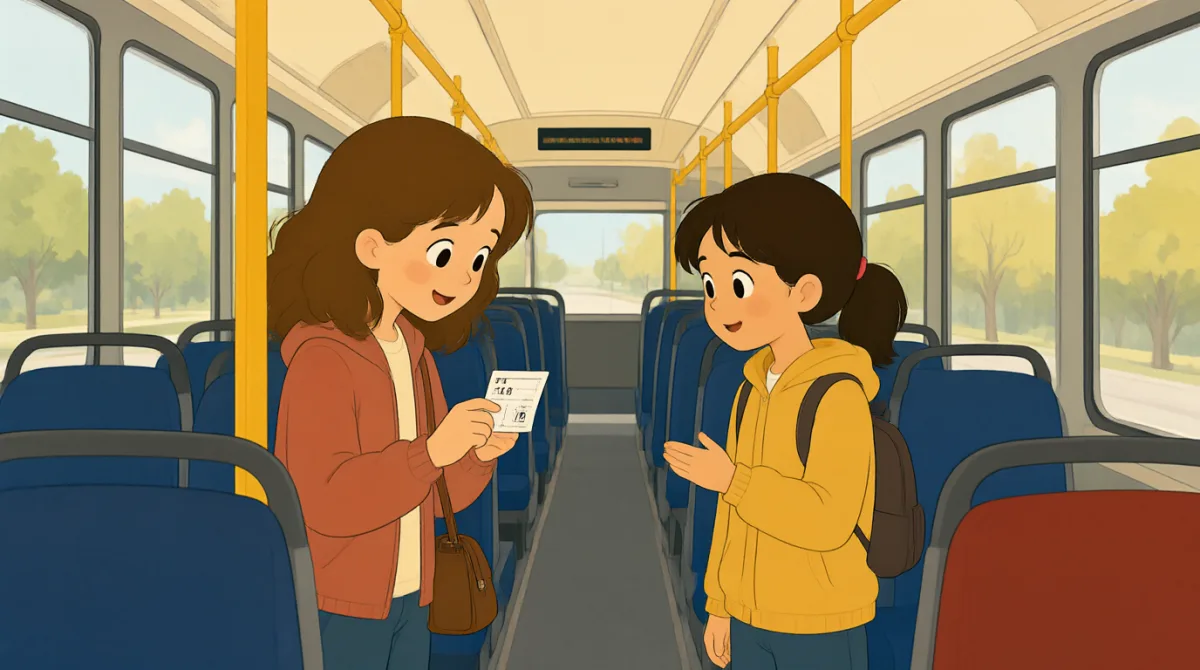

Excuse me, my ticket says seat 14. Is that on this bus?
Disculpa, en mi billete dice asiento 14. ¿Es en este autobús?

Yes, it is. Your seat is by the window, about halfway down.
Sí. Tu asiento está junto a la ventana, más o menos a mitad del autobús.
Thanks! Could you help me find it? The numbers are hard to see.
¡Gracias! ¿Me ayudas a encontrarlo? Cuesta ver los números.
Sure. Follow me. Look for the number above each seat.
Claro. Sígueme. Busca el número encima de cada asiento.
Oh, there it is. Can I put my small bag here?
Ah, ahí está. ¿Puedo dejar aquí mi bolso pequeño?
Yes, you can put it under the seat in front of you.
Sí, puedes ponerlo debajo del asiento de delante.
Great. I don't want it to block the aisle.
Genial. No quiero que bloquee el pasillo.
Good idea. Keep your ticket with you, and enjoy the ride!
Buena idea. Lleva el billete contigo y ¡que disfrutes del viaje!
Vocabulario8
- Excuse meDisculpa
Use this polite phrase to get someone's attention or ask a question.
Usa esta expresión cortés para llamar la atención de alguien o hacerle una pregunta.
- ticket saysen el billete dice
This means the information is written on your ticket. You can use it to talk about details on a ticket or other document.
Significa que la información está escrita en el billete. Puedes usar esta expresión para hablar de los datos que aparecen en un billete u otro documento.
- by the windowjunto a la ventana
This describes a seat next to the window. You can use “by the” to say that something is next to a place or object.
Describe un asiento que está al lado de la ventana. En inglés, puedes usar “by the” para decir que algo está junto a un lugar o un objeto.
- halfway downa mitad del autobús
This means partway along something, not near the beginning or the end. It helps describe where a seat is on the bus.
Significa que algo está más o menos a medio camino, no cerca del principio ni del final. Sirve para indicar dónde está un asiento en el autobús.
- Follow meSígueme
Use this phrase to ask someone to come with you while you show them the way.
Usa esta expresión para pedirle a alguien que vaya contigo mientras le enseñas el camino.
- under the seat in front of youdebajo del asiento de delante
This tells someone where to put a bag or other item. You can use “under the” to describe a place below something.
Indica dónde puede poner alguien un bolso u otro objeto. En inglés, puedes usar “under the” para describir un lugar que está debajo de algo.
- block the aislebloquear el pasillo
This means to stop people from walking along the aisle. You can use “block” when something is in the way.
Significa impedir que la gente pase por el pasillo. Puedes usar “block” cuando algo estorba el paso.
- Keep your ticket with youLleva el billete contigo
This means to carry your ticket and not leave it behind. You can use “keep [something] with you” for important items.
Significa llevar el billete encima y no dejarlo olvidado. Puedes usar “keep [something] with you” para hablar de objetos importantes que conviene llevar consigo.
Frases clave8
- 1
Excuse me, my ticket says seat 14. Is that on this bus?
Disculpa, en mi billete dice asiento 14. ¿Es en este autobús?
Use this to politely check whether your ticket is for the bus you are on. You can replace “seat 14” with your own seat number.
Usa esta frase para comprobar cortésmente si tu billete es para el autobús en el que estás. Puedes sustituir “seat 14” por el número de tu asiento.
- 2
Your seat is by the window, about halfway down.
Tu asiento está junto a la ventana, más o menos a mitad del autobús.
This is a useful way to describe where a seat is. You can change “by the window” and “halfway down” to give other location details.
Es una forma útil de indicar dónde está un asiento. Puedes cambiar “by the window” y “halfway down” para dar otras indicaciones de ubicación.
- 3
Could you help me find it?
¿Me ayudas a encontrarlo?
Use this polite question when you need help locating something. Replace “it” with the item or place you are looking for.
Usa esta pregunta cortés cuando necesites ayuda para encontrar algo. Sustituye “it” por el objeto o lugar que estás buscando.
- 4
Follow me.
Sígueme.
Use this short phrase to show someone the way. It is useful when you are guiding someone to a place.
Usa esta expresión breve para mostrarle el camino a alguien. Es útil cuando lo estás guiando a un lugar.
- 5
Can I put my small bag here?
¿Puedo dejar aquí mi bolso pequeño?
Use this to ask permission to put something in a particular place. You can replace “my small bag” with another item.
Usa esta frase para pedir permiso para poner algo en un lugar concreto. Puedes sustituir “my small bag” por otro objeto.
- 6
You can put it under the seat in front of you.
Puedes ponerlo debajo del asiento de delante.
This gives a clear instruction about where to place something. You can change the location phrase to suggest a different spot.
Esta frase indica claramente dónde colocar algo. Puedes cambiar la expresión de lugar para sugerir otro sitio.
- 7
I don't want it to block the aisle.
No quiero que bloquee el pasillo.
Use this to explain that you do not want an item to get in people's way. You can replace “the aisle” with another walkway or space.
Usa esta frase para explicar que no quieres que un objeto estorbe a la gente. Puedes sustituir “the aisle” por otro pasillo o espacio de paso.
- 8
Keep your ticket with you, and enjoy the ride!
Lleva el billete contigo y ¡que disfrutes del viaje!
This is a friendly reminder to hold on to your ticket, followed by a warm wish for the trip. You can use “Keep your [item] with you” to remind someone to carry something important.
Es un recordatorio amable para que alguien no pierda de vista su billete, seguido de un buen deseo para el viaje. Puedes usar “Keep your [item] with you” para recordarle a alguien que lleve consigo algo importante.