Finding Seats Outside
Draußen Sitzplätze suchen
On the ferry, Emma and Jack look for seats outside. They find a place to sit and enjoy the view.
Auf der Fähre suchen Emma und Jack draußen nach Sitzplätzen. Sie finden einen Platz und genießen die Aussicht.
Dialog8
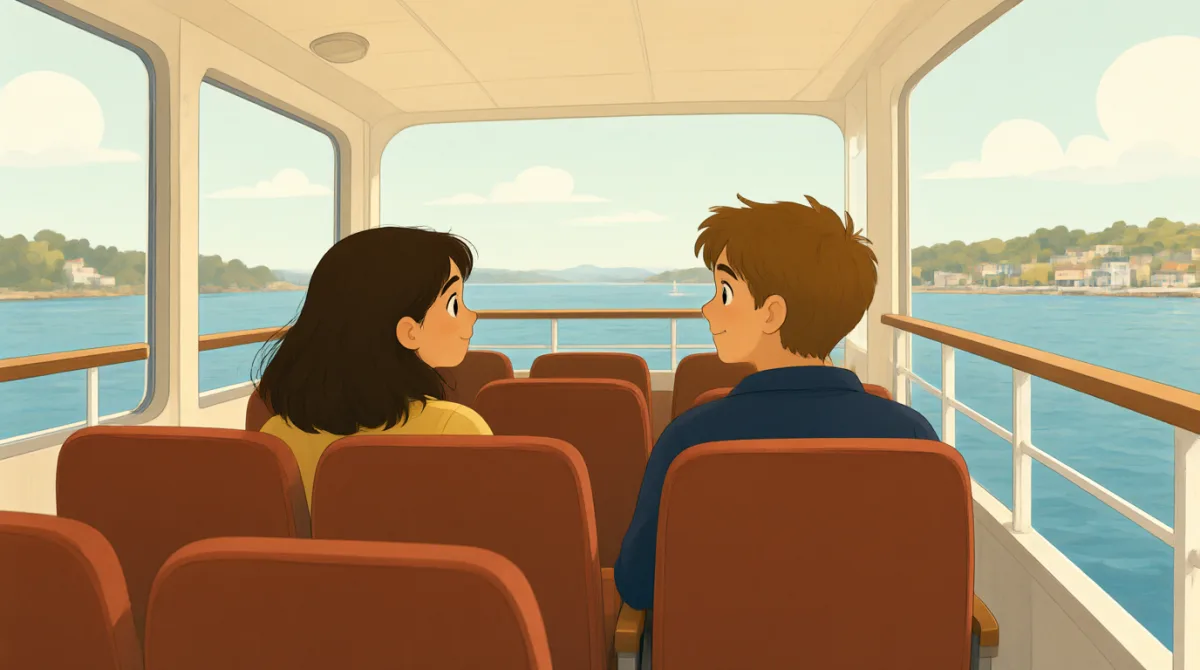

Is there a place to sit outside? I’d love to see the view.
Gibt es draußen einen Platz zum Sitzen? Ich würde gern die Aussicht sehen.

I think there are seats on the upper deck. Let’s go up.
Ich glaube, auf dem Oberdeck gibt es Sitzplätze. Lass uns hochgehen.
Are these seats free? I don’t see anyone here.
Sind diese Plätze frei? Ich sehe niemanden hier.
They look free. Let’s sit here, near the rail.
Sie sehen frei aus. Lass uns hier am Geländer sitzen.
Great! The water looks so blue today.
Super! Das Wasser sieht heute so blau aus.
Yeah, and we can see the island from here.
Ja, und von hier aus können wir die Insel sehen.
I’m glad we came outside. It’s much nicer up here.
Ich bin froh, dass wir nach draußen gekommen sind. Hier oben ist es viel schöner.
Me too. Let’s enjoy the ride before we arrive.
Ich auch. Lass uns die Fahrt genießen, bevor wir ankommen.
Wortschatz8
- outsidedraußen
In this conversation, outside means in the open air, not inside the ferry. You can ask, “Can we sit outside?”
In diesem Gespräch bedeutet “outside” (draußen), dass man sich an der frischen Luft und nicht im Inneren der Fähre befindet. Du kannst fragen: “Can we sit outside?” (Können wir draußen sitzen?)
- the viewdie Aussicht
The view is what you can see around you, such as the sea and the island. Use “I’d love to see the view” to say you want to look at the scenery.
“The view” (die Aussicht) ist das, was du um dich herum sehen kannst, zum Beispiel das Meer und die Insel. Mit “I’d love to see the view” (Ich würde gern die Aussicht sehen) sagst du, dass du dir gern die Landschaft ansehen möchtest.
- upper deckdas Oberdeck
The upper deck is the higher level of a boat or ferry. You can say, “Let’s go up to the upper deck.”
Das “upper deck” (Oberdeck) ist das höher gelegene Deck eines Boots oder einer Fähre. Du kannst sagen: “Let’s go up to the upper deck.” (Lass uns aufs Oberdeck gehen.)
- freefrei
Here, free means available for someone to use, not costing no money. You can ask, “Is this seat free?”
Hier bedeutet “free” (frei), dass ein Platz verfügbar ist und jemand ihn benutzen kann – nicht, dass er nichts kostet. Du kannst fragen: “Is this seat free?” (Ist dieser Platz frei?)
- near the railam Geländer
Near the rail means close to the barrier along the edge of the deck. You can use this phrase to describe where you want to sit.
“Near the rail” (am Geländer) bedeutet, dass man sich nahe an der Absperrung am Rand des Decks befindet. Mit dieser Wendung kannst du beschreiben, wo du sitzen möchtest.
- the islanddie Insel
An island is land with water all around it. In this dialogue, Emma and Jack can see the island from the ferry.
Eine “island” (Insel) ist ein Stück Land, das vollständig von Wasser umgeben ist. In diesem Dialog können Emma und Jack die Insel von der Fähre aus sehen.
- came outsidenach draußen gekommen
“Came outside” means moved from inside to a place outdoors. You can say, “I’m glad we came outside” when you are happy you went outdoors.
“Came outside” (nach draußen gekommen) bedeutet, dass man von drinnen nach draußen gegangen ist. Wenn du froh bist, nach draußen gegangen zu sein, kannst du sagen: “I’m glad we came outside” (Ich bin froh, dass wir nach draußen gekommen sind).
- arriveankommen
To arrive means to reach a place. Use “before we arrive” to talk about what you can do before reaching your destination.
“To arrive” (ankommen) bedeutet, einen Ort zu erreichen. Mit “before we arrive” (bevor wir ankommen) sprichst du darüber, was ihr tun könnt, bevor ihr euer Ziel erreicht.
Wichtige Sätze7
- 1
Is there a place to sit outside?
Gibt es draußen einen Platz zum Sitzen?
Use this question to ask if there is somewhere to sit outdoors. You can replace “outside” with another place, such as “near the window.”
Mit dieser Frage erkundigst du dich, ob es draußen irgendwo einen Sitzplatz gibt. Du kannst “outside” durch einen anderen Ort ersetzen, zum Beispiel “near the window” (am Fenster).
- 2
I think there are seats on the upper deck.
Ich glaube, auf dem Oberdeck gibt es Sitzplätze.
This is a useful way to share information when you are not completely sure. You can replace “seats” or “on the upper deck” with other details.
Das ist eine nützliche Formulierung, um Informationen weiterzugeben, wenn du dir nicht ganz sicher bist. Du kannst “seats” oder “on the upper deck” durch andere Angaben ersetzen.
- 3
Are these seats free?
Sind diese Plätze frei?
Use this question to check if seats are available. You can also ask, “Is this seat free?” when asking about one seat.
Mit dieser Frage prüfst du, ob Sitzplätze verfügbar sind. Wenn du nach einem einzelnen Platz fragst, kannst du auch sagen: “Is this seat free?” (Ist dieser Platz frei?)
- 4
Let’s sit here, near the rail.
Lass uns hier am Geländer sitzen.
Use “Let’s” to suggest doing something together, and add a place to say where. For example, “Let’s sit here, near the window.”
Mit “Let’s” schlägst du vor, etwas gemeinsam zu tun. Ergänze einen Ort, um zu sagen, wo ihr es tun könnt. Zum Beispiel: “Let’s sit here, near the window.” (Lass uns hier am Fenster sitzen.)
- 5
The water looks so blue today.
Das Wasser sieht heute so blau aus.
This sentence describes what you see and gives a simple opinion. You can change “blue” to another describing word, such as “calm.”
Dieser Satz beschreibt, was du siehst, und drückt eine einfache Meinung aus. Du kannst “blue” durch ein anderes beschreibendes Wort ersetzen, zum Beispiel “calm” (ruhig).
- 6
I’m glad we came outside.
Ich bin froh, dass wir nach draußen gekommen sind.
Use this sentence to say you are happy about a choice you made. You can replace “came outside” with another activity, such as “took the ferry.”
Mit diesem Satz sagst du, dass du froh über eine Entscheidung bist, die ihr getroffen habt. Du kannst “came outside” durch eine andere Aktivität ersetzen, zum Beispiel “took the ferry” (mit der Fähre gefahren sind).
- 7
Let’s enjoy the ride before we arrive.
Lass uns die Fahrt genießen, bevor wir ankommen.
This is a friendly suggestion to enjoy a journey before reaching your destination. You can replace “the ride” with “the trip.”
Das ist ein freundlicher Vorschlag, die Fahrt zu genießen, bevor ihr euer Ziel erreicht. Du kannst “the ride” durch “the trip” ersetzen.