Buying Fresh Vegetables
Kupowanie świeżych warzyw
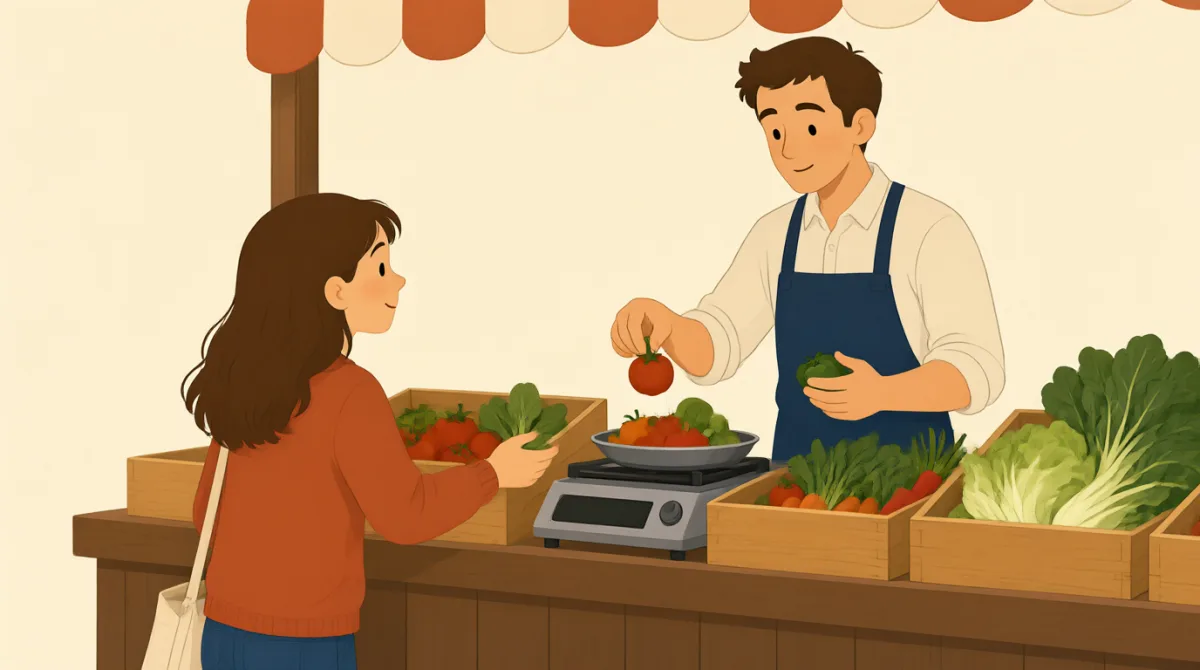
Emma picks out vegetables at David’s stall and asks how much they cost. David weighs her choices and helps her stay within her budget.
Emma wybiera warzywa na stoisku Davida i pyta o ich cenę. David waży wybrane przez nią warzywa i pomaga jej zmieścić się w budżecie.
Dialog9

Hi, David. I’d like some carrots and tomatoes. How much are they?
Cześć, David. Poproszę marchewki i pomidory. Ile kosztują?

The carrots are two dollars a pound, and the tomatoes are three.
Marchewki kosztują dwa dolary za funt, a pomidory trzy.
I’ll take one pound of carrots and two pounds of tomatoes, please.
Poproszę funt marchewek i dwa funty pomidorów.
Sure. I’ll weigh them now. The total comes to eight dollars.
Jasne. Zaraz je zważę. Razem będzie osiem dolarów.
Oh, I only have six dollars. Could I get fewer tomatoes?
Och, mam tylko sześć dolarów. Czy mogłabym wziąć mniej pomidorów?
Of course. One pound of tomatoes makes the total five dollars.
Oczywiście. Funt pomidorów sprawi, że razem zapłacisz pięć dolarów.
That works. Are these carrots fresh? They look great.
W porządku. Czy te marchewki są świeże? Wyglądają świetnie.
They came in this morning. They’re crisp and sweet.
Dostawa przyszła dziś rano. Są chrupiące i słodkie.
Great! I’ll take them. Here’s five dollars.
Świetnie! Wezmę je. Proszę, pięć dolarów.
Słownictwo8
- a poundfunt
A pound is a unit for measuring weight. You can use it when asking for or buying food.
Funt to jednostka miary masy. Możesz użyć tego słowa, pytając o jedzenie lub je kupując.
- I’ll takewezmę
This is a common way to say you want to buy something. You can use it to order items or choose what to buy.
To częsty sposób, by powiedzieć, że chcesz coś kupić. Możesz tak zamawiać produkty lub wybierać, co kupisz.
- weigh themzważyć je
To weigh something is to find out how heavy it is. At a market, a seller may weigh your food before giving you the price.
Zważyć coś to sprawdzić, ile to waży. Na targu sprzedawca może zważyć produkty przed podaniem ceny.
- the total comes torazem wychodzi
This phrase tells you the full price of the items together. You can use it when talking about the cost of a purchase.
Ten zwrot podaje łączną cenę wszystkich produktów. Możesz go użyć, mówiąc o koszcie zakupów.
- fewer tomatoesmniej pomidorów
Use “fewer” with things you can count, such as tomatoes. You can use this phrase to ask for a smaller number of items.
Słowa „fewer” używamy z rzeczami, które można policzyć, takimi jak pomidory. Możesz użyć tego zwrotu, prosząc o mniejszą liczbę produktów.
- That works.W porządku.
This means that something is okay or suitable for you. You can say it when you agree with a price or suggestion.
To znaczy, że coś ci odpowiada lub jest dla ciebie odpowiednie. Możesz tak powiedzieć, zgadzając się na cenę lub propozycję.
- came in this morningdostawa przyszła dziś rano
This means the vegetables arrived earlier today. You can ask when food came in to learn how fresh it is.
To znaczy, że warzywa dotarły wcześniej tego dnia. Możesz zapytać, kiedy dostarczono produkty, aby dowiedzieć się, jak świeże są.
- crisp and sweetchrupiące i słodkie
“Crisp” describes food that is firm and fresh, while “sweet” describes its taste. These words are useful for talking about vegetables and fruit.
„Crisp” opisuje jedzenie, które jest jędrne i świeże, a „sweet” określa jego smak. Te słowa przydają się podczas rozmowy o warzywach i owocach.
Kluczowe zdania8
- 1
I’d like some carrots and tomatoes.
Poproszę marchewki i pomidory.
This is a polite way to say what you want to buy. You can reuse it with other foods, such as “I’d like some apples and bread.”
To uprzejmy sposób, by powiedzieć, co chcesz kupić. Możesz użyć tego zdania z innymi produktami, na przykład: “I’d like some apples and bread.” (Poproszę jabłka i chleb).
- 2
How much are they?
Ile kosztują?
Use this question to ask the price of more than one item. For one item, you can ask, “How much is it?”
Użyj tego pytania, by zapytać o cenę kilku produktów. O jeden produkt możesz zapytać: “How much is it?” (Ile to kosztuje?).
- 3
I’ll take one pound of carrots and two pounds of tomatoes, please.
Poproszę funt marchewek i dwa funty pomidorów.
This sentence places an order and gives the amounts you want. You can change the foods and quantities to fit your shopping list.
To zdanie pozwala złożyć zamówienie i podać potrzebne ilości. Możesz zmienić produkty i ilości, dopasowując je do swojej listy zakupów.
- 4
The total comes to eight dollars.
Razem wychodzi osiem dolarów.
This tells someone the full price of a purchase. You can replace “eight dollars” with the correct amount.
W ten sposób podajesz komuś łączną cenę zakupów. Zamiast “eight dollars” możesz podać właściwą kwotę.
- 5
Could I get fewer tomatoes?
Czy mogłabym wziąć mniej pomidorów?
This is a polite way to ask for a smaller number of something. You can use “Could I get fewer…” with other countable items.
To uprzejmy sposób, by poprosić o mniejszą liczbę czegoś. Możesz użyć “Could I get fewer…” także w odniesieniu do innych policzalnych produktów.
- 6
Are these carrots fresh?
Czy te marchewki są świeże?
Use this question to ask whether food is fresh. You can replace “carrots” with another food, such as “apples.”
Użyj tego pytania, by zapytać, czy jedzenie jest świeże. Zamiast “carrots” możesz wstawić nazwę innego produktu, na przykład “apples.”
- 7
They came in this morning.
Dostawa przyszła dziś rano.
This tells someone when the items arrived. You can use it to answer a question about how fresh market food is.
W ten sposób informujesz kogoś, kiedy dotarły produkty. Możesz użyć tego zdania, odpowiadając na pytanie o świeżość jedzenia na targu.
- 8
Here’s five dollars.
Proszę, pięć dolarów.
This is a simple way to hand over money when paying. You can change the amount to match the price.
To prosty sposób, by podać pieniądze podczas płacenia. Możesz zmienić kwotę, aby odpowiadała cenie.