Dropping Your Phone
Faire tomber son téléphone
Emma drops her phone on the sidewalk and the screen cracks. She tells Jack how it happened.
Emma fait tomber son téléphone sur le trottoir et l’écran se fissure. Elle raconte à Jack ce qui s’est passé.
Dialogue8
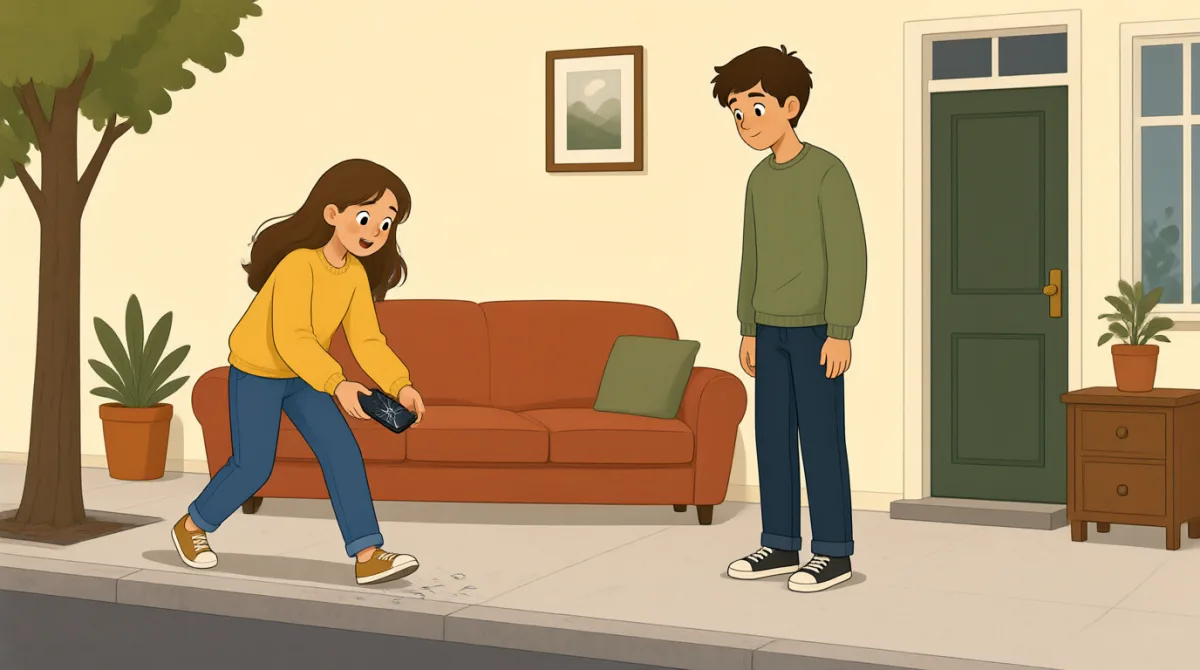

Look at my phone, Jack. I dropped it on the sidewalk.
Regarde mon téléphone, Jack. Je l’ai fait tomber sur le trottoir.

Oh no! Did it fall out of your bag?
Oh non ! Il est tombé de ton sac ?
No, I was holding it when I tripped over a small crack.
Non, je le tenais quand j’ai trébuché à cause d’une petite fissure dans le trottoir.
That sounds painful. Did you hurt your hands?
Ça a dû faire mal. Tu t’es fait mal aux mains ?
No, I'm okay. But the screen hit the ground and cracked.
Non, ça va. Mais l’écran a heurté le sol et s’est fissuré.
Can you still use it, or is the screen completely broken?
Tu peux encore t’en servir ou l’écran est complètement cassé ?
It still turns on, but I can barely read the screen.
Il s’allume encore, mais j’ai beaucoup de mal à lire l’écran.
You should take it to a repair shop soon.
Tu devrais l’apporter bientôt dans un atelier de réparation.
Vocabulaire7
- dropped itl’ai fait tomber
This means the phone fell from Emma’s hand. Use “I dropped it” to say that you accidentally let something fall.
Cela signifie que le téléphone est tombé de la main d’Emma. Utilise “I dropped it” pour dire que tu as laissé tomber quelque chose par accident.
- sidewalktrottoir
A sidewalk is a path beside a road where people walk. You can say, “I saw my friend on the sidewalk.”
Un trottoir est un chemin le long d’une route, réservé aux piétons. Tu peux dire : “I saw my friend on the sidewalk.” (J’ai vu mon ami sur le trottoir.)
- tripped overtrébucher sur
This means Emma caught her foot on something and almost fell. You can say, “I tripped over a step.”
Cela signifie qu’Emma a accroché son pied à quelque chose et a failli tomber. Tu peux dire : “I tripped over a step.” (J’ai trébuché sur une marche.)
- hurt your handsse faire mal aux mains
This asks if someone’s hands were injured or painful. Use “Did you hurt your…?” to ask about an injury.
Cette question demande si les mains de quelqu’un ont été blessées ou lui font mal. Utilise “Did you hurt your…?” pour demander si quelqu’un s’est blessé.
- turns ons’allumer
This means the phone starts working when Emma presses its power button. Use “turn on” for phones, lights, and other devices.
Cela signifie que le téléphone se met en marche quand Emma appuie sur le bouton d’alimentation. Utilise “turn on” pour les téléphones, les lumières et les autres appareils.
- barely readavoir beaucoup de mal à lire
This means Emma can read the screen only with difficulty. Use “barely” to say that something happens, but only a little.
Cela signifie qu’Emma ne peut lire l’écran qu’avec difficulté. Utilise “barely” pour dire que quelque chose se produit, mais tout juste.
- repair shopatelier de réparation
A repair shop is a place where people fix broken things. You can take a phone or another device to a repair shop.
Un atelier de réparation est un endroit où l’on répare les objets cassés. Tu peux y apporter un téléphone ou un autre appareil.
Phrases clés6
- 1
I dropped it on the sidewalk.
Je l’ai fait tomber sur le trottoir.
This explains where and how the phone fell. You can reuse the pattern “I dropped it on…” to say where you accidentally dropped something.
Cette phrase précise où et comment le téléphone est tombé. Tu peux reprendre le modèle “I dropped it on…” pour dire où tu as fait tomber quelque chose par accident.
- 2
Did it fall out of your bag?
Il est tombé de ton sac ?
This is a simple question about how something was lost or dropped. Replace “your bag” with another place, such as “your pocket.”
C’est une question simple sur la façon dont quelque chose a été perdu ou est tombé. Remplace “your bag” par un autre endroit, par exemple “your pocket.”
- 3
I was holding it when I tripped over a small crack.
Je le tenais quand j’ai trébuché à cause d’une petite fissure dans le trottoir.
This sentence explains what Emma was doing when the accident happened. Use “I was [doing something] when…” to describe an action interrupted by an event.
Cette phrase explique ce qu’Emma faisait au moment de l’accident. Utilise “I was [doing something] when…” pour décrire une action qui a été interrompue par un événement.
- 4
Did you hurt your hands?
Tu t’es fait mal aux mains ?
This is a useful way to ask if someone was injured. Replace “your hands” with another body part, such as “your knee.”
C’est une façon pratique de demander si quelqu’un s’est blessé. Remplace “your hands” par une autre partie du corps, par exemple “your knee.”
- 5
It still turns on, but I can barely read the screen.
Il s’allume encore, mais j’ai beaucoup de mal à lire l’écran.
This describes a device that works partly but has a problem. Use “It still…, but…” to explain what works and what does not.
Cette phrase décrit un appareil qui fonctionne encore en partie, mais qui a un problème. Utilise “It still…, but…” pour expliquer ce qui fonctionne et ce qui ne fonctionne pas.
- 6
You should take it to a repair shop soon.
Tu devrais l’apporter bientôt dans un atelier de réparation.
This gives simple advice about getting the phone fixed. Use “You should take it to…” to recommend a place or service.
Cette phrase donne un conseil simple pour faire réparer le téléphone. Utilise “You should take it to…” pour recommander un endroit ou un service.