Dropping Your Phone
Se te cayó el teléfono
Emma drops her phone on the sidewalk and the screen cracks. She tells Jack how it happened.
A Emma se le cae el teléfono en la acera y se le rompe la pantalla. Le cuenta a Jack cómo pasó.
Diálogo8
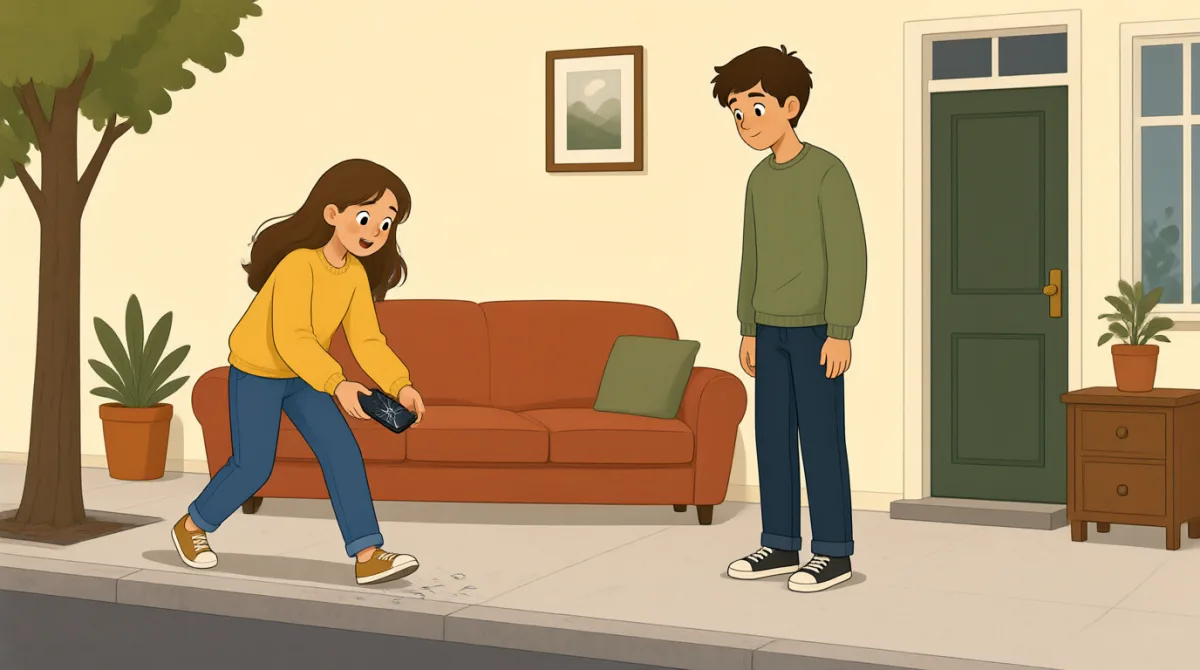

Look at my phone, Jack. I dropped it on the sidewalk.
Mira mi teléfono, Jack. Se me cayó en la acera.

Oh no! Did it fall out of your bag?
¡Oh, no! ¿Se te cayó del bolso?
No, I was holding it when I tripped over a small crack.
No, lo llevaba en la mano cuando tropecé con una pequeña grieta.
That sounds painful. Did you hurt your hands?
Qué doloroso. ¿Te lastimaste las manos?
No, I'm okay. But the screen hit the ground and cracked.
No, estoy bien. Pero la pantalla golpeó el suelo y se rompió.
Can you still use it, or is the screen completely broken?
¿Todavía puedes usarlo o la pantalla está completamente rota?
It still turns on, but I can barely read the screen.
Todavía enciende, pero casi no puedo leer la pantalla.
You should take it to a repair shop soon.
Deberías llevarlo pronto a un taller de reparación.
Vocabulario7
- dropped itse me cayó
This means the phone fell from Emma’s hand. Use “I dropped it” to say that you accidentally let something fall.
Significa que el teléfono se le cayó de la mano a Emma. Usa “I dropped it” para decir que se te cayó algo por accidente.
- sidewalkacera
A sidewalk is a path beside a road where people walk. You can say, “I saw my friend on the sidewalk.”
Una acera es el camino junto a la calle por donde caminan las personas. Puedes decir: “I saw my friend on the sidewalk” (Vi a mi amigo en la acera).
- tripped overtropecé con
This means Emma caught her foot on something and almost fell. You can say, “I tripped over a step.”
Significa que Emma enganchó el pie con algo y casi se cayó. Puedes decir: “I tripped over a step” (Tropecé con un escalón).
- hurt your hands¿te lastimaste las manos?
This asks if someone’s hands were injured or painful. Use “Did you hurt your…?” to ask about an injury.
Esta pregunta sirve para saber si alguien se lastimó las manos o siente dolor. Usa “Did you hurt your…?” para preguntar si alguien se lastimó.
- turns onenciende
This means the phone starts working when Emma presses its power button. Use “turn on” for phones, lights, and other devices.
Significa que el teléfono empieza a funcionar cuando Emma presiona el botón de encendido. Usa “turn on” para hablar de teléfonos, luces y otros aparatos.
- barely readcasi no puedo leer
This means Emma can read the screen only with difficulty. Use “barely” to say that something happens, but only a little.
Significa que a Emma le cuesta mucho leer la pantalla. Usa “barely” para decir que algo sucede, pero apenas.
- repair shoptaller de reparación
A repair shop is a place where people fix broken things. You can take a phone or another device to a repair shop.
Un taller de reparación es un lugar donde arreglan cosas rotas. Puedes llevar un teléfono u otro aparato a un taller de reparación.
Frases clave6
- 1
I dropped it on the sidewalk.
Se me cayó en la acera.
This explains where and how the phone fell. You can reuse the pattern “I dropped it on…” to say where you accidentally dropped something.
Esto explica dónde y cómo se cayó el teléfono. Puedes reutilizar la estructura “I dropped it on…” para decir dónde se te cayó algo por accidente.
- 2
Did it fall out of your bag?
¿Se te cayó del bolso?
This is a simple question about how something was lost or dropped. Replace “your bag” with another place, such as “your pocket.”
Esta es una pregunta sencilla sobre cómo se perdió o se cayó algo. Cambia “your bag” por otro lugar, como “your pocket.”
- 3
I was holding it when I tripped over a small crack.
Lo llevaba en la mano cuando tropecé con una pequeña grieta.
This sentence explains what Emma was doing when the accident happened. Use “I was [doing something] when…” to describe an action interrupted by an event.
Esta oración explica qué estaba haciendo Emma cuando ocurrió el accidente. Usa “I was [doing something] when…” para describir una acción que se vio interrumpida por algo.
- 4
Did you hurt your hands?
¿Te lastimaste las manos?
This is a useful way to ask if someone was injured. Replace “your hands” with another body part, such as “your knee.”
Esta es una forma útil de preguntar si alguien se lastimó. Cambia “your hands” por otra parte del cuerpo, como “your knee.”
- 5
It still turns on, but I can barely read the screen.
Todavía enciende, pero casi no puedo leer la pantalla.
This describes a device that works partly but has a problem. Use “It still…, but…” to explain what works and what does not.
Esto describe un aparato que todavía funciona, aunque tiene un problema. Usa “It still…, but…” para explicar qué funciona y qué no.
- 6
You should take it to a repair shop soon.
Deberías llevarlo pronto a un taller de reparación.
This gives simple advice about getting the phone fixed. Use “You should take it to…” to recommend a place or service.
Este es un consejo sencillo para que reparen el teléfono. Usa “You should take it to…” para recomendar un lugar o servicio.