Dropping Your Phone
Deixando o celular cair
Emma drops her phone on the sidewalk and the screen cracks. She tells Jack how it happened.
Emma deixa o celular cair na calçada, e a tela racha. Ela conta a Jack como aconteceu.
Diálogo8
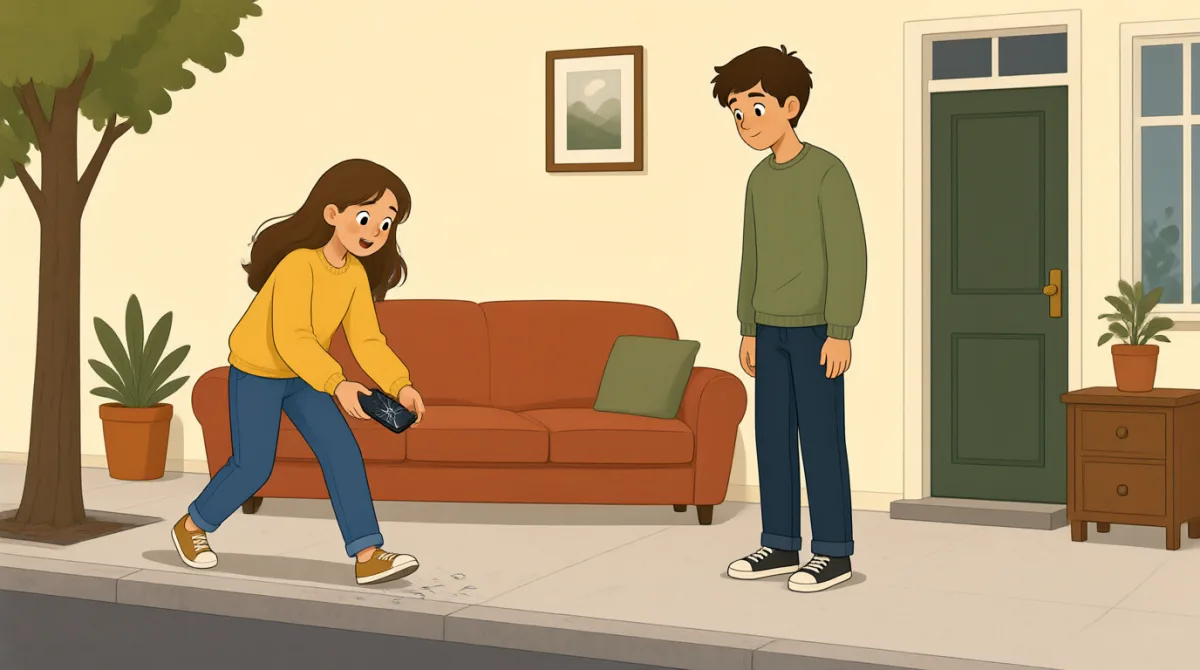

Look at my phone, Jack. I dropped it on the sidewalk.
Olha meu celular, Jack. Deixei ele cair na calçada.

Oh no! Did it fall out of your bag?
Ah, não! Ele caiu da sua bolsa?
No, I was holding it when I tripped over a small crack.
Não, eu estava segurando o celular quando tropecei numa rachadura pequena.
That sounds painful. Did you hurt your hands?
Parece que deve ter doído. Você machucou as mãos?
No, I'm okay. But the screen hit the ground and cracked.
Não, estou bem. Mas a tela bateu no chão e rachou.
Can you still use it, or is the screen completely broken?
Você ainda consegue usar ou a tela está completamente quebrada?
It still turns on, but I can barely read the screen.
Ele ainda liga, mas mal consigo ler o que aparece na tela.
You should take it to a repair shop soon.
Você devia levar o celular a uma assistência técnica logo.
Vocabulário7
- dropped itdeixei cair
This means the phone fell from Emma’s hand. Use “I dropped it” to say that you accidentally let something fall.
Isso quer dizer que o celular caiu da mão da Emma. Use “I dropped it” para dizer que você deixou algo cair sem querer.
- sidewalkcalçada
A sidewalk is a path beside a road where people walk. You can say, “I saw my friend on the sidewalk.”
Uma sidewalk é um caminho ao lado da rua por onde as pessoas andam. Você pode dizer: “I saw my friend on the sidewalk.” (Vi meu amigo na calçada.)
- tripped overtropecei em
This means Emma caught her foot on something and almost fell. You can say, “I tripped over a step.”
Isso quer dizer que Emma prendeu o pé em alguma coisa e quase caiu. Você pode dizer: “I tripped over a step.” (Tropecei num degrau.)
- hurt your handsmachucou as mãos
This asks if someone’s hands were injured or painful. Use “Did you hurt your…?” to ask about an injury.
Essa pergunta quer saber se as mãos de alguém se machucaram ou estão doloridas. Use “Did you hurt your…?” para perguntar se alguém se machucou.
- turns onliga
This means the phone starts working when Emma presses its power button. Use “turn on” for phones, lights, and other devices.
Isso quer dizer que o celular começa a funcionar quando Emma aperta o botão de ligar. Use “turn on” para celulares, luzes e outros aparelhos.
- barely readmal consigo ler
This means Emma can read the screen only with difficulty. Use “barely” to say that something happens, but only a little.
Isso quer dizer que Emma consegue ler o que aparece na tela com dificuldade. Use “barely” para dizer que algo acontece, mas por muito pouco.
- repair shopassistência técnica
A repair shop is a place where people fix broken things. You can take a phone or another device to a repair shop.
Uma repair shop é um lugar onde consertam coisas quebradas. Você pode levar um celular ou outro aparelho a uma repair shop.
Frases-chave6
- 1
I dropped it on the sidewalk.
Deixei ele cair na calçada.
This explains where and how the phone fell. You can reuse the pattern “I dropped it on…” to say where you accidentally dropped something.
Essa frase explica onde e como o celular caiu. Você pode reutilizar a estrutura “I dropped it on…” para dizer onde deixou algo cair sem querer.
- 2
Did it fall out of your bag?
Ele caiu da sua bolsa?
This is a simple question about how something was lost or dropped. Replace “your bag” with another place, such as “your pocket.”
Essa é uma pergunta simples sobre como alguém perdeu ou deixou algo cair. Troque “your bag” por outro lugar, como “your pocket” (seu bolso).
- 3
I was holding it when I tripped over a small crack.
Eu estava segurando o celular quando tropecei numa rachadura pequena.
This sentence explains what Emma was doing when the accident happened. Use “I was [doing something] when…” to describe an action interrupted by an event.
Essa frase explica o que Emma estava fazendo quando o acidente aconteceu. Use “I was [doing something] when…” para descrever uma ação que foi interrompida por um acontecimento.
- 4
Did you hurt your hands?
Você machucou as mãos?
This is a useful way to ask if someone was injured. Replace “your hands” with another body part, such as “your knee.”
Essa é uma forma útil de perguntar se alguém se machucou. Troque “your hands” por outra parte do corpo, como “your knee” (seu joelho).
- 5
It still turns on, but I can barely read the screen.
Ele ainda liga, mas mal consigo ler o que aparece na tela.
This describes a device that works partly but has a problem. Use “It still…, but…” to explain what works and what does not.
Essa frase descreve um aparelho que ainda funciona, mas tem um problema. Use “It still…, but…” para explicar o que funciona e o que não funciona.
- 6
You should take it to a repair shop soon.
Você devia levar o celular a uma assistência técnica logo.
This gives simple advice about getting the phone fixed. Use “You should take it to…” to recommend a place or service.
Essa frase dá um conselho simples para consertar o celular. Use “You should take it to…” para recomendar um lugar ou serviço.