Dropping Your Phone
Dein Handy fallen lassen
Emma drops her phone on the sidewalk and the screen cracks. She tells Jack how it happened.
Emma lässt ihr Handy auf den Gehweg fallen, und das Display bekommt einen Riss. Sie erzählt Jack, wie es passiert ist.
Dialog8
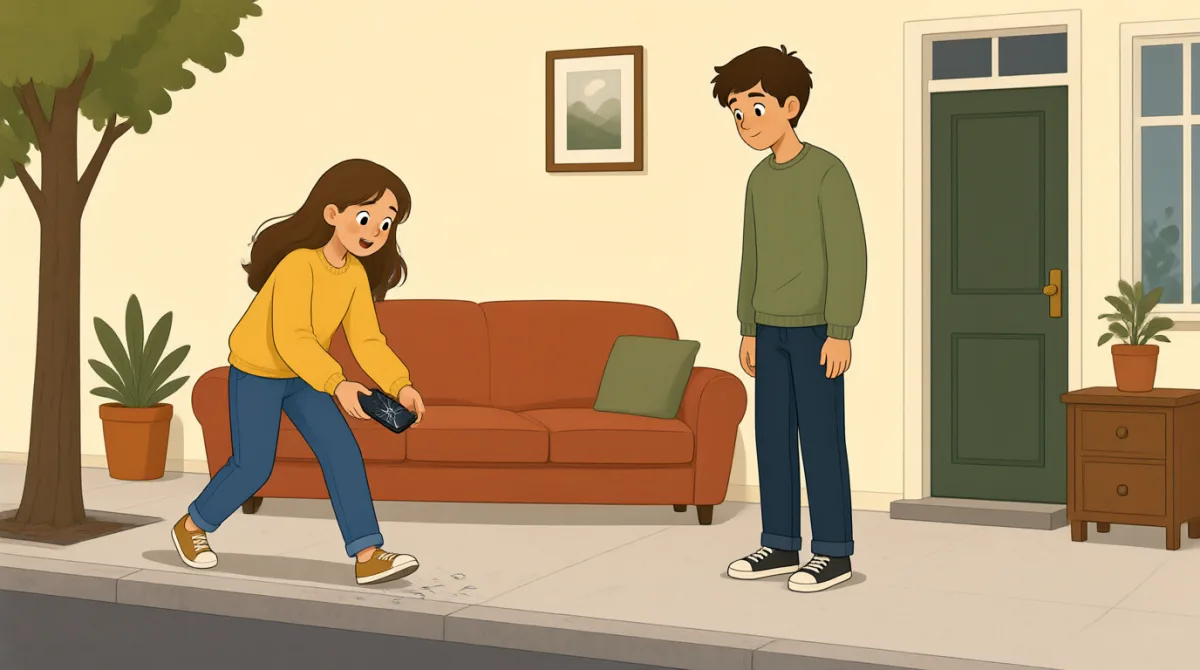

Look at my phone, Jack. I dropped it on the sidewalk.
Schau dir mein Handy an, Jack. Ich hab’s auf den Gehweg fallen lassen.

Oh no! Did it fall out of your bag?
Oh nein! Ist es aus deiner Tasche gefallen?
No, I was holding it when I tripped over a small crack.
Nein, ich hatte es in der Hand, als ich über einen kleinen Riss im Gehweg gestolpert bin.
That sounds painful. Did you hurt your hands?
Das klingt schmerzhaft. Hast du dir an den Händen wehgetan?
No, I'm okay. But the screen hit the ground and cracked.
Nein, mir geht’s gut. Aber das Display ist auf den Boden geknallt und gesprungen.
Can you still use it, or is the screen completely broken?
Kannst du es noch benutzen, oder ist das Display komplett kaputt?
It still turns on, but I can barely read the screen.
Es geht noch an, aber ich kann das Display kaum lesen.
You should take it to a repair shop soon.
Du solltest es bald zu einer Handywerkstatt bringen.
Wortschatz7
- dropped ithabe es fallen lassen
This means the phone fell from Emma’s hand. Use “I dropped it” to say that you accidentally let something fall.
Das bedeutet, dass das Handy Emma aus der Hand gefallen ist. Mit „I dropped it“ sagst du, dass du etwas versehentlich hast fallen lassen.
- sidewalkGehweg
A sidewalk is a path beside a road where people walk. You can say, “I saw my friend on the sidewalk.”
Ein „sidewalk“ ist ein Weg neben einer Straße, auf dem Menschen gehen. Du kannst sagen: „I saw my friend on the sidewalk.“ (Ich habe meinen Freund auf dem Gehweg gesehen.)
- tripped overüber etwas gestolpert sein
This means Emma caught her foot on something and almost fell. You can say, “I tripped over a step.”
Das bedeutet, dass Emma mit dem Fuß irgendwo hängen geblieben und beinahe hingefallen ist. Du kannst sagen: „I tripped over a step.“ (Ich bin über eine Stufe gestolpert.)
- hurt your handssich an den Händen wehgetan haben
This asks if someone’s hands were injured or painful. Use “Did you hurt your…?” to ask about an injury.
Damit fragt man, ob jemand sich an den Händen verletzt hat oder ob sie wehtun. Mit „Did you hurt your…?“ fragst du nach einer Verletzung.
- turns ongeht an
This means the phone starts working when Emma presses its power button. Use “turn on” for phones, lights, and other devices.
Das bedeutet, dass das Handy funktioniert, wenn Emma den Einschaltknopf drückt. „Turn on“ benutzt du bei Handys, Lampen und anderen Geräten.
- barely readkaum lesen können
This means Emma can read the screen only with difficulty. Use “barely” to say that something happens, but only a little.
Das bedeutet, dass Emma das Display nur mit Mühe lesen kann. Mit „barely“ sagst du, dass etwas zwar passiert, aber nur sehr eingeschränkt.
- repair shopReparaturwerkstatt
A repair shop is a place where people fix broken things. You can take a phone or another device to a repair shop.
Eine „repair shop“ ist ein Ort, an dem kaputte Dinge repariert werden. Du kannst ein Handy oder ein anderes Gerät in eine Reparaturwerkstatt bringen.
Wichtige Sätze6
- 1
I dropped it on the sidewalk.
Ich hab’s auf den Gehweg fallen lassen.
This explains where and how the phone fell. You can reuse the pattern “I dropped it on…” to say where you accidentally dropped something.
Damit wird erklärt, wo und wie das Handy heruntergefallen ist. Mit dem Satzmuster „I dropped it on…“ kannst du sagen, wo du etwas versehentlich hast fallen lassen.
- 2
Did it fall out of your bag?
Ist es aus deiner Tasche gefallen?
This is a simple question about how something was lost or dropped. Replace “your bag” with another place, such as “your pocket.”
Das ist eine einfache Frage dazu, wie jemand etwas verloren oder fallen gelassen hat. Ersetze „your bag“ durch einen anderen Ort, zum Beispiel „your pocket“.
- 3
I was holding it when I tripped over a small crack.
Ich hatte es in der Hand, als ich über einen kleinen Riss im Gehweg gestolpert bin.
This sentence explains what Emma was doing when the accident happened. Use “I was [doing something] when…” to describe an action interrupted by an event.
Dieser Satz erklärt, was Emma gerade tat, als der Unfall passierte. Mit „I was [doing something] when…“ beschreibst du eine Handlung, die durch ein Ereignis unterbrochen wurde.
- 4
Did you hurt your hands?
Hast du dir an den Händen wehgetan?
This is a useful way to ask if someone was injured. Replace “your hands” with another body part, such as “your knee.”
So kannst du fragen, ob sich jemand verletzt hat. Ersetze „your hands“ durch einen anderen Körperteil, zum Beispiel „your knee“.
- 5
It still turns on, but I can barely read the screen.
Es geht noch an, aber ich kann das Display kaum lesen.
This describes a device that works partly but has a problem. Use “It still…, but…” to explain what works and what does not.
Damit beschreibst du ein Gerät, das teilweise funktioniert, aber ein Problem hat. Mit „It still…, but…“ erklärst du, was noch funktioniert und was nicht.
- 6
You should take it to a repair shop soon.
Du solltest es bald zu einer Reparaturwerkstatt bringen.
This gives simple advice about getting the phone fixed. Use “You should take it to…” to recommend a place or service.
Damit gibst du den einfachen Rat, das Handy reparieren zu lassen. Mit „You should take it to…“ empfiehlst du einen Ort oder eine Dienstleistung.