Getting Help With the Job
Un coup de main pour le travail
Jack sees Emma setting up the ladder and offers to help. Together, they hang the birdhouse safely.
Jack voit Emma installer l’échelle et lui propose son aide. Ensemble, ils accrochent le nichoir en toute sécurité.
Dialogue9
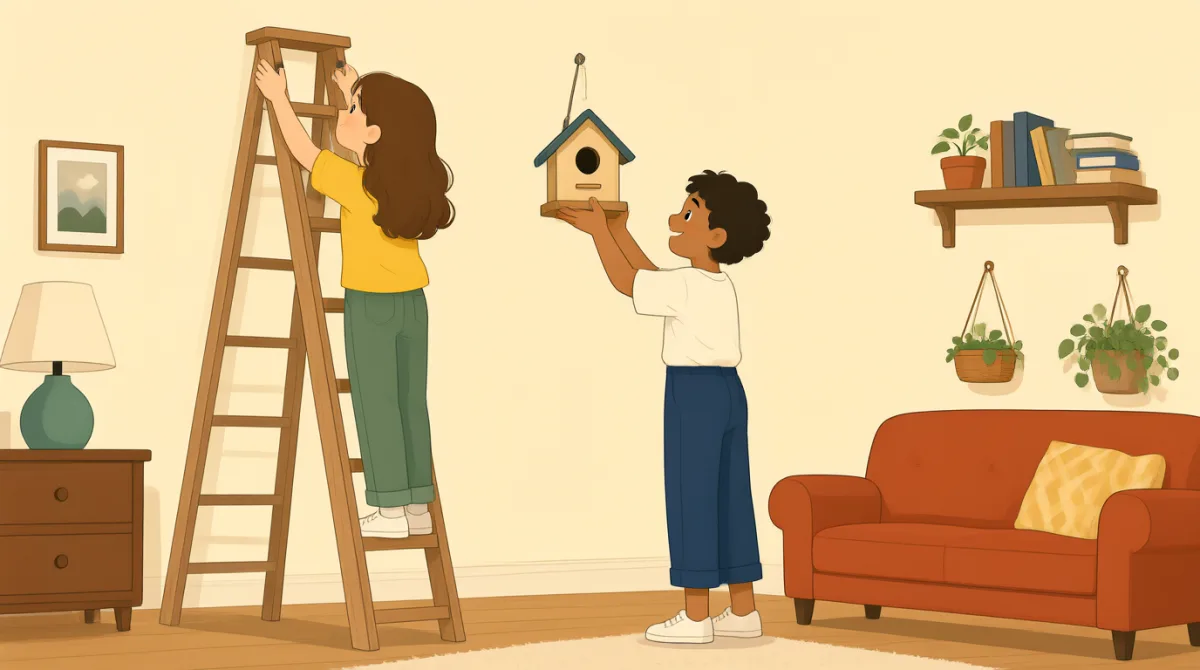

I’m putting the ladder here, but I’m not sure the ground is flat.
Je mets l’échelle ici, mais je ne suis pas sûre que le sol soit plat.

Hi, Emma. I can help. Let’s move it onto the flat part of the yard.
Salut, Emma. Je peux t’aider. Déplaçons-la sur la partie plate du jardin.
Thanks! I want to hang the birdhouse on that tree, just above the low branch.
Merci ! Je veux accrocher le nichoir à cet arbre, juste au-dessus de la branche basse.
Good spot. I’ll hold the ladder while you climb, and you can pass me the birdhouse.
Bon endroit. Je tiendrai l’échelle pendant que tu montes, et tu pourras me passer le nichoir.
Okay. Is it steady now? I don’t want it to move while I’m up there.
D’accord. Elle est stable, maintenant ? Je ne veux pas qu’elle bouge pendant que je suis là-haut.
It’s steady. Keep both feet on the steps, and don’t reach too far to the side.
Elle est stable. Garde les deux pieds sur les barreaux et ne te penche pas trop sur le côté.
Got it. I’ll climb slowly. Please hand me the birdhouse when I’m near the top.
Compris. Je vais monter doucement. Passe-moi le nichoir quand je serai près du haut.
Here you go. I’ll keep holding the ladder until you’re back on the ground.
Voilà. Je continuerai à tenir l’échelle jusqu’à ce que tu sois redescendue.
Thanks, Jack! It’s up, and it looks great. We did it safely.
Merci, Jack ! Il est installé, et il est superbe. On a fait ça en toute sécurité.
Vocabulaire8
- flat part of the yardpartie plate du jardin
The area of the yard that is level, not sloping. You can use “flat part” to describe a safe place to set something down.
La zone du jardin qui est bien horizontale, et non en pente. Tu peux dire “flat part” pour désigner un endroit sûr où poser quelque chose.
- hang the birdhouseaccrocher le nichoir
To put the birdhouse up so it stays on a tree or another surface. You can use “hang” for things like pictures, lights, or decorations.
Installer le nichoir pour qu’il reste fixé à un arbre ou à une autre surface. Tu peux utiliser “hang” pour parler de tableaux, de lumières ou de décorations qu’on accroche.
- hold the laddertenir l’échelle
To keep the ladder steady with your hands. This phrase is useful when someone is climbing and needs help staying safe.
Maintenir l’échelle stable avec les mains. Cette expression est utile quand quelqu’un grimpe et a besoin d’aide pour rester en sécurité.
- pass me the birdhouseme passer le nichoir
To give the birdhouse to me by moving it from your hands to mine. You can use “pass me” when asking someone to hand you something.
Me donner le nichoir en le faisant passer de tes mains aux miennes. Tu peux utiliser “pass me” pour demander à quelqu’un de te tendre quelque chose.
- steadystable
Not moving or shaking. You can use this word to check that a ladder or other object is safe to use.
Qui ne bouge pas et ne tremble pas. Tu peux utiliser ce mot pour vérifier qu’une échelle ou un autre objet peut être utilisé sans danger.
- reach too far to the sidese pencher trop sur le côté
To stretch your body sideways too much. This phrase can be used as a safety warning when someone is working at a height.
Étendre son corps trop loin sur le côté. Cette expression peut servir d’avertissement de sécurité quand quelqu’un travaille en hauteur.
- climb slowlymonter doucement
To go up carefully and not too quickly. You can use this phrase to remind someone to take their time.
Monter prudemment, sans aller trop vite. Tu peux utiliser cette expression pour rappeler à quelqu’un de prendre son temps.
- back on the groundredescendu au sol
Returned to the ground after being somewhere higher. You can use this phrase when talking about someone coming down from a ladder.
Être revenu au sol après s’être trouvé en hauteur. Tu peux utiliser cette expression pour parler de quelqu’un qui descend d’une échelle.
Phrases clés8
- 1
I can help.
Je peux t’aider.
A simple way to offer assistance. You can use it when you see someone doing a task alone.
Une façon simple de proposer son aide. Tu peux le dire quand tu vois quelqu’un faire une tâche seul.
- 2
Let’s move it onto the flat part of the yard.
Déplaçons-la sur la partie plate du jardin.
This suggests moving something together to a safer, level place. Replace “it” and “the flat part of the yard” with the object and destination you mean.
Cette phrase propose de déplacer quelque chose ensemble vers un endroit plat et plus sûr. Remplace “it” et “the flat part of the yard” par l’objet et l’endroit que tu veux désigner.
- 3
I’ll hold the ladder while you climb, and you can pass me the birdhouse.
Je tiendrai l’échelle pendant que tu montes, et tu pourras me passer le nichoir.
This sentence explains how two people will help each other with a task. Use “I’ll [action] while you [action]” to describe two things happening at the same time.
Cette phrase explique comment deux personnes vont s’entraider pour faire quelque chose. Utilise “I’ll [action] while you [action]” pour décrire deux actions qui se déroulent en même temps.
- 4
Is it steady now?
Elle est stable, maintenant ?
A useful question for checking whether something is stable and safe. Replace “it” with an object, such as a chair or table.
Une question pratique pour vérifier si quelque chose est stable et sûr. Remplace “it” par un objet, comme une chaise ou une table.
- 5
Keep both feet on the steps, and don’t reach too far to the side.
Garde les deux pieds sur les barreaux et ne te penche pas trop sur le côté.
This gives two clear safety instructions. You can use “Keep…” and “don’t…” to tell someone what to do and what to avoid.
Cette phrase donne deux consignes de sécurité claires. Tu peux utiliser “Keep…” et “don’t…” pour dire à quelqu’un quoi faire et quoi éviter.
- 6
I’ll climb slowly.
Je vais monter doucement.
This is a short way to say you will go up carefully. You can use “I’ll [action] slowly” to describe how you plan to do something.
Une façon concise de dire que tu vas monter prudemment. Tu peux utiliser “I’ll [action] slowly” pour décrire comment tu comptes faire quelque chose.
- 7
I’ll keep holding the ladder until you’re back on the ground.
Je continuerai à tenir l’échelle jusqu’à ce que tu sois redescendue.
This promises to continue helping until a particular event happens. Use “until” to say when an action will stop.
Cette phrase promet de continuer à aider jusqu’à ce qu’un événement précis se produise. Utilise “until” pour indiquer quand une action s’arrêtera.
- 8
We did it safely.
On a fait ça en toute sécurité.
This means the task is finished and no one was hurt. You can use “We did it” to celebrate completing something together.
Cela signifie que la tâche est terminée et que personne ne s’est blessé. Tu peux utiliser “We did it” pour célébrer quelque chose que vous avez accompli ensemble.