Getting Help With the Job
Hilfe bei der Arbeit
Jack sees Emma setting up the ladder and offers to help. Together, they hang the birdhouse safely.
Jack sieht, wie Emma die Leiter aufstellt, und bietet seine Hilfe an. Zusammen hängen sie das Vogelhaus sicher auf.
Dialog9
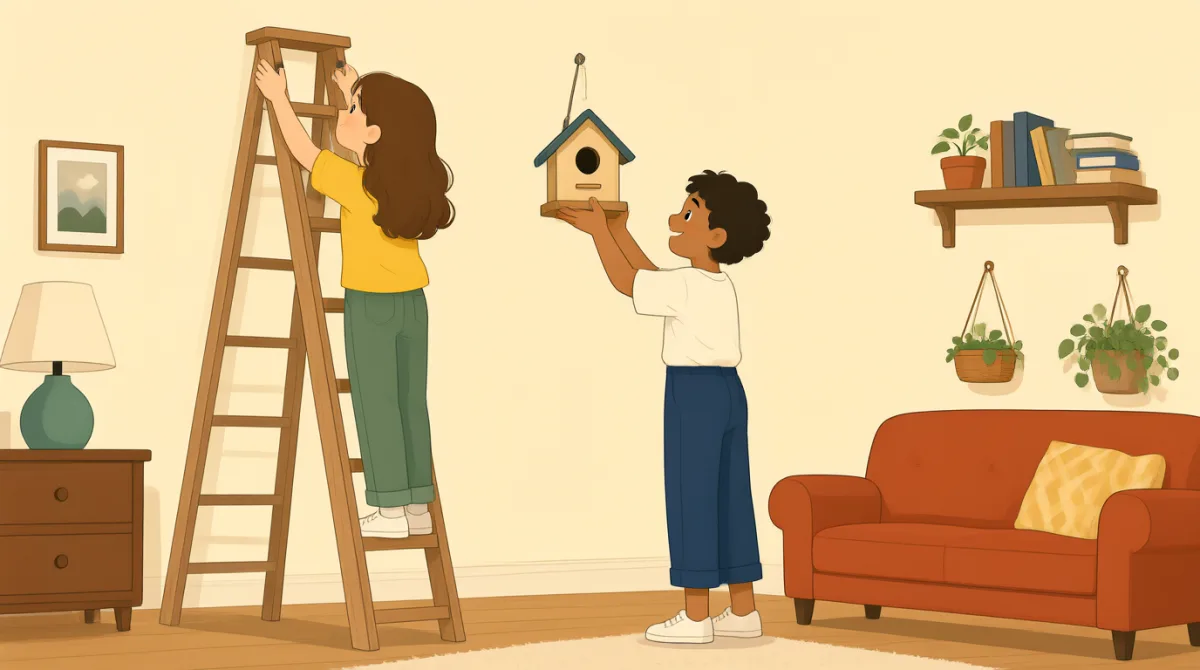

I’m putting the ladder here, but I’m not sure the ground is flat.
Ich stelle die Leiter hier auf, aber ich bin mir nicht sicher, ob der Boden eben ist.

Hi, Emma. I can help. Let’s move it onto the flat part of the yard.
Hi, Emma. Ich kann dir helfen. Lass uns die Leiter auf die ebene Stelle im Garten stellen.
Thanks! I want to hang the birdhouse on that tree, just above the low branch.
Danke! Ich möchte das Vogelhaus an dem Baum dort aufhängen, direkt über dem niedrigen Ast.
Good spot. I’ll hold the ladder while you climb, and you can pass me the birdhouse.
Gute Stelle. Ich halte die Leiter fest, während du hochkletterst, und du kannst mir das Vogelhaus reichen.
Okay. Is it steady now? I don’t want it to move while I’m up there.
Okay. Steht sie jetzt fest? Ich möchte nicht, dass sie wackelt, während ich oben bin.
It’s steady. Keep both feet on the steps, and don’t reach too far to the side.
Sie steht fest. Lass beide Füße auf den Sprossen und lehn dich nicht zu weit zur Seite.
Got it. I’ll climb slowly. Please hand me the birdhouse when I’m near the top.
Alles klar. Ich klettere langsam hoch. Gib mir bitte das Vogelhaus, wenn ich fast oben bin.
Here you go. I’ll keep holding the ladder until you’re back on the ground.
Hier, bitte. Ich halte die Leiter weiter fest, bis du wieder unten bist.
Thanks, Jack! It’s up, and it looks great. We did it safely.
Danke, Jack! Es hängt, und es sieht toll aus. Wir haben es sicher geschafft.
Wortschatz8
- flat part of the yardebene Stelle im Garten
The area of the yard that is level, not sloping. You can use “flat part” to describe a safe place to set something down.
Das ist ein flacher, ebener Bereich im Garten, der nicht abschüssig ist. „flat part“ kannst du verwenden, wenn du eine sichere Stelle beschreibst, an der man etwas abstellen kann.
- hang the birdhousedas Vogelhaus aufhängen
To put the birdhouse up so it stays on a tree or another surface. You can use “hang” for things like pictures, lights, or decorations.
Das Vogelhaus so befestigen, dass es an einem Baum oder einer anderen Oberfläche hängt. „hang“ kannst du auch für Dinge wie Bilder, Lichter oder Dekorationen verwenden.
- hold the ladderdie Leiter festhalten
To keep the ladder steady with your hands. This phrase is useful when someone is climbing and needs help staying safe.
Die Leiter mit den Händen stabil halten. Diese Wendung ist hilfreich, wenn jemand hinaufklettert und Unterstützung braucht, um sicher zu bleiben.
- pass me the birdhousemir das Vogelhaus reichen
To give the birdhouse to me by moving it from your hands to mine. You can use “pass me” when asking someone to hand you something.
Das Vogelhaus aus deiner Hand in meine Hand geben. Mit „pass me“ kannst du jemanden bitten, dir etwas zu reichen.
- steadystabil
Not moving or shaking. You can use this word to check that a ladder or other object is safe to use.
Etwas bewegt oder wackelt nicht. Mit diesem Wort kannst du prüfen, ob eine Leiter oder ein anderer Gegenstand sicher steht.
- reach too far to the sidesich zu weit zur Seite lehnen
To stretch your body sideways too much. This phrase can be used as a safety warning when someone is working at a height.
Den Körper zu stark zur Seite strecken. Diese Wendung eignet sich als Sicherheitshinweis, wenn jemand in der Höhe arbeitet.
- climb slowlylangsam hochklettern
To go up carefully and not too quickly. You can use this phrase to remind someone to take their time.
Vorsichtig und nicht zu schnell hinaufsteigen. Mit dieser Wendung kannst du jemanden daran erinnern, sich Zeit zu lassen.
- back on the groundwieder unten sein
Returned to the ground after being somewhere higher. You can use this phrase when talking about someone coming down from a ladder.
Wieder am Boden sein, nachdem man sich weiter oben befunden hat. Diese Wendung kannst du verwenden, wenn jemand von einer Leiter herunterkommt.
Wichtige Sätze8
- 1
I can help.
Ich kann dir helfen.
A simple way to offer assistance. You can use it when you see someone doing a task alone.
Eine einfache Art, Hilfe anzubieten. Das kannst du sagen, wenn du siehst, dass jemand allein an einer Aufgabe arbeitet.
- 2
Let’s move it onto the flat part of the yard.
Lass uns die Leiter auf die ebene Stelle im Garten stellen.
This suggests moving something together to a safer, level place. Replace “it” and “the flat part of the yard” with the object and destination you mean.
Damit schlägst du vor, etwas gemeinsam an einen sichereren, ebenen Ort zu stellen. Ersetze „it“ und „the flat part of the yard“ durch den Gegenstand und den Zielort, die du meinst.
- 3
I’ll hold the ladder while you climb, and you can pass me the birdhouse.
Ich halte die Leiter fest, während du hochkletterst, und du kannst mir das Vogelhaus reichen.
This sentence explains how two people will help each other with a task. Use “I’ll [action] while you [action]” to describe two things happening at the same time.
Dieser Satz erklärt, wie zwei Personen einander bei einer Aufgabe helfen. Mit „I’ll [action] while you [action]“ beschreibst du zwei Dinge, die gleichzeitig passieren.
- 4
Is it steady now?
Steht sie jetzt fest?
A useful question for checking whether something is stable and safe. Replace “it” with an object, such as a chair or table.
Eine nützliche Frage, um zu prüfen, ob etwas stabil und sicher steht. Ersetze „it“ durch einen Gegenstand, zum Beispiel einen Stuhl oder einen Tisch.
- 5
Keep both feet on the steps, and don’t reach too far to the side.
Lass beide Füße auf den Sprossen und lehn dich nicht zu weit zur Seite.
This gives two clear safety instructions. You can use “Keep…” and “don’t…” to tell someone what to do and what to avoid.
Dieser Satz enthält zwei klare Sicherheitshinweise. Mit „Keep…“ und „don’t…“ kannst du jemandem sagen, was er tun und was er vermeiden soll.
- 6
I’ll climb slowly.
Ich klettere langsam hoch.
This is a short way to say you will go up carefully. You can use “I’ll [action] slowly” to describe how you plan to do something.
So sagst du kurz, dass du vorsichtig hinaufsteigen wirst. Mit „I’ll [action] slowly“ beschreibst du, wie du etwas tun möchtest.
- 7
I’ll keep holding the ladder until you’re back on the ground.
Ich halte die Leiter weiter fest, bis du wieder unten bist.
This promises to continue helping until a particular event happens. Use “until” to say when an action will stop.
Damit versprichst du, so lange weiterzuhelfen, bis ein bestimmtes Ereignis eintritt. Mit „until“ sagst du, wann eine Handlung endet.
- 8
We did it safely.
Wir haben es sicher geschafft.
This means the task is finished and no one was hurt. You can use “We did it” to celebrate completing something together.
Das bedeutet, dass die Aufgabe erledigt ist und niemand verletzt wurde. Mit „We did it“ kannst du feiern, dass ihr etwas gemeinsam geschafft habt.