Offering Something in Return
Offrir quelque chose en retour
Emma offers Jack some homemade cookies to thank him for lending the ladder and helping out. Jack happily accepts.
Pour remercier Jack de lui avoir prêté son échelle et de l’avoir aidée, Emma lui offre des biscuits faits maison. Jack les accepte avec plaisir.
Dialogue8
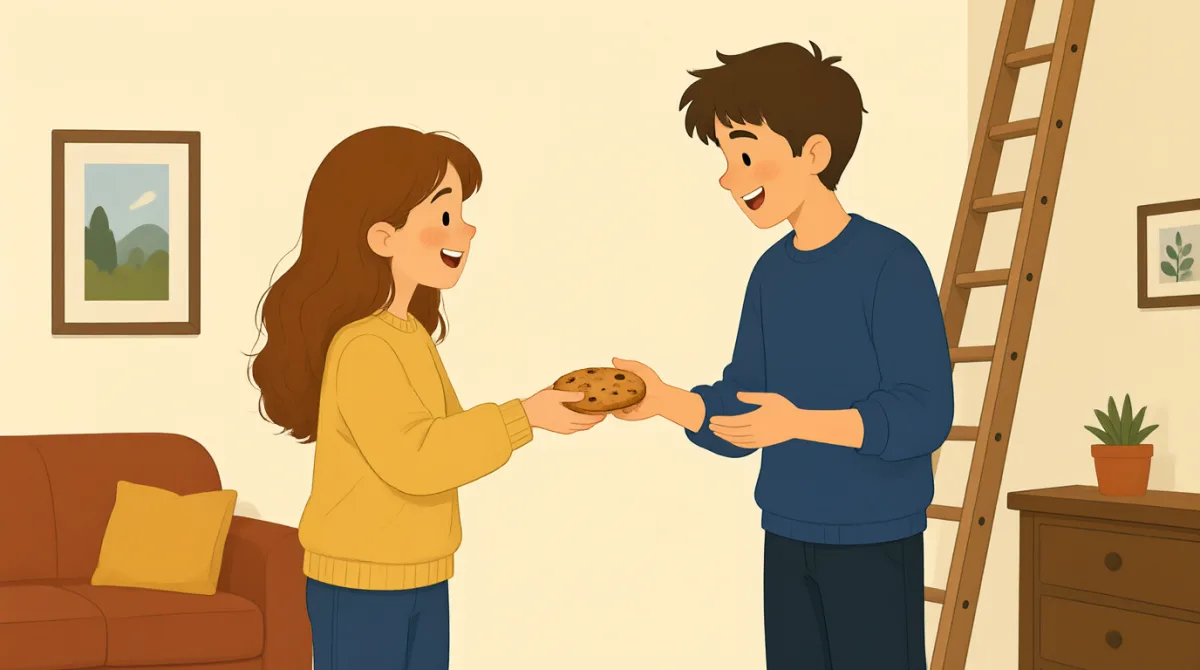

Hi, Jack. I brought you some homemade cookies to say thank you.
Salut, Jack. Je t’ai apporté des biscuits faits maison pour te remercier.

That’s so kind of you, Emma. You didn’t have to do that.
C’est vraiment gentil, Emma. Tu n’étais pas obligée.
I wanted to. You lent me your ladder and helped me hang the birdhouse.
J’en avais envie. Tu m’as prêté ton échelle et tu m’as aidée à accrocher le nichoir.
I’m glad to help. How did the birdhouse turn out?
Ça m’a fait plaisir de t’aider. Alors, le nichoir, il rend comment ?
It looks great! I saw a little bird checking it out this morning.
Il est super ! J’ai vu un petit oiseau qui l’inspectait ce matin.
That’s great news. And these cookies smell delicious.
C’est une super nouvelle. Et ces biscuits sentent très bon.
I made chocolate chip ones. Please take some for later.
J’en ai fait au chocolat. Sers-toi, tu pourras en garder pour plus tard.
Thanks, Emma. I’d love some. I’ll enjoy them with my tea.
Merci, Emma. Avec plaisir. Je les dégusterai avec mon thé.
Vocabulaire8
- homemade cookiesbiscuits faits maison
Cookies made at home, not bought from a store. You can use this phrase to describe food you made yourself.
Des biscuits préparés chez soi, et non achetés en magasin. Tu peux employer cette expression pour parler d’un plat que tu as préparé toi-même.
- say thank youremercier
To express that you are grateful. You can bring someone a small gift to say thank you.
Exprimer sa gratitude. Tu peux apporter un petit cadeau à quelqu’un pour le remercier.
- You didn’t have to do that.Tu n’étais pas obligé(e) de faire ça.
A polite way to say someone did something kind that was not necessary. People often say this when they receive a gift or favor.
Une façon polie de dire que quelqu’un a fait quelque chose de gentil, même si ce n’était pas nécessaire. On dit souvent cela quand on reçoit un cadeau ou un service.
- helped mem’a aidé(e)
Gave me help with something. Use “helped me” to talk about support someone gave in the past.
M’a apporté son aide pour quelque chose. Utilise “helped me” pour parler d’un soutien reçu dans le passé.
- turn outse révéler / donner comme résultat
To have a particular result or appearance. Ask “How did it turn out?” to find out whether something went well.
Avoir un résultat ou un aspect particulier. Demande “How did it turn out?” pour savoir si quelque chose s’est bien passé ou à quoi cela ressemble.
- checking it outl’inspecter
Looking at or exploring something. You can use “check it out” when someone takes a closer look at a new place or thing.
Regarder ou explorer quelque chose. Tu peux utiliser “check it out” quand quelqu’un examine de plus près un nouvel endroit ou un nouvel objet.
- take someen prendre
Have or accept some of something that is being offered. You can say this when offering food to a guest.
Prendre ou accepter une partie de ce qu’on te propose. Tu peux dire cela quand tu offres à manger à un invité.
- I’d love some.J’en veux bien.
A friendly way to accept an offer. Use it when you would really like some food or drink.
Une façon amicale d’accepter une offre. Utilise cette expression quand tu as vraiment envie de manger ou de boire ce qu’on te propose.
Phrases clés8
- 1
I brought you some homemade cookies to say thank you.
Je t’ai apporté des biscuits faits maison pour te remercier.
Use this sentence when giving someone a small gift to show appreciation. Replace “homemade cookies” with another gift, such as “some flowers.”
Utilise cette phrase pour offrir un petit cadeau à quelqu’un afin de lui montrer ta gratitude. Remplace “homemade cookies” par un autre cadeau, comme “some flowers.”
- 2
You didn’t have to do that.
Tu n’étais pas obligé(e) de faire ça.
This is a polite response when someone does something kind for you. You can use it when receiving a gift or a favor.
C’est une réponse polie quand quelqu’un fait quelque chose de gentil pour toi. Tu peux l’utiliser quand tu reçois un cadeau ou un service.
- 3
You lent me your ladder and helped me hang the birdhouse.
Tu m’as prêté ton échelle et tu m’as aidée à accrocher le nichoir.
Use this sentence to thank someone for specific help they gave you. Replace “lent me your ladder” and “hang the birdhouse” with the favor and task.
Utilise cette phrase pour remercier quelqu’un d’une aide précise. Remplace “lent me your ladder” et “hang the birdhouse” par le service rendu et la tâche accomplie.
- 4
How did the birdhouse turn out?
Alors, le nichoir, il rend comment ?
Ask this to find out how a finished task or project looks. Replace “the birdhouse” with another project, such as “your painting.”
Pose cette question pour savoir à quoi ressemble un travail ou un projet une fois terminé. Remplace “the birdhouse” par un autre projet, comme “your painting.”
- 5
I saw a little bird checking it out this morning.
J’ai vu un petit oiseau qui l’inspectait ce matin.
Use this sentence to describe something you noticed in the past. “Checking it out” means looking at or exploring something.
Utilise cette phrase pour décrire quelque chose que tu as remarqué dans le passé. “Checking it out” signifie regarder ou explorer quelque chose.
- 6
Please take some for later.
Sers-toi, tu pourras en garder pour plus tard.
This is a friendly way to offer someone food to enjoy later. Replace “some” with the item, such as “a cookie.”
C’est une façon amicale de proposer à quelqu’un de quoi manger plus tard. Remplace “some” par l’aliment proposé, comme “a cookie.”
- 7
I’d love some.
J’en veux bien.
Use this friendly phrase to accept an offer. You can say it when someone offers you food or a drink.
Utilise cette expression amicale pour accepter une offre. Tu peux la dire quand quelqu’un te propose à manger ou à boire.
- 8
I’ll enjoy them with my tea.
Je les dégusterai avec mon thé.
Use this to say when or how you plan to enjoy something. Replace “them” with the food or treat you are talking about.
Utilise cette phrase pour dire quand ou comment tu comptes savourer quelque chose. Remplace “them” par l’aliment ou la gourmandise dont tu parles.