Finding the Ticket
Encontrar la multa
Emma finds a parking ticket on her car and asks Jack why she got it. They check the time and place on the ticket.
Emma encuentra una multa de estacionamiento en su auto y le pregunta a Jack por qué se la pusieron. Revisan la hora y el lugar que aparecen en la multa.
Diálogo8
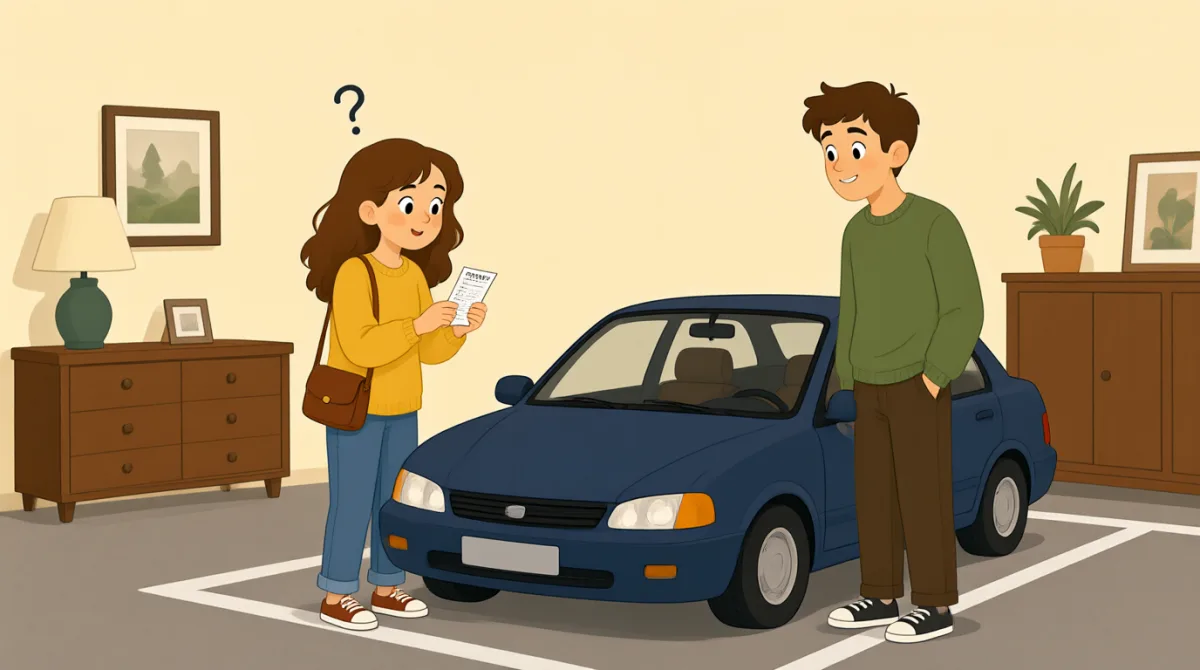

Jack, there’s a parking ticket on my car. Why did I get one?
Jack, tengo una multa de estacionamiento en el auto. ¿Por qué me la pusieron?

Let’s take a look. Where did you park?
A ver. ¿Dónde estacionaste?
On Pine Street, near the coffee shop. I parked there this morning.
En Pine Street, cerca de la cafetería. Estacioné ahí esta mañana.
The ticket says Pine Street, but let’s check the time.
La multa dice Pine Street, pero revisemos la hora.
It says 10:15 a.m. I thought parking was allowed there.
Dice 10:15 a. m. Pensé que ahí se podía estacionar.
It says your car was there during street cleaning hours.
Dice que tu auto estaba ahí durante el horario de limpieza de la calle.
Oh, I didn’t see that. Is there a date on the ticket?
Ah, no me fijé en eso. ¿La multa tiene fecha?
Yes, it was issued today. The time and place are both listed here.
Sí, la emitieron hoy. Aquí aparecen tanto la hora como el lugar.
Vocabulario8
- parking ticketmulta de estacionamiento
A parking ticket is a notice you get for parking against the rules. Here, Emma finds one on her car.
Una multa de estacionamiento es un aviso que recibes por estacionar infringiendo las normas. Aquí, Emma encuentra una en su auto.
- take a lookechar un vistazo
This means to look at something. You can say, “Let’s take a look” when you want to check something together.
Significa mirar algo. Puedes decir “Let’s take a look” (Echemos un vistazo) cuando quieras revisar algo junto con otra persona.
- Where did you park?¿Dónde estacionaste?
This question asks about the place where someone left their car. You can use it to ask where someone parked.
Esta pregunta se refiere al lugar donde alguien dejó su auto. Puedes usarla para preguntar dónde estacionó alguien.
- near the coffee shopcerca de la cafetería
This phrase describes a place that is close to the coffee shop. Use “near” to say that one place is close to another.
Esta expresión describe un lugar que está a poca distancia de la cafetería. Usa “near” para decir que un lugar está cerca de otro.
- check the timerevisar la hora
This means to look at what time something happened. You can use it when you want to confirm a time.
Significa comprobar a qué hora ocurrió algo. Puedes usar esta expresión cuando quieras confirmar una hora.
- parking was allowedse podía estacionar
This means it was okay to leave a car there. Use “was allowed” to talk about a past rule or permission.
Significa que estaba permitido dejar el auto ahí. Usa “was allowed” para hablar de una norma o permiso del pasado.
- street cleaning hourshorario de limpieza de la calle
These are the times when a street is cleaned, and parking may not be allowed. You might see these hours on a parking sign.
Son las horas en que limpian una calle y puede que no esté permitido estacionar. Es posible que veas ese horario en una señal de estacionamiento.
- issued todayemitida hoy
This means the ticket was given or created today. Use “issued” to say when an official notice or document was given.
Significa que la multa se entregó o se emitió hoy. Usa “issued” para indicar cuándo se entregó un aviso o documento oficial.
Frases clave8
- 1
Why did I get one?
¿Por qué me la pusieron?
Use this question to ask why something happened to you. “One” refers to a parking ticket mentioned just before.
Usa esta pregunta para preguntar por qué te pasó algo. “One” se refiere a una multa de estacionamiento mencionada justo antes.
- 2
Where did you park?
¿Dónde estacionaste?
This is a simple way to ask where someone left their car. Replace “park” with another verb to ask about a past action.
Es una forma sencilla de preguntar dónde dejó alguien su auto. Puedes sustituir “park” por otro verbo para preguntar por una acción pasada.
- 3
I parked there this morning.
Estacioné ahí esta mañana.
Use this sentence to say where and when you left your car. You can change “there” and “this morning” to give different details.
Usa esta oración para decir dónde y cuándo dejaste el auto. Puedes cambiar “there” y “this morning” para dar otros detalles.
- 4
The ticket says Pine Street, but let’s check the time.
La multa dice Pine Street, pero revisemos la hora.
This sentence shares one detail and suggests checking another. Use “The [document] says…” to report information written on a document.
Esta oración menciona un dato y propone revisar otro. Usa “The [document] says…” para contar la información que aparece en un documento.
- 5
I thought parking was allowed there.
Pensé que ahí se podía estacionar.
Use this sentence to explain what you believed was okay. “I thought…” is useful for talking about a past belief that may have been wrong.
Usa esta oración para explicar qué creías que estaba permitido. “I thought…” sirve para hablar de una creencia pasada que quizá era equivocada.
- 6
Oh, I didn’t see that.
Ah, no me fijé en eso.
This is a natural way to say you did not notice something. You can use it when someone points out information you missed.
Es una forma natural de decir que no notaste algo. Puedes usarla cuando alguien te señala una información que se te había pasado.
- 7
Is there a date on the ticket?
¿La multa tiene fecha?
Use this question to ask whether a document shows a date. Replace “the ticket” with another document or item.
Usa esta pregunta para saber si un documento muestra una fecha. Puedes sustituir “the ticket” por otro documento u objeto.
- 8
The time and place are both listed here.
Aquí aparecen tanto la hora como el lugar.
This sentence explains that two details are written on the document. Use “both” to emphasize that two things are included.
Esta oración explica que dos datos están escritos en el documento. Usa “both” para enfatizar que aparecen ambas cosas.