Finding the Ticket
Den Strafzettel finden
Emma finds a parking ticket on her car and asks Jack why she got it. They check the time and place on the ticket.
Emma findet einen Strafzettel an ihrem Auto und fragt Jack, warum sie ihn bekommen hat. Sie sehen sich die Uhrzeit und den Ort auf dem Strafzettel an.
Dialog8
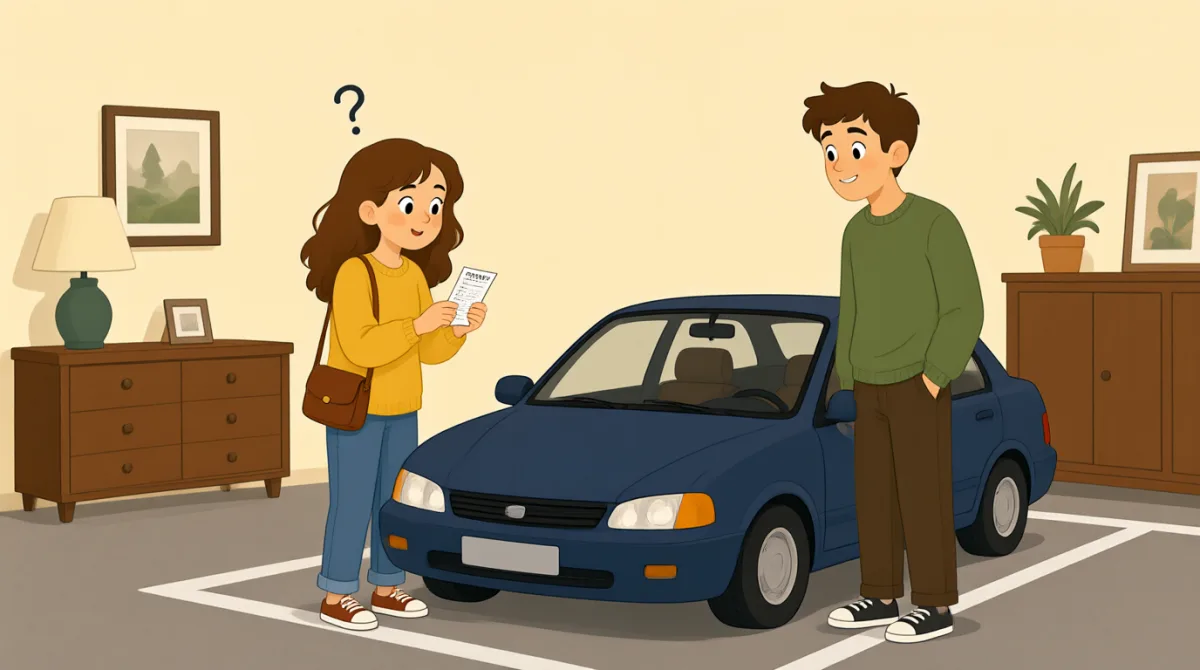

Jack, there’s a parking ticket on my car. Why did I get one?
Jack, an meinem Auto ist ein Strafzettel. Warum hab ich den bekommen?

Let’s take a look. Where did you park?
Schauen wir mal. Wo hast du geparkt?
On Pine Street, near the coffee shop. I parked there this morning.
In der Pine Street, in der Nähe vom Café. Ich hab heute Morgen dort geparkt.
The ticket says Pine Street, but let’s check the time.
Auf dem Strafzettel steht Pine Street, aber lass uns die Uhrzeit überprüfen.
It says 10:15 a.m. I thought parking was allowed there.
Da steht 10:15 Uhr. Ich dachte, dort durfte man parken.
It says your car was there during street cleaning hours.
Da steht, dass dein Auto während der Straßenreinigung dort stand.
Oh, I didn’t see that. Is there a date on the ticket?
Oh, das hab ich nicht gesehen. Steht auf dem Strafzettel ein Datum?
Yes, it was issued today. The time and place are both listed here.
Ja, er wurde heute ausgestellt. Uhrzeit und Ort stehen beide hier.
Wortschatz8
- parking ticketder Strafzettel
A parking ticket is a notice you get for parking against the rules. Here, Emma finds one on her car.
Ein Strafzettel ist eine Mitteilung, die man bekommt, wenn man falsch parkt. Hier findet Emma einen an ihrem Auto.
- take a lookeinen Blick darauf werfen
This means to look at something. You can say, “Let’s take a look” when you want to check something together.
Das bedeutet, sich etwas anzusehen. „Let’s take a look“ heißt „Schauen wir mal“ und passt, wenn ihr etwas gemeinsam überprüfen wollt.
- Where did you park?Where did you park?
This question asks about the place where someone left their car. You can use it to ask where someone parked.
Mit dieser Frage fragst du, wo jemand sein Auto abgestellt hat. Du kannst damit nach dem Ort fragen, an dem jemand geparkt hat.
- near the coffee shopin der Nähe des Cafés
This phrase describes a place that is close to the coffee shop. Use “near” to say that one place is close to another.
Diese Wendung beschreibt einen Ort, der nicht weit vom Café entfernt ist. Mit „near“ sagst du, dass sich ein Ort nahe bei einem anderen befindet.
- check the timedie Uhrzeit überprüfen
This means to look at what time something happened. You can use it when you want to confirm a time.
Das bedeutet, nachzusehen, um welche Uhrzeit etwas passiert ist. Du kannst die Wendung verwenden, wenn du eine Uhrzeit bestätigen möchtest.
- parking was allowedParken war erlaubt
This means it was okay to leave a car there. Use “was allowed” to talk about a past rule or permission.
Das bedeutet, dass es in Ordnung war, dort ein Auto abzustellen. Mit „was allowed“ sprichst du über eine frühere Regel oder Erlaubnis.
- street cleaning hoursZeiten der Straßenreinigung
These are the times when a street is cleaned, and parking may not be allowed. You might see these hours on a parking sign.
Das sind die Zeiten, in denen eine Straße gereinigt wird und Parken möglicherweise verboten ist. Diese Zeiten stehen oft auf einem Verkehrsschild.
- issued todayheute ausgestellt
This means the ticket was given or created today. Use “issued” to say when an official notice or document was given.
Das bedeutet, dass der Strafzettel heute ausgestellt oder ausgehändigt wurde. Mit „issued“ gibst du an, wann ein offizielles Dokument oder eine Mitteilung ausgestellt wurde.
Wichtige Sätze8
- 1
Why did I get one?
Warum hab ich den bekommen?
Use this question to ask why something happened to you. “One” refers to a parking ticket mentioned just before.
Mit dieser Frage fragst du, warum dir etwas passiert ist. „One“ bezieht sich hier auf einen Strafzettel, der gerade erwähnt wurde.
- 2
Where did you park?
Wo hast du geparkt?
This is a simple way to ask where someone left their car. Replace “park” with another verb to ask about a past action.
So fragst du ganz einfach, wo jemand sein Auto abgestellt hat. Du kannst „park“ durch ein anderes Verb ersetzen, um nach einer Handlung in der Vergangenheit zu fragen.
- 3
I parked there this morning.
Ich hab heute Morgen dort geparkt.
Use this sentence to say where and when you left your car. You can change “there” and “this morning” to give different details.
Mit diesem Satz sagst du, wo und wann du dein Auto abgestellt hast. Du kannst „there“ und „this morning“ ändern, um andere Einzelheiten zu nennen.
- 4
The ticket says Pine Street, but let’s check the time.
Auf dem Strafzettel steht Pine Street, aber lass uns die Uhrzeit überprüfen.
This sentence shares one detail and suggests checking another. Use “The [document] says…” to report information written on a document.
Dieser Satz nennt eine Information und schlägt vor, eine weitere zu überprüfen. Mit „The [document] says…“ gibst du Informationen wieder, die in einem Dokument stehen.
- 5
I thought parking was allowed there.
Ich dachte, dort durfte man parken.
Use this sentence to explain what you believed was okay. “I thought…” is useful for talking about a past belief that may have been wrong.
Mit diesem Satz erklärst du, was deiner Meinung nach in Ordnung war. „I thought…“ ist nützlich, wenn du von einer früheren Annahme sprichst, die sich als falsch herausstellen könnte.
- 6
Oh, I didn’t see that.
Oh, das hab ich nicht gesehen.
This is a natural way to say you did not notice something. You can use it when someone points out information you missed.
So sagst du auf natürliche Weise, dass du etwas nicht bemerkt hast. Du kannst den Satz verwenden, wenn dich jemand auf eine Information hinweist, die dir entgangen ist.
- 7
Is there a date on the ticket?
Steht auf dem Strafzettel ein Datum?
Use this question to ask whether a document shows a date. Replace “the ticket” with another document or item.
Mit dieser Frage erkundigst du dich, ob ein Dokument ein Datum enthält. Du kannst „the ticket“ durch ein anderes Dokument oder einen anderen Gegenstand ersetzen.
- 8
The time and place are both listed here.
Uhrzeit und Ort stehen beide hier.
This sentence explains that two details are written on the document. Use “both” to emphasize that two things are included.
Dieser Satz sagt, dass zwei Angaben auf dem Dokument stehen. Mit „both“ betonst du, dass beide Informationen enthalten sind.