Missing the Bus
Den Bus verpasst
Leo misses his bus to work and tells his friend Emma about the rough start to his day. Emma asks what happened.
Leo verpasst seinen Bus zur Arbeit und erzählt seiner Freundin Emma, dass sein Tag ziemlich schlecht angefangen hat. Emma fragt, was passiert ist.
Dialog8
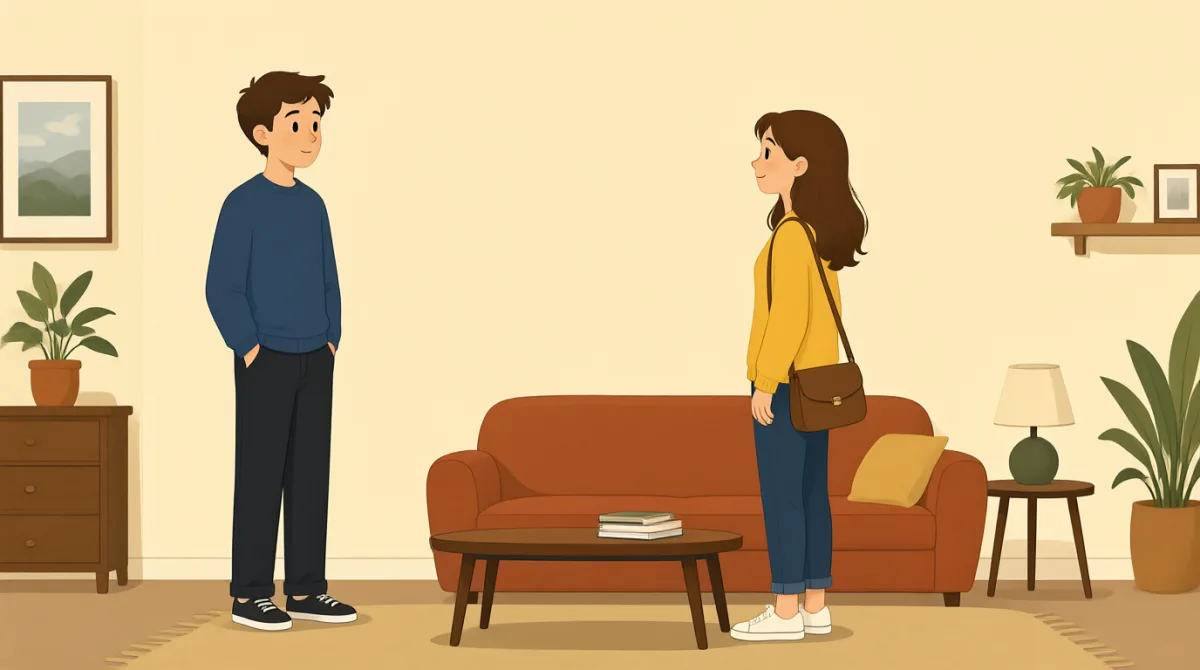

I had a terrible start to my day. I missed the bus to work.
Mein Tag hat echt schlecht angefangen. Ich hab den Bus zur Arbeit verpasst.

Oh no! What happened? Did you get up late?
Oh nein! Was ist passiert? Bist du spät aufgestanden?
No, I got up on time, but I couldn't find my keys.
Nein, ich bin rechtzeitig aufgestanden, aber ich konnte meine Schlüssel nicht finden.
That sounds frustrating. Where did you look?
Das klingt echt frustrierend. Wo hast du gesucht?
I looked in my bag and on the kitchen table. They were by the door.
Ich hab in meiner Tasche und auf dem Küchentisch gesucht. Sie lagen neben der Tür.
Oh, I hate when that happens. Did you catch the next bus?
Oh, ich hasse es, wenn das passiert. Hast du den nächsten Bus erwischt?
No, it had already left. I had to wait twenty minutes.
Nein, der war schon weg. Ich musste zwanzig Minuten warten.
I'm sorry, Leo. I hope the rest of your day goes better.
Tut mir leid, Leo. Ich hoffe, der Rest deines Tages läuft besser.
Wortschatz7
- terrible startein richtig schlechter Start
A very bad beginning to a day or event. You can say, “I had a terrible start to my morning.”
Ein sehr schlechter Anfang eines Tages oder Ereignisses. Du kannst sagen: “I had a terrible start to my morning.” (Mein Morgen hat richtig schlecht angefangen.)
- missed the busden Bus verpasst
You did not get on the bus because it left before you arrived. Use “missed the bus” to explain why you are late.
Du bist nicht in den Bus eingestiegen, weil er schon abgefahren war, bevor du angekommen bist. Mit “missed the bus” kannst du erklären, warum du zu spät bist.
- looked in my bagin meiner Tasche gesucht
Searched inside your bag for something. Use “looked in” when you search inside a place or container.
Du hast in deiner Tasche nach etwas gesucht. Verwende “looked in”, wenn du in einem Ort oder Behälter nach etwas suchst.
- by the doorneben der Tür
Next to or near the door. You can use “by” to say where something is, as in “My shoes are by the door.”
Direkt neben der Tür oder in ihrer Nähe. Mit “by” kannst du angeben, wo sich etwas befindet, zum Beispiel: “My shoes are by the door.” (Meine Schuhe stehen neben der Tür.)
- catch the next busden nächsten Bus erwischen
Get on the next bus that comes. You can ask, “Can we catch the next bus?”
In den nächsten Bus einsteigen, der kommt. Du kannst fragen: “Can we catch the next bus?” (Können wir den nächsten Bus nehmen?)
- had to waitwarten müssen
Needed to stay somewhere until something happened. Use “had to” to talk about something necessary in the past.
Irgendwo bleiben müssen, bis etwas passiert. Mit “had to” sprichst du über etwas, das in der Vergangenheit notwendig war.
- the rest of your dayder Rest deines Tages
The part of the day that is still left. You can wish someone, “I hope the rest of your day goes well.”
Der Teil des Tages, der noch vor dir liegt. Du kannst jemandem wünschen: “I hope the rest of your day goes well.” (Ich hoffe, der Rest deines Tages läuft gut.)
Wichtige Sätze8
- 1
I had a terrible start to my day.
Mein Tag hat richtig schlecht angefangen.
Use this to say that your day began badly. You can replace “terrible” with “good” or “busy” to describe a different start.
Mit diesem Satz sagst du, dass dein Tag schlecht begonnen hat. Du kannst “terrible” durch “good” oder “busy” ersetzen, um einen anderen Start zu beschreiben.
- 2
I missed the bus to work.
Ich hab den Bus zur Arbeit verpasst.
This is a simple way to explain that you did not get on your bus. Replace “the bus” with another thing you missed, such as “my train.”
So kannst du einfach erklären, dass du nicht in deinen Bus eingestiegen bist. Ersetze “the bus” durch etwas anderes, das du verpasst hast, zum Beispiel “my train”.
- 3
Did you get up late?
Bist du spät aufgestanden?
Use this question to ask if someone woke up later than planned. You can ask, “Did you get up late for school?”
Mit dieser Frage möchtest du wissen, ob jemand später als geplant aufgewacht ist. Du kannst fragen: “Did you get up late for school?” (Bist du zu spät für die Schule aufgestanden?)
- 4
I couldn't find my keys.
Ich konnte meine Schlüssel nicht finden.
Use this to explain that you searched for something but did not find it. Replace “my keys” with another item, such as “my phone.”
Mit diesem Satz erklärst du, dass du etwas gesucht, aber nicht gefunden hast. Ersetze “my keys” durch einen anderen Gegenstand, zum Beispiel “my phone”.
- 5
Where did you look?
Wo hast du gesucht?
This question asks where someone searched for something. You can use it when helping someone find a lost item.
Mit dieser Frage möchtest du wissen, wo jemand nach etwas gesucht hat. Du kannst sie stellen, wenn du jemandem hilfst, einen verlorenen Gegenstand zu finden.
- 6
They were by the door.
Sie lagen neben der Tür.
Use this to say where plural items were. For one item, say, “It was by the door.”
Mit diesem Satz sagst du, wo sich mehrere Gegenstände befanden. Bei einem Gegenstand sagst du: “It was by the door.”
- 7
I had to wait twenty minutes.
Ich musste zwanzig Minuten warten.
This tells someone how long you needed to wait. Replace “twenty minutes” with another length of time.
Damit sagst du jemandem, wie lange du warten musstest. Ersetze “twenty minutes” durch eine andere Zeitspanne.
- 8
I hope the rest of your day goes better.
Ich hoffe, der Rest deines Tages läuft besser.
This is a kind way to wish someone a better day after something went wrong. You can also say, “I hope your week goes better.”
Das ist eine nette Art, jemandem einen besseren Tag zu wünschen, nachdem etwas schiefgelaufen ist. Du kannst auch sagen: “I hope your week goes better.” (Ich hoffe, deine Woche läuft besser.)