Knocking on the Door
Klopfen an der Tür
Emma visits her neighbor Jack to ask for a little help. Jack answers the door and asks what she needs.
Emma besucht ihren Nachbarn Jack, um ihn um eine kleine Hilfe zu bitten. Jack öffnet die Tür und fragt, was sie braucht.
Dialog8
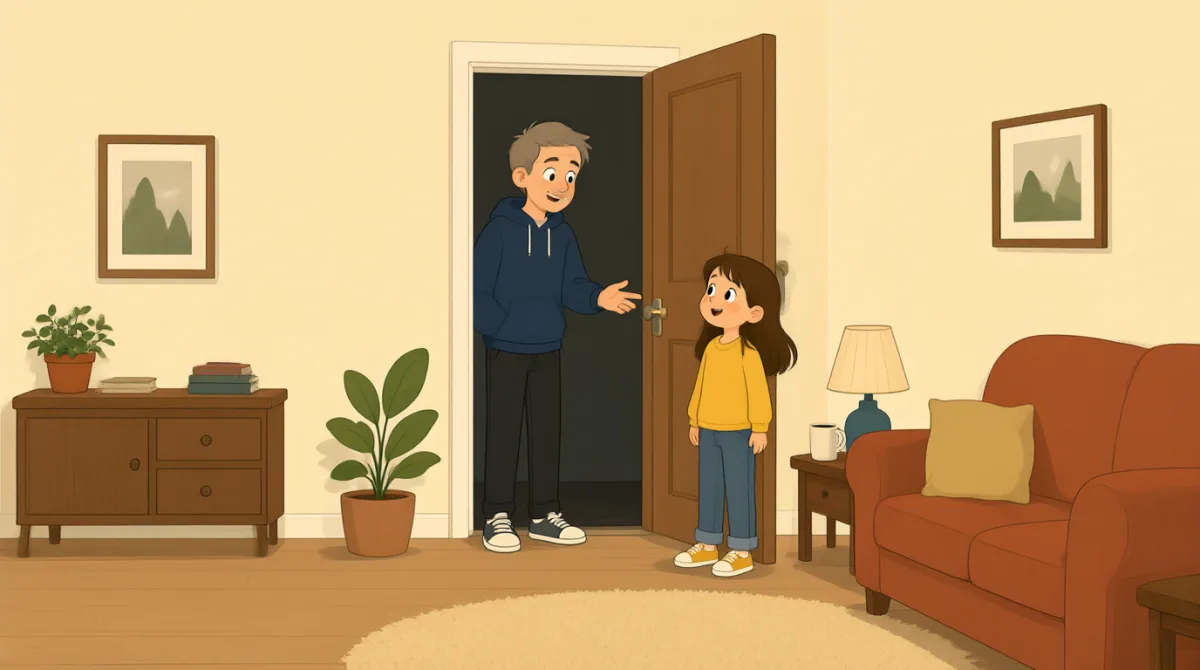

Hi, Jack. Sorry to bother you. Do you have a minute?
Hi, Jack. Entschuldige die Störung. Hast du kurz Zeit?

Hi, Emma. Sure. What do you need?
Hi, Emma. Klar. Was brauchst du?
I need a little help with something in my yard.
Ich brauche ein bisschen Hilfe bei etwas in meinem Garten.
Okay. What are you trying to do?
Okay. Was hast du vor?
I want to hang something up, but I need a ladder.
Ich möchte etwas aufhängen, aber dafür brauche ich eine Leiter.
Sure. What are you going to hang?
Klar. Was möchtest du aufhängen?
A small birdhouse. I bought it last week.
Ein kleines Vogelhaus. Ich habe es letzte Woche gekauft.
That sounds nice. The ladder is in my garage. Give me a minute.
Das klingt schön. Die Leiter steht in meiner Garage. Gib mir eine Minute.
Wortschatz7
- Sorry to bother you.Entschuldige die Störung.
This is a polite way to start a request when you think you may interrupt someone. You can also say it before asking a neighbor or coworker for help.
Das ist eine höfliche Art, eine Bitte einzuleiten, wenn du glaubst, jemanden vielleicht zu unterbrechen. Du kannst das auch sagen, bevor du einen Nachbarn oder Kollegen um Hilfe bittest.
- Do you have a minute?Hast du kurz Zeit?
This asks if someone has a little time to talk. Use it before making a request or asking a question.
Damit fragst du, ob jemand kurz Zeit zum Reden hat. Verwende die Frage, bevor du um etwas bittest oder eine Frage stellst.
- a little helpein bisschen Hilfe
This means some help, but not a lot. You can say, “I need a little help with my homework.”
Das bedeutet, dass du etwas Hilfe brauchst, aber nicht sehr viel. Du kannst zum Beispiel sagen: „I need a little help with my homework.“
- What are you trying to do?Was hast du vor?
This asks about someone’s goal or activity. Use it when you want to understand what a person is working on.
Damit fragst du nach dem Ziel oder der Tätigkeit einer Person. Verwende die Frage, wenn du verstehen möchtest, woran jemand gerade arbeitet.
- hang something upetwas aufhängen
This means to put something on a wall or another high place. You can hang up a picture, a coat, or a birdhouse.
Das bedeutet, etwas an eine Wand oder an einen anderen höher gelegenen Ort zu hängen. Du kannst zum Beispiel ein Bild, einen Mantel oder ein Vogelhaus aufhängen.
- last weekletzte Woche
This means the week before this one. Use it to talk about something that happened in the recent past.
Das bedeutet die Woche vor dieser Woche. Verwende den Ausdruck, um von etwas zu erzählen, das in der jüngeren Vergangenheit passiert ist.
- Give me a minute.Gib mir eine Minute.
This asks someone to wait for a short time. You can say it when you need to get something before helping.
Damit bittest du jemanden, kurz zu warten. Du kannst das sagen, wenn du erst noch etwas holen musst, bevor du helfen kannst.
Wichtige Sätze7
- 1
Sorry to bother you.
Entschuldige die Störung.
This is a polite way to begin when asking someone for help or interrupting them. You can use it with neighbors, coworkers, or other people you know.
Das ist eine höfliche Art, ein Gespräch zu beginnen, wenn du jemanden um Hilfe bittest oder unterbrichst. Du kannst das zu Nachbarn, Kollegen oder anderen Leuten sagen, die du kennst.
- 2
Do you have a minute?
Hast du kurz Zeit?
This is a friendly way to check if someone is free to talk. You can use it before making a request.
Das ist eine freundliche Art zu fragen, ob jemand gerade Zeit zum Reden hat. Du kannst die Frage stellen, bevor du um etwas bittest.
- 3
I need a little help with something in my yard.
Ich brauche ein bisschen Hilfe bei etwas in meinem Garten.
This sentence explains that you need some help and says where the task is. Replace “my yard” with another place, such as “my kitchen” or “my car.”
Mit diesem Satz sagst du, dass du Hilfe brauchst und wo die Aufgabe erledigt werden muss. Ersetze „my yard“ durch einen anderen Ort, zum Beispiel „my kitchen“ oder „my car“.
- 4
What are you trying to do?
Was hast du vor?
This is a useful question when you want to understand someone’s plan or problem. You can use it when a person is doing a task.
Diese Frage ist hilfreich, wenn du den Plan oder das Problem einer Person verstehen möchtest. Du kannst sie stellen, wenn jemand gerade eine Aufgabe erledigt.
- 5
I want to hang something up, but I need a ladder.
Ich möchte etwas aufhängen, aber dafür brauche ich eine Leiter.
This sentence explains what you want to do and what you need for it. Use “I want to..., but I need...” to describe a goal and a problem.
Mit diesem Satz erklärst du, was du tun möchtest und was du dafür brauchst. Verwende „I want to..., but I need...“, um ein Ziel und ein Problem zu beschreiben.
- 6
I bought it last week.
Ich habe es letzte Woche gekauft.
This is a simple way to say when you bought something. Replace “it” with the item if the listener does not know what you mean.
So kannst du einfach sagen, wann du etwas gekauft hast. Ersetze „it“ durch den Gegenstand, wenn dein Gegenüber nicht weiß, was du meinst.
- 7
Give me a minute.
Gib mir eine Minute.
This is a natural way to ask someone to wait briefly. You can use it when you need time to find or prepare something.
Das ist eine natürliche Art, jemanden zu bitten, kurz zu warten. Du kannst es sagen, wenn du etwas Zeit brauchst, um etwas zu suchen oder vorzubereiten.