Knocking on the Door
Emma visits her neighbor Jack to ask for a little help. Jack answers the door and asks what she needs.
Dialogue8
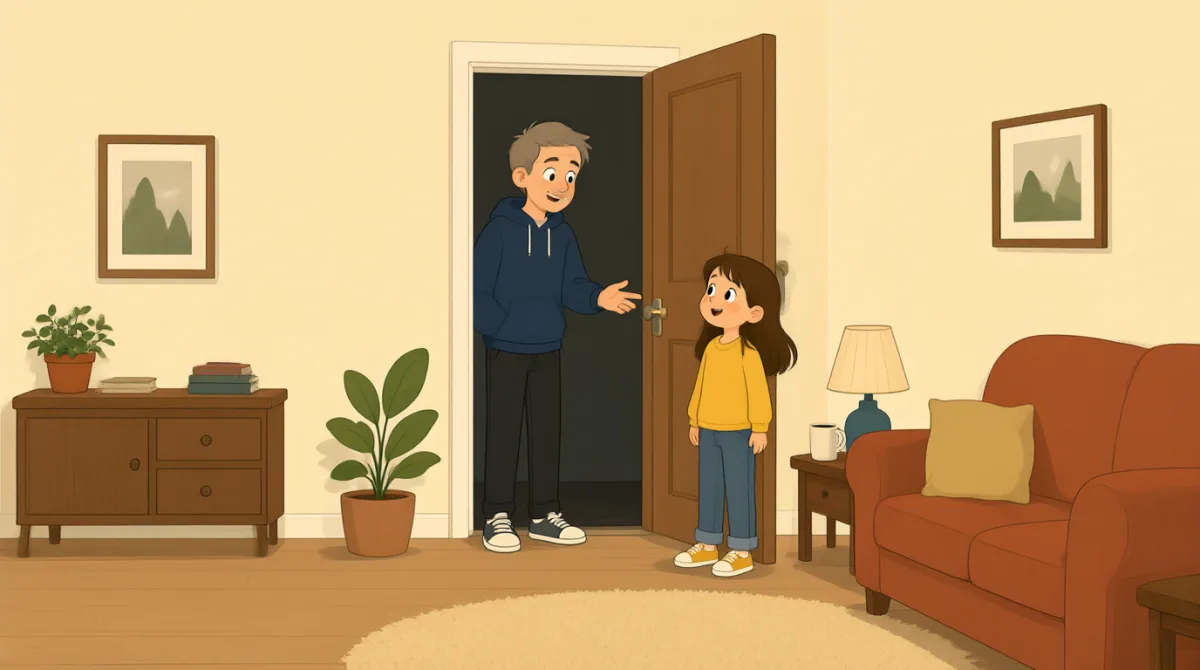

Hi, Jack. Sorry to bother you. Do you have a minute?

Hi, Emma. Sure. What do you need?
I need a little help with something in my yard.
Okay. What are you trying to do?
I want to hang something up, but I need a ladder.
Sure. What are you going to hang?
A small birdhouse. I bought it last week.
That sounds nice. The ladder is in my garage. Give me a minute.
Vocabulary7
- Sorry to bother you.
This is a polite way to start a request when you think you may interrupt someone. You can also say it before asking a neighbor or coworker for help.
- Do you have a minute?
This asks if someone has a little time to talk. Use it before making a request or asking a question.
- a little help
This means some help, but not a lot. You can say, “I need a little help with my homework.”
- What are you trying to do?
This asks about someone’s goal or activity. Use it when you want to understand what a person is working on.
- hang something up
This means to put something on a wall or another high place. You can hang up a picture, a coat, or a birdhouse.
- last week
This means the week before this one. Use it to talk about something that happened in the recent past.
- Give me a minute.
This asks someone to wait for a short time. You can say it when you need to get something before helping.
Key Sentences7
- 1
Sorry to bother you.
This is a polite way to begin when asking someone for help or interrupting them. You can use it with neighbors, coworkers, or other people you know.
- 2
Do you have a minute?
This is a friendly way to check if someone is free to talk. You can use it before making a request.
- 3
I need a little help with something in my yard.
This sentence explains that you need some help and says where the task is. Replace “my yard” with another place, such as “my kitchen” or “my car.”
- 4
What are you trying to do?
This is a useful question when you want to understand someone’s plan or problem. You can use it when a person is doing a task.
- 5
I want to hang something up, but I need a ladder.
This sentence explains what you want to do and what you need for it. Use “I want to..., but I need...” to describe a goal and a problem.
- 6
I bought it last week.
This is a simple way to say when you bought something. Replace “it” with the item if the listener does not know what you mean.
- 7
Give me a minute.
This is a natural way to ask someone to wait briefly. You can use it when you need time to find or prepare something.