Knocking on the Door
Llaman a la puerta
Emma visits her neighbor Jack to ask for a little help. Jack answers the door and asks what she needs.
Emma visita a su vecino Jack para pedirle un poco de ayuda. Jack abre la puerta y le pregunta qué necesita.
Diálogo8
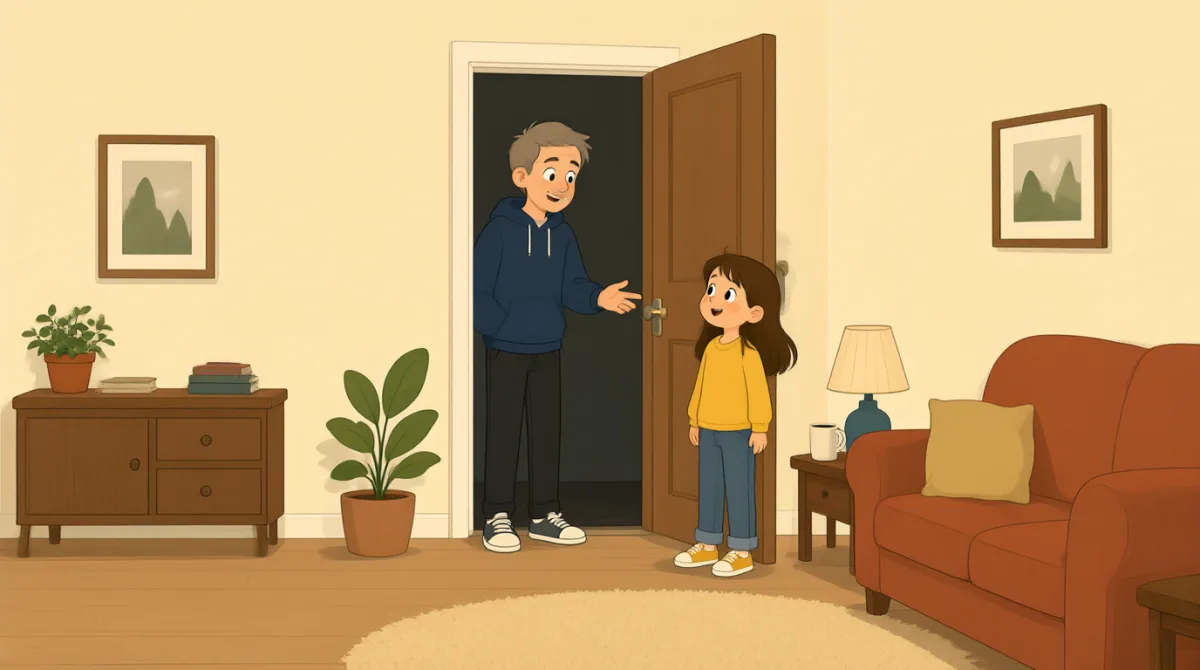

Hi, Jack. Sorry to bother you. Do you have a minute?
Hola, Jack. Perdona que te moleste. ¿Tienes un minuto?

Hi, Emma. Sure. What do you need?
Hola, Emma. Claro. ¿Qué necesitas?
I need a little help with something in my yard.
Necesito un poco de ayuda con algo en mi patio.
Okay. What are you trying to do?
Vale. ¿Qué estás intentando hacer?
I want to hang something up, but I need a ladder.
Quiero colgar algo, pero necesito una escalera.
Sure. What are you going to hang?
Claro. ¿Qué vas a colgar?
A small birdhouse. I bought it last week.
Una casita para pájaros pequeña. La compré la semana pasada.
That sounds nice. The ladder is in my garage. Give me a minute.
Qué bien. La escalera está en mi garaje. Dame un minuto.
Vocabulario7
- Sorry to bother you.Perdona que te moleste.
This is a polite way to start a request when you think you may interrupt someone. You can also say it before asking a neighbor or coworker for help.
Es una forma educada de empezar una petición cuando crees que podrías interrumpir a alguien. También puedes decirlo antes de pedirle ayuda a un vecino o a un compañero de trabajo.
- Do you have a minute?¿Tienes un minuto?
This asks if someone has a little time to talk. Use it before making a request or asking a question.
Con esta pregunta, consultas si alguien tiene un ratito para hablar. Úsala antes de hacer una petición o una pregunta.
- a little helpun poco de ayuda
This means some help, but not a lot. You can say, “I need a little help with my homework.”
Significa algo de ayuda, pero no mucha. Puedes decir: “I need a little help with my homework.” (Necesito un poco de ayuda con los deberes.)
- What are you trying to do?¿Qué estás intentando hacer?
This asks about someone’s goal or activity. Use it when you want to understand what a person is working on.
Con esta pregunta, preguntas cuál es el objetivo o la actividad de alguien. Úsala cuando quieras entender en qué está trabajando una persona.
- hang something upcolgar algo
This means to put something on a wall or another high place. You can hang up a picture, a coat, or a birdhouse.
Significa poner algo en una pared o en otro lugar elevado. Puedes colgar un cuadro, un abrigo o una casita para pájaros.
- last weekla semana pasada
This means the week before this one. Use it to talk about something that happened in the recent past.
Se refiere a la semana anterior a esta. Úsalo para hablar de algo que ocurrió hace poco.
- Give me a minute.Dame un minuto.
This asks someone to wait for a short time. You can say it when you need to get something before helping.
Es una forma de pedirle a alguien que espere un ratito. Puedes decirlo cuando necesitas ir a buscar algo antes de ayudar.
Frases clave7
- 1
Sorry to bother you.
Perdona que te moleste.
This is a polite way to begin when asking someone for help or interrupting them. You can use it with neighbors, coworkers, or other people you know.
Es una forma educada de empezar cuando le pides ayuda a alguien o lo interrumpes. Puedes usarla con vecinos, compañeros de trabajo u otras personas que conozcas.
- 2
Do you have a minute?
¿Tienes un minuto?
This is a friendly way to check if someone is free to talk. You can use it before making a request.
Es una forma amable de preguntar si alguien tiene tiempo para hablar. Puedes usarla antes de hacer una petición.
- 3
I need a little help with something in my yard.
Necesito un poco de ayuda con algo en mi patio.
This sentence explains that you need some help and says where the task is. Replace “my yard” with another place, such as “my kitchen” or “my car.”
Esta frase explica que necesitas algo de ayuda e indica dónde hay que hacer la tarea. Puedes sustituir “my yard” por otro lugar, como “my kitchen” o “my car”.
- 4
What are you trying to do?
¿Qué estás intentando hacer?
This is a useful question when you want to understand someone’s plan or problem. You can use it when a person is doing a task.
Es una pregunta útil cuando quieres entender el plan o el problema de alguien. Puedes usarla cuando una persona está haciendo una tarea.
- 5
I want to hang something up, but I need a ladder.
Quiero colgar algo, pero necesito una escalera.
This sentence explains what you want to do and what you need for it. Use “I want to..., but I need...” to describe a goal and a problem.
Esta frase explica qué quieres hacer y qué necesitas para hacerlo. Usa “I want to..., but I need...” para describir un objetivo y un problema.
- 6
I bought it last week.
La compré la semana pasada.
This is a simple way to say when you bought something. Replace “it” with the item if the listener does not know what you mean.
Es una forma sencilla de decir cuándo compraste algo. Sustituye “it” por el nombre del objeto si la otra persona no sabe a qué te refieres.
- 7
Give me a minute.
Dame un minuto.
This is a natural way to ask someone to wait briefly. You can use it when you need time to find or prepare something.
Es una forma natural de pedirle a alguien que espere un momento. Puedes usarla cuando necesitas tiempo para encontrar o preparar algo.