Getting the Key and a Tour
Entrega da chave e visita
Jack meets Emma at the rental, hands over the key, and shows her around. Emma asks where to find a few useful things before settling in.
Jack encontra Emma no alojamento, entrega a chave e mostra o espaço. Antes de se instalar, Emma pergunta onde pode encontrar algumas coisas úteis.
Diálogo9
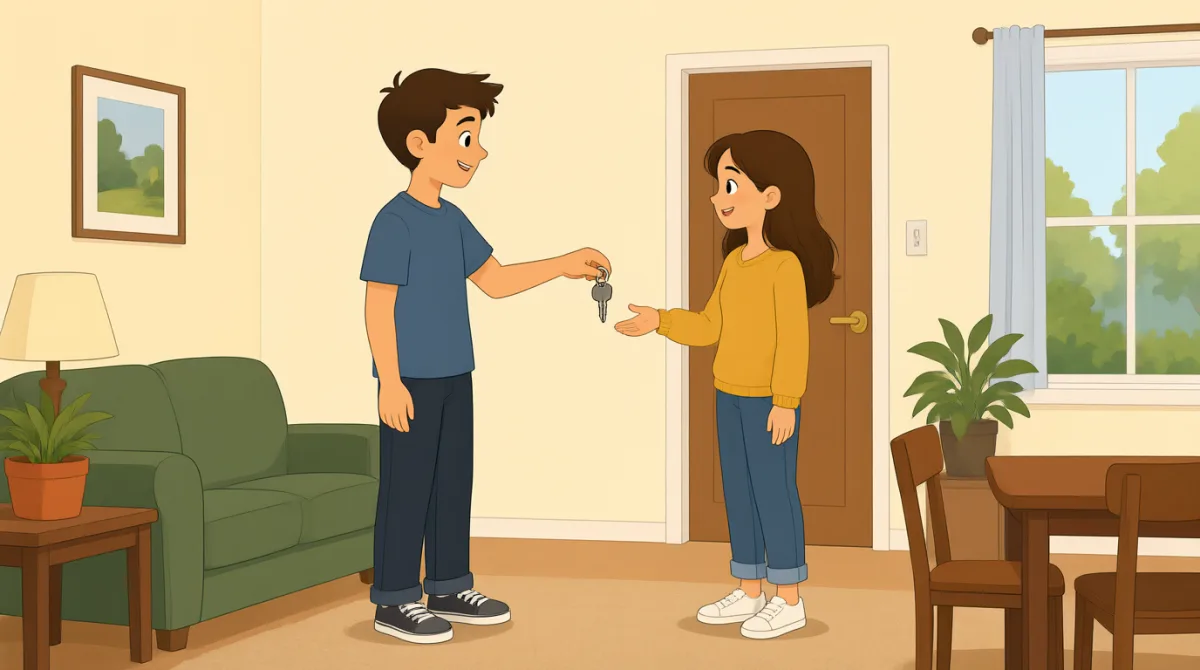

Hi, Emma! You made it. Here’s the key. Let me show you around before you get settled.
Oi, Emma! Que bom que você chegou. Aqui está a chave. Deixa eu te mostrar o lugar antes de você se instalar.

Thanks! The place looks lovely. Where should I leave my shoes, and is it okay to open the windows?
Obrigada! O lugar é uma graça. Onde devo deixar os sapatos? E tudo bem abrir as janelas?
You can leave your shoes by the front door. And sure, open the windows—just remember to close them if it rains.
Você pode deixar os sapatos perto da porta de entrada. E claro, pode abrir as janelas — só não se esqueça de fechá-las se chover.
Got it. Could you show me where the towels are? I’d also like to find the extra blankets before tonight.
Entendi. Você pode me mostrar onde ficam as toalhas? Também queria encontrar os cobertores extras antes de hoje à noite.
The towels are in the bathroom cabinet, and the extra blankets are in the bedroom closet on the top shelf.
As toalhas ficam no armário do banheiro, e os cobertores extras estão no armário do quarto, na prateleira de cima.
Perfect. And how does the coffee maker work? I’m hoping to have a cup before I head out tomorrow.
Perfeito. E como funciona a cafeteira? Espero tomar uma xícara antes de sair amanhã.
Just add water here and a scoop of coffee in the filter. I’ve left a few packets on the counter to get you started.
É só colocar água aqui e uma colher de café no filtro. Deixei alguns sachês na bancada para você começar.
That’s really helpful, thanks. One last thing—where can I find a flashlight in case I need it at night?
Que bom, obrigada. Só mais uma coisa: onde posso encontrar uma lanterna, caso precise dela à noite?
There’s one in the kitchen drawer by the fridge. If anything else comes up, just message me and I’ll be happy to help.
Tem uma na gaveta da cozinha, perto da geladeira. Se surgir qualquer outra coisa, é só me mandar uma mensagem que vou ficar feliz em ajudar.
Vocabulário7
- You made it.You made it. (Que bom que você chegou.)
This is a friendly way to say someone has arrived. You can use it to welcome a guest or friend.
Essa é uma maneira simpática de dizer que alguém chegou. Você pode usá-la para dar boas-vindas a uma visita ou a um amigo.
- show you aroundshow you around (mostrar o lugar)
To show someone the different rooms or areas of a place. It is useful when welcoming someone to a home, hotel, or workplace.
Significa mostrar a alguém os diferentes cômodos ou áreas de um lugar. É útil ao receber alguém em casa, em um hotel ou no trabalho.
- get settledget settled (se instalar)
To unpack and become comfortable in a new place. You can use it when talking about arriving at a rental or moving into a new home.
Significa desfazer as malas e começar a se sentir à vontade em um lugar novo. Você pode usar essa expressão ao chegar a um alojamento de temporada ou se mudar para uma casa nova.
- by the front doorby the front door (perto da porta de entrada)
This means next to or near the main entrance. Use “by” to describe where something is located.
Significa ao lado ou perto da entrada principal. Use “by” para dizer onde algo está.
- get you startedget you started (para você começar)
This means to provide what someone needs at the beginning. You can use it when offering a small amount of help or supplies.
Significa fornecer o que alguém precisa no início. Você pode usar essa expressão ao oferecer uma pequena ajuda ou alguns suprimentos.
- in case I need itin case I need it (caso eu precise)
This means for a possible situation when something might be needed. Use “in case” to explain why you are preparing for something.
Significa para uma situação possível em que algo talvez seja necessário. Use “in case” para explicar por que você está se preparando para alguma coisa.
- comes upcomes up (surge)
In this context, something that “comes up” is an unexpected question or problem. You can use this phrase when offering help if a need arises.
Nesse contexto, algo que “comes up” é uma pergunta ou um problema inesperado. Você pode usar essa expressão ao se oferecer para ajudar caso surja alguma necessidade.
Frases-chave6
- 1
Let me show you around before you get settled.
Deixa eu te mostrar o lugar antes de você se instalar.
This is a welcoming way to offer someone a tour before they unpack or relax. You can reuse “Let me show you around” when introducing someone to a new place.
Essa é uma maneira acolhedora de oferecer uma visita pelo lugar antes de a pessoa desfazer as malas ou relaxar. Você pode reutilizar “Let me show you around” (Deixa eu te mostrar o lugar) ao apresentar alguém a um lugar novo.
- 2
Where should I leave my shoes, and is it okay to open the windows?
Onde devo deixar os sapatos? E tudo bem abrir as janelas?
This politely asks about two practical house rules. You can replace “leave my shoes” or “open the windows” with other actions you want permission or guidance for.
Essa frase pergunta com educação sobre duas regras práticas da casa. Você pode substituir “leave my shoes” ou “open the windows” por outras ações sobre as quais queira pedir permissão ou orientação.
- 3
Could you show me where the towels are?
Você pode me mostrar onde ficam as toalhas?
This is a polite way to ask where something is. Reuse “Could you show me where the ___ is/are?” to ask about items in a home or other place.
Essa é uma maneira educada de perguntar onde está alguma coisa. Reutilize “Could you show me where the ___ is/are?” para perguntar sobre objetos em casa ou em outro lugar.
- 4
I’d also like to find the extra blankets before tonight.
Também queria encontrar os cobertores extras antes de hoje à noite.
This explains what you want to locate and when you will need it. You can use “I’d also like to find…” to add another request.
Essa frase explica o que você quer encontrar e quando vai precisar. Você pode usar “I’d also like to find…” para acrescentar outro pedido.
- 5
I’m hoping to have a cup before I head out tomorrow.
Espero tomar uma xícara antes de sair amanhã.
This naturally explains a plan using “I’m hoping to” and “head out,” which means leave. You can change the activity and time to describe your own plans.
Essa é uma forma natural de explicar um plano usando “I’m hoping to” e “head out”, que significa sair. Você pode mudar a atividade e o horário para falar dos seus próprios planos.
- 6
If anything else comes up, just message me and I’ll be happy to help.
Se surgir qualquer outra coisa, é só me mandar uma mensagem que vou ficar feliz em ajudar.
This offers help in a friendly, reassuring way. You can reuse “If anything else comes up” when inviting someone to contact you with further questions.
Essa frase se oferece para ajudar de forma simpática e tranquilizadora. Você pode reutilizar “If anything else comes up” ao convidar alguém a entrar em contato se tiver outras dúvidas.