Getting the Key and a Tour
Recibir la llave y conocer el alojamiento
Jack meets Emma at the rental, hands over the key, and shows her around. Emma asks where to find a few useful things before settling in.
Jack recibe a Emma en el alojamiento, le entrega la llave y le muestra la casa. Antes de instalarse, Emma pregunta dónde puede encontrar algunas cosas útiles.
Diálogo9
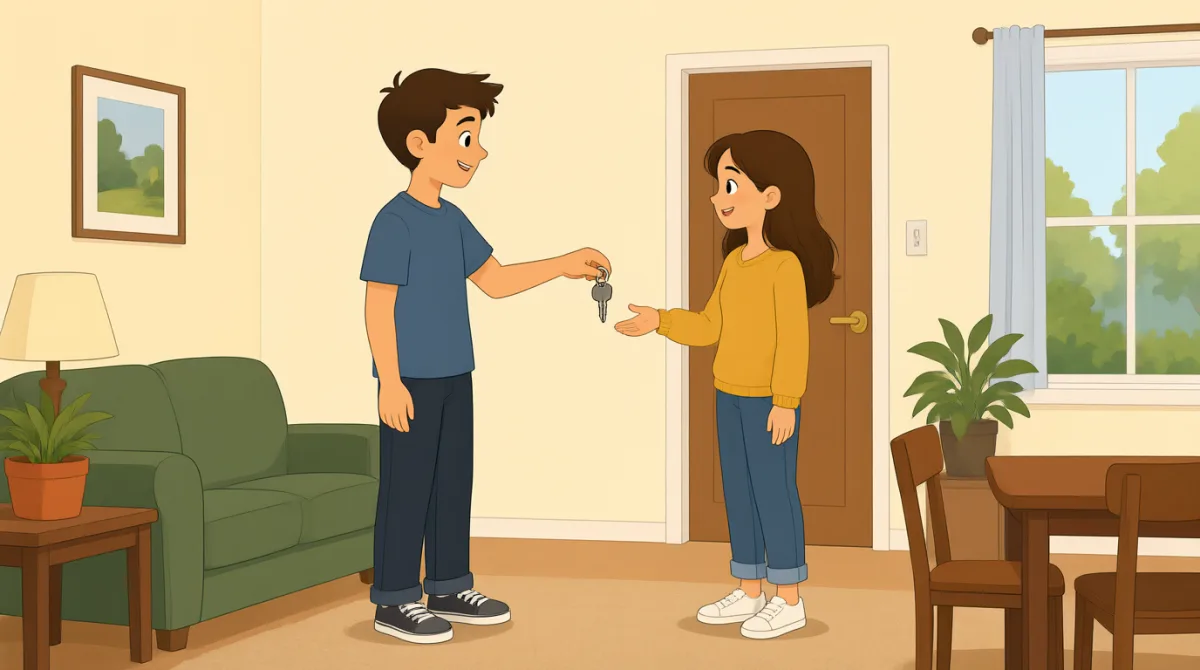

Hi, Emma! You made it. Here’s the key. Let me show you around before you get settled.
¡Hola, Emma! Ya llegaste. Aquí tienes la llave. Déjame mostrarte la casa antes de que te instales.

Thanks! The place looks lovely. Where should I leave my shoes, and is it okay to open the windows?
¡Gracias! El lugar es precioso. ¿Dónde dejo los zapatos? ¿Y puedo abrir las ventanas?
You can leave your shoes by the front door. And sure, open the windows—just remember to close them if it rains.
Puedes dejar los zapatos junto a la puerta principal. Y claro, abre las ventanas; solo acuérdate de cerrarlas si llueve.
Got it. Could you show me where the towels are? I’d also like to find the extra blankets before tonight.
Entendido. ¿Me puedes mostrar dónde están las toallas? También quisiera encontrar las mantas extra antes de esta noche.
The towels are in the bathroom cabinet, and the extra blankets are in the bedroom closet on the top shelf.
Las toallas están en el armario del baño y las mantas extra, en el clóset del dormitorio, en el estante de arriba.
Perfect. And how does the coffee maker work? I’m hoping to have a cup before I head out tomorrow.
Perfecto. ¿Y cómo funciona la cafetera? Espero poder tomarme una taza antes de salir mañana.
Just add water here and a scoop of coffee in the filter. I’ve left a few packets on the counter to get you started.
Solo pon agua aquí y una cucharada de café en el filtro. Te dejé unos cuantos sobres en la encimera para que tengas para empezar.
That’s really helpful, thanks. One last thing—where can I find a flashlight in case I need it at night?
Qué útil, gracias. Una última cosa: ¿dónde puedo encontrar una linterna por si la necesito de noche?
There’s one in the kitchen drawer by the fridge. If anything else comes up, just message me and I’ll be happy to help.
Hay una en el cajón de la cocina, junto al refrigerador. Si surge cualquier otra cosa, mándame un mensaje y con gusto te ayudo.
Vocabulario7
- You made it.Ya llegaste.
This is a friendly way to say someone has arrived. You can use it to welcome a guest or friend.
Es una forma amistosa de decir que alguien ha llegado. Puedes usarla para recibir a un huésped o a un amigo.
- show you aroundmostrarte la casa
To show someone the different rooms or areas of a place. It is useful when welcoming someone to a home, hotel, or workplace.
Consiste en enseñarle a alguien las distintas habitaciones o zonas de un lugar. Es útil para recibir a alguien en una casa, un hotel o un lugar de trabajo.
- get settledinstalarse
To unpack and become comfortable in a new place. You can use it when talking about arriving at a rental or moving into a new home.
Significa desempacar y empezar a sentirse cómodo en un lugar nuevo. Puedes usarlo al hablar de llegar a un alojamiento o mudarse a una casa nueva.
- by the front doorjunto a la puerta principal
This means next to or near the main entrance. Use “by” to describe where something is located.
Significa al lado o cerca de la entrada principal. Usa “by” para indicar dónde está algo.
- get you startedpara que tengas para empezar
This means to provide what someone needs at the beginning. You can use it when offering a small amount of help or supplies.
Significa darle a alguien lo que necesita al principio. Puedes usar esta expresión cuando ofreces un poco de ayuda o algunos suministros.
- in case I need itpor si lo necesito
This means for a possible situation when something might be needed. Use “in case” to explain why you are preparing for something.
Se refiere a una posible situación en la que algo podría hacer falta. Usa “in case” para explicar por qué te estás preparando para algo.
- comes upsurge
In this context, something that “comes up” is an unexpected question or problem. You can use this phrase when offering help if a need arises.
En este contexto, algo que “comes up” es una pregunta o un problema inesperado. Puedes usar esta expresión al ofrecer ayuda por si surge alguna necesidad.
Frases clave6
- 1
Let me show you around before you get settled.
Déjame mostrarte la casa antes de que te instales.
This is a welcoming way to offer someone a tour before they unpack or relax. You can reuse “Let me show you around” when introducing someone to a new place.
Es una forma acogedora de ofrecerle a alguien un recorrido antes de que desempaca o se relaje. Puedes volver a usar “Let me show you around” para presentar un lugar nuevo a alguien.
- 2
Where should I leave my shoes, and is it okay to open the windows?
¿Dónde dejo los zapatos? ¿Y puedo abrir las ventanas?
This politely asks about two practical house rules. You can replace “leave my shoes” or “open the windows” with other actions you want permission or guidance for.
Esta frase pregunta amablemente por dos normas prácticas de la casa. Puedes sustituir “leave my shoes” o “open the windows” por otras acciones sobre las que quieras pedir permiso o indicaciones.
- 3
Could you show me where the towels are?
¿Me puedes mostrar dónde están las toallas?
This is a polite way to ask where something is. Reuse “Could you show me where the ___ is/are?” to ask about items in a home or other place.
Es una forma amable de preguntar dónde está algo. Puedes reutilizar “Could you show me where the ___ is/are?” para preguntar por cosas en una casa o en otro lugar.
- 4
I’d also like to find the extra blankets before tonight.
También quisiera encontrar las mantas extra antes de esta noche.
This explains what you want to locate and when you will need it. You can use “I’d also like to find…” to add another request.
Esta frase explica qué quieres encontrar y cuándo lo necesitarás. Puedes usar “I’d also like to find…” para añadir otra petición.
- 5
I’m hoping to have a cup before I head out tomorrow.
Espero poder tomarme una taza antes de salir mañana.
This naturally explains a plan using “I’m hoping to” and “head out,” which means leave. You can change the activity and time to describe your own plans.
Es una forma natural de explicar un plan con “I’m hoping to” y “head out”, que significa salir. Puedes cambiar la actividad y el momento para describir tus propios planes.
- 6
If anything else comes up, just message me and I’ll be happy to help.
Si surge cualquier otra cosa, mándame un mensaje y con gusto te ayudo.
This offers help in a friendly, reassuring way. You can reuse “If anything else comes up” when inviting someone to contact you with further questions.
Esta frase ofrece ayuda de una forma amable y tranquilizadora. Puedes volver a usar “If anything else comes up” para invitar a alguien a ponerse en contacto contigo si tiene más preguntas.