The Child Won't Sleep
A criança não quer dormir
At bedtime, the child says they are not tired and asks Emma to stay. Emma reads a short story and comforts them as they get ready to sleep.
Na hora de dormir, a criança diz que não está com sono e pede para Emma ficar. Emma lê uma história curta e a conforta enquanto ela se prepara para dormir.
Diálogo8
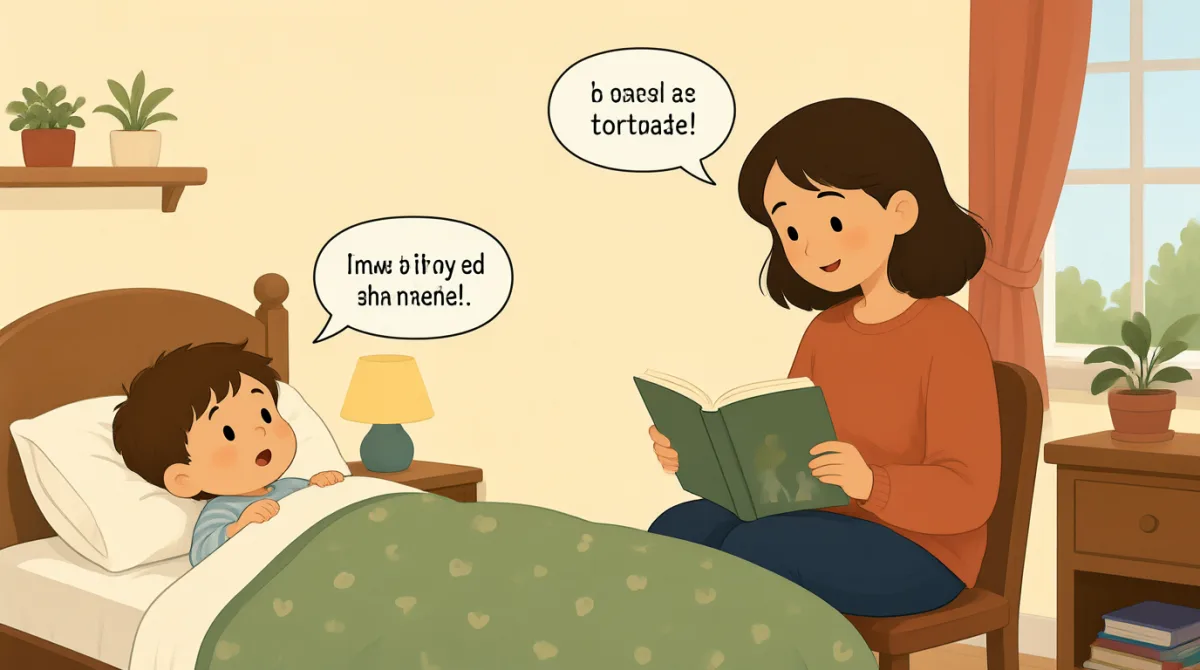

It’s bedtime now. Are you ready to get into bed?
Já está na hora de dormir. Está pronta para ir para a cama?

I’m not tired! Can you stay with me for a little while?
Não estou com sono! Você pode ficar comigo mais um pouquinho?
Of course. Let’s get your pajamas on, then I’ll read you a story.
Claro. Vamos colocar seu pijama e depois eu leio uma história para você.
Can you read the one about the little bear?
Você pode ler aquela história do ursinho?
Sure. Climb into bed, and I’ll get the book from your shelf.
Claro. Deite na cama que eu vou pegar o livro na sua estante.
Will you stay until I fall asleep?
Você vai ficar até eu dormir?
I’ll stay while we read. After the story, you can close your eyes.
Vou ficar aqui enquanto a gente lê. Depois da história, você pode fechar os olhos.
Okay. Please read it slowly. I like the bear’s house.
Tá bom. Lê devagar, por favor. Eu gosto da casa do ursinho.
Vocabulário8
- bedtimehora de dormir
The time when a child goes to bed to sleep. You can say, “It’s bedtime now” to tell someone it is time to get ready for bed.
É a hora em que uma criança vai para a cama para dormir. Você pode dizer “It’s bedtime now” (“Já está na hora de dormir”) para avisar que chegou a hora de se preparar para ir para a cama.
- get into bedir para a cama
To climb into bed and lie down. Use this phrase when you ask someone to start going to sleep.
Deitar-se na cama. Use essa expressão quando pedir a alguém que comece a se preparar para dormir.
- stay with meficar comigo
To remain near someone and keep them company. A child might ask you to stay with them when they feel unsure or lonely.
Continuar perto de alguém e fazer companhia. Uma criança pode pedir que você fique com ela quando estiver insegura ou se sentir sozinha.
- for a little whilepor mais um pouquinho
For a short amount of time. You can use it to ask someone to stay or wait briefly.
Por um curto período. Você pode usar essa expressão para pedir que alguém fique ou espere só mais um pouco.
- get your pajamas oncolocar o pijama
To put on your pajamas. You can use “get [your clothes] on” when it is time to get dressed.
Vestir o pijama. Você pode usar “get [your clothes] on” (“vestir [sua roupa]”) quando chegar a hora de se vestir.
- climb into beddeitar na cama
To get into bed, usually by moving onto it. This is a gentle way to tell a child to get into bed.
Ir para a cama, geralmente subindo nela para se deitar. É um jeito carinhoso de dizer a uma criança que vá para a cama.
- fall asleepadormecer
To begin sleeping. You can use it to talk about the moment someone starts to sleep.
Começar a dormir. Você pode usar essa expressão para falar do momento em que alguém começa a dormir.
- close your eyesfechar os olhos
To shut your eyes. At bedtime, this can be a gentle suggestion to relax and get ready to sleep.
Fechar os olhos. Na hora de dormir, pode ser um convite gentil para relaxar e se preparar para dormir.
Frases-chave8
- 1
It’s bedtime now.
Já está na hora de dormir.
This is a simple way to tell someone it is time to go to bed. You can change “bedtime” to another activity, such as “It’s lunch time now.”
Essa é uma maneira simples de avisar que chegou a hora de ir para a cama. Você pode trocar “bedtime” por outra atividade, como em “It’s lunch time now.” (“Já está na hora do almoço.”)
- 2
Can you stay with me for a little while?
Você pode ficar comigo mais um pouquinho?
Use this question to ask someone to keep you company briefly. You can replace “stay with me” with another request, such as “sit with me.”
Use essa pergunta para pedir que alguém faça companhia por um tempinho. Você pode trocar “stay with me” por outro pedido, como “sit with me” (“sente-se comigo”).
- 3
Of course.
Claro.
This is a warm, natural way to agree to a request. You can use it instead of “yes” when you want to sound reassuring.
Essa é uma maneira carinhosa e natural de aceitar um pedido. Você pode usá-la em vez de “yes” quando quiser tranquilizar alguém.
- 4
Let’s get your pajamas on, then I’ll read you a story.
Vamos colocar seu pijama e depois eu leio uma história para você.
This sentence gives two simple plans in order. You can use “Let’s [activity], then I’ll [next activity]” to explain what will happen next.
Essa frase apresenta dois planos simples, em ordem. Você pode usar “Let’s [activity], then I’ll [next activity]” para explicar o que vai acontecer em seguida.
- 5
Climb into bed, and I’ll get the book from your shelf.
Deite na cama que eu vou pegar o livro na sua estante.
This combines a gentle instruction with a promise to do something. You can use “and I’ll…” to explain what you will do next.
Essa frase combina uma instrução gentil com a promessa de fazer algo. Você pode usar “and I’ll…” para explicar o que vai fazer em seguida.
- 6
Will you stay until I fall asleep?
Você vai ficar até eu dormir?
Use this question to ask whether someone will remain until something happens. Replace “I fall asleep” with another event, such as “the movie ends.”
Use essa pergunta para saber se alguém vai ficar até que algo aconteça. Troque “I fall asleep” por outro acontecimento, como “the movie ends” (“o filme acabar”).
- 7
I’ll stay while we read.
Vou ficar aqui enquanto a gente lê.
This sentence promises to stay during an activity. You can use “I’ll [action] while we [activity]” to describe what you will do at the same time.
Essa frase promete que você vai ficar durante uma atividade. Você pode usar “I’ll [action] while we [activity]” para descrever o que vai fazer enquanto vocês fazem outra coisa.
- 8
Please read it slowly.
Lê devagar, por favor.
This is a polite way to ask someone to read at a slower speed. You can use “Please [verb] slowly” for other activities, such as speaking or walking.
Essa é uma maneira educada de pedir a alguém que leia mais devagar. Você pode usar “Please [verb] slowly” em outras situações, como ao pedir que alguém fale ou caminhe devagar.