The Child Won't Sleep
La niña no quiere dormir
At bedtime, the child says they are not tired and asks Emma to stay. Emma reads a short story and comforts them as they get ready to sleep.
A la hora de dormir, la niña dice que no tiene sueño y le pide a Emma que se quede. Emma le lee un cuento corto y la tranquiliza mientras se prepara para dormir.
Diálogo8
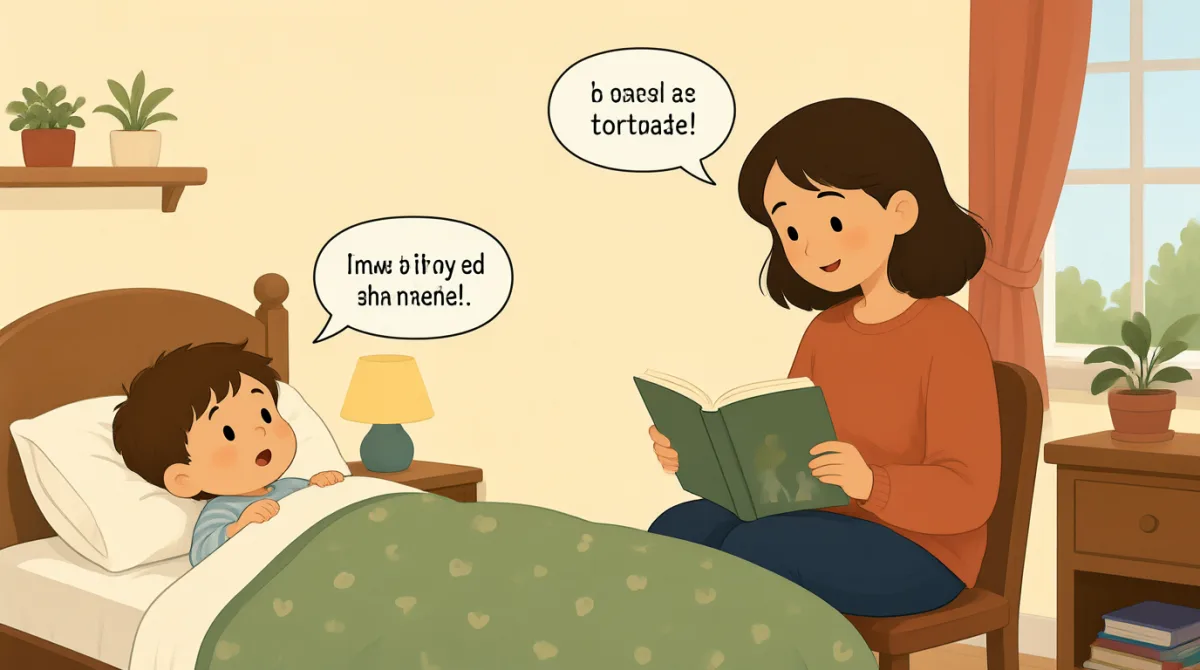

It’s bedtime now. Are you ready to get into bed?
Ya es hora de dormir. ¿Estás lista para acostarte?

I’m not tired! Can you stay with me for a little while?
¡No tengo sueño! ¿Te puedes quedar conmigo un ratito?
Of course. Let’s get your pajamas on, then I’ll read you a story.
Claro. Vamos a ponerte el pijama y después te leo un cuento.
Can you read the one about the little bear?
¿Me lees el cuento del osito?
Sure. Climb into bed, and I’ll get the book from your shelf.
Claro. Métete en la cama y voy a buscar el libro a tu estantería.
Will you stay until I fall asleep?
¿Te quedarás hasta que me duerma?
I’ll stay while we read. After the story, you can close your eyes.
Me quedaré mientras leemos. Cuando terminemos el cuento, puedes cerrar los ojos.
Okay. Please read it slowly. I like the bear’s house.
Vale. Léelo despacito, por favor. Me gusta la casa del osito.
Vocabulario8
- bedtimela hora de dormir
The time when a child goes to bed to sleep. You can say, “It’s bedtime now” to tell someone it is time to get ready for bed.
Es el momento en que un niño se va a la cama para dormir. Puedes decir “It’s bedtime now” (Ya es hora de dormir) para avisarle a alguien de que es hora de prepararse para acostarse.
- get into bedacostarse
To climb into bed and lie down. Use this phrase when you ask someone to start going to sleep.
Meterse en la cama y tumbarse. Usa esta expresión cuando le pidas a alguien que empiece a prepararse para dormir.
- stay with mequedarte conmigo
To remain near someone and keep them company. A child might ask you to stay with them when they feel unsure or lonely.
Permanecer cerca de alguien y hacerle compañía. Un niño podría pedirte que te quedes con él si se siente inseguro o solo.
- for a little whileun ratito
For a short amount of time. You can use it to ask someone to stay or wait briefly.
Durante poco tiempo. Puedes usar esta expresión para pedirle a alguien que se quede o espere un momento.
- get your pajamas onponerte el pijama
To put on your pajamas. You can use “get [your clothes] on” when it is time to get dressed.
Vestirte con el pijama. Puedes usar “get [your clothes] on” (ponerte [la ropa]) cuando sea hora de vestirse.
- climb into bedmeterte en la cama
To get into bed, usually by moving onto it. This is a gentle way to tell a child to get into bed.
Acostarte en la cama, normalmente subiéndote a ella. Es una forma cariñosa de decirle a un niño que se meta en la cama.
- fall asleepdormirse
To begin sleeping. You can use it to talk about the moment someone starts to sleep.
Empezar a dormir. Puedes usar esta expresión para hablar del momento en que alguien empieza a dormir.
- close your eyescerrar los ojos
To shut your eyes. At bedtime, this can be a gentle suggestion to relax and get ready to sleep.
Bajar los párpados y dejar los ojos cerrados. A la hora de dormir, puede ser una sugerencia suave para relajarse y prepararse para dormir.
Frases clave8
- 1
It’s bedtime now.
Ya es hora de dormir.
This is a simple way to tell someone it is time to go to bed. You can change “bedtime” to another activity, such as “It’s lunch time now.”
Esta es una forma sencilla de decirle a alguien que es hora de irse a la cama. Puedes cambiar “bedtime” por otra actividad, como en “It’s lunch time now” (Ahora es la hora de comer).
- 2
Can you stay with me for a little while?
¿Te puedes quedar conmigo un ratito?
Use this question to ask someone to keep you company briefly. You can replace “stay with me” with another request, such as “sit with me.”
Usa esta pregunta para pedirle a alguien que te haga compañía un momento. Puedes sustituir “stay with me” por otra petición, como “sit with me” (siéntate conmigo).
- 3
Of course.
Claro.
This is a warm, natural way to agree to a request. You can use it instead of “yes” when you want to sound reassuring.
Esta es una forma cálida y natural de aceptar una petición. Puedes decirla en lugar de “yes” (sí) para sonar más tranquilizador.
- 4
Let’s get your pajamas on, then I’ll read you a story.
Vamos a ponerte el pijama y después te leo un cuento.
This sentence gives two simple plans in order. You can use “Let’s [activity], then I’ll [next activity]” to explain what will happen next.
Esta frase presenta dos planes sencillos en orden. Puedes usar “Let’s [activity], then I’ll [next activity]” (Vamos a [actividad] y después [siguiente actividad]) para explicar qué pasará a continuación.
- 5
Climb into bed, and I’ll get the book from your shelf.
Métete en la cama y voy a buscar el libro a tu estantería.
This combines a gentle instruction with a promise to do something. You can use “and I’ll…” to explain what you will do next.
Esta frase combina una indicación amable con la promesa de hacer algo. Puedes usar “and I’ll…” (y yo…) para explicar qué harás después.
- 6
Will you stay until I fall asleep?
¿Te quedarás hasta que me duerma?
Use this question to ask whether someone will remain until something happens. Replace “I fall asleep” with another event, such as “the movie ends.”
Usa esta pregunta para preguntar si alguien se quedará hasta que ocurra algo. Sustituye “I fall asleep” por otro acontecimiento, como “the movie ends” (se acaba la película).
- 7
I’ll stay while we read.
Me quedaré mientras leemos.
This sentence promises to stay during an activity. You can use “I’ll [action] while we [activity]” to describe what you will do at the same time.
Esta frase promete que te quedarás durante una actividad. Puedes usar “I’ll [action] while we [activity]” (Yo [acción] mientras [actividad]) para describir lo que harás al mismo tiempo.
- 8
Please read it slowly.
Léelo despacito, por favor.
This is a polite way to ask someone to read at a slower speed. You can use “Please [verb] slowly” for other activities, such as speaking or walking.
Esta es una forma amable de pedirle a alguien que lea más despacio. Puedes usar “Please [verb] slowly” (Por favor, [verbo] despacio) para otras actividades, como hablar o caminar.