The Child Won't Sleep
At bedtime, the child says they are not tired and asks Emma to stay. Emma reads a short story and comforts them as they get ready to sleep.
Dialogue8
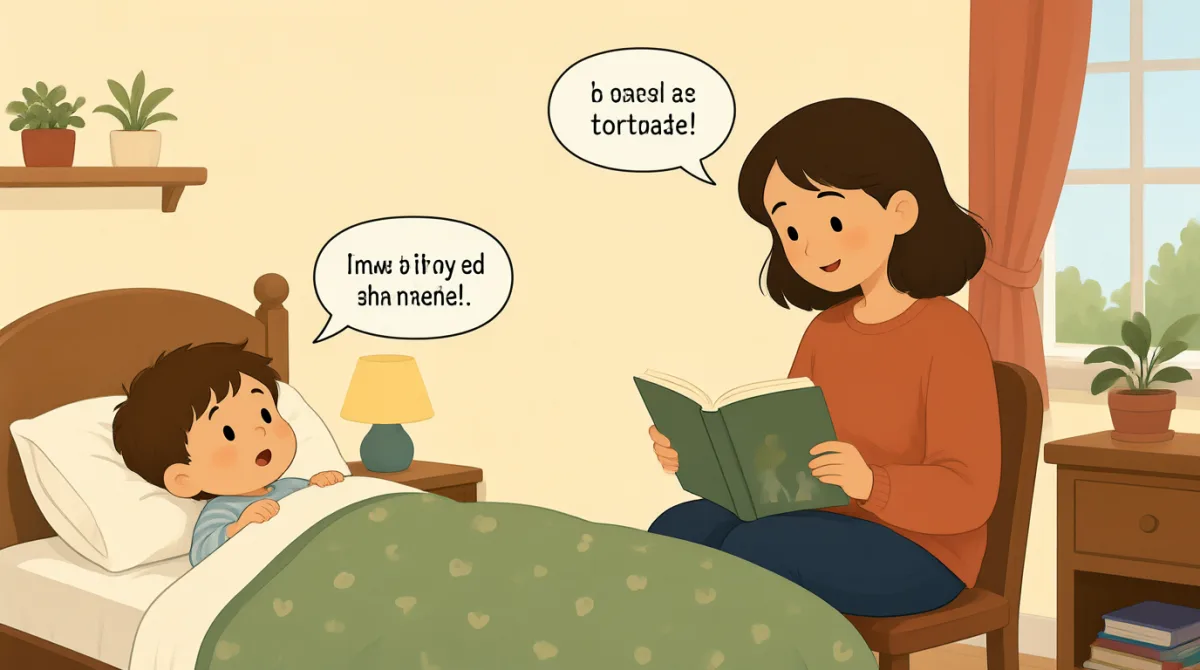

It’s bedtime now. Are you ready to get into bed?

I’m not tired! Can you stay with me for a little while?
Of course. Let’s get your pajamas on, then I’ll read you a story.
Can you read the one about the little bear?
Sure. Climb into bed, and I’ll get the book from your shelf.
Will you stay until I fall asleep?
I’ll stay while we read. After the story, you can close your eyes.
Okay. Please read it slowly. I like the bear’s house.
Vocabulary8
- bedtime
The time when a child goes to bed to sleep. You can say, “It’s bedtime now” to tell someone it is time to get ready for bed.
- get into bed
To climb into bed and lie down. Use this phrase when you ask someone to start going to sleep.
- stay with me
To remain near someone and keep them company. A child might ask you to stay with them when they feel unsure or lonely.
- for a little while
For a short amount of time. You can use it to ask someone to stay or wait briefly.
- get your pajamas on
To put on your pajamas. You can use “get [your clothes] on” when it is time to get dressed.
- climb into bed
To get into bed, usually by moving onto it. This is a gentle way to tell a child to get into bed.
- fall asleep
To begin sleeping. You can use it to talk about the moment someone starts to sleep.
- close your eyes
To shut your eyes. At bedtime, this can be a gentle suggestion to relax and get ready to sleep.
Key Sentences8
- 1
It’s bedtime now.
This is a simple way to tell someone it is time to go to bed. You can change “bedtime” to another activity, such as “It’s lunch time now.”
- 2
Can you stay with me for a little while?
Use this question to ask someone to keep you company briefly. You can replace “stay with me” with another request, such as “sit with me.”
- 3
Of course.
This is a warm, natural way to agree to a request. You can use it instead of “yes” when you want to sound reassuring.
- 4
Let’s get your pajamas on, then I’ll read you a story.
This sentence gives two simple plans in order. You can use “Let’s [activity], then I’ll [next activity]” to explain what will happen next.
- 5
Climb into bed, and I’ll get the book from your shelf.
This combines a gentle instruction with a promise to do something. You can use “and I’ll…” to explain what you will do next.
- 6
Will you stay until I fall asleep?
Use this question to ask whether someone will remain until something happens. Replace “I fall asleep” with another event, such as “the movie ends.”
- 7
I’ll stay while we read.
This sentence promises to stay during an activity. You can use “I’ll [action] while we [activity]” to describe what you will do at the same time.
- 8
Please read it slowly.
This is a polite way to ask someone to read at a slower speed. You can use “Please [verb] slowly” for other activities, such as speaking or walking.