Explaining What Happened
Mia and David meet with the patient's daughter, Grace Wilson, to explain that a medication was administered incorrectly. They describe what is known about the error and its effects, while acknowledging the limits of what they can say so far.
Dialogue12
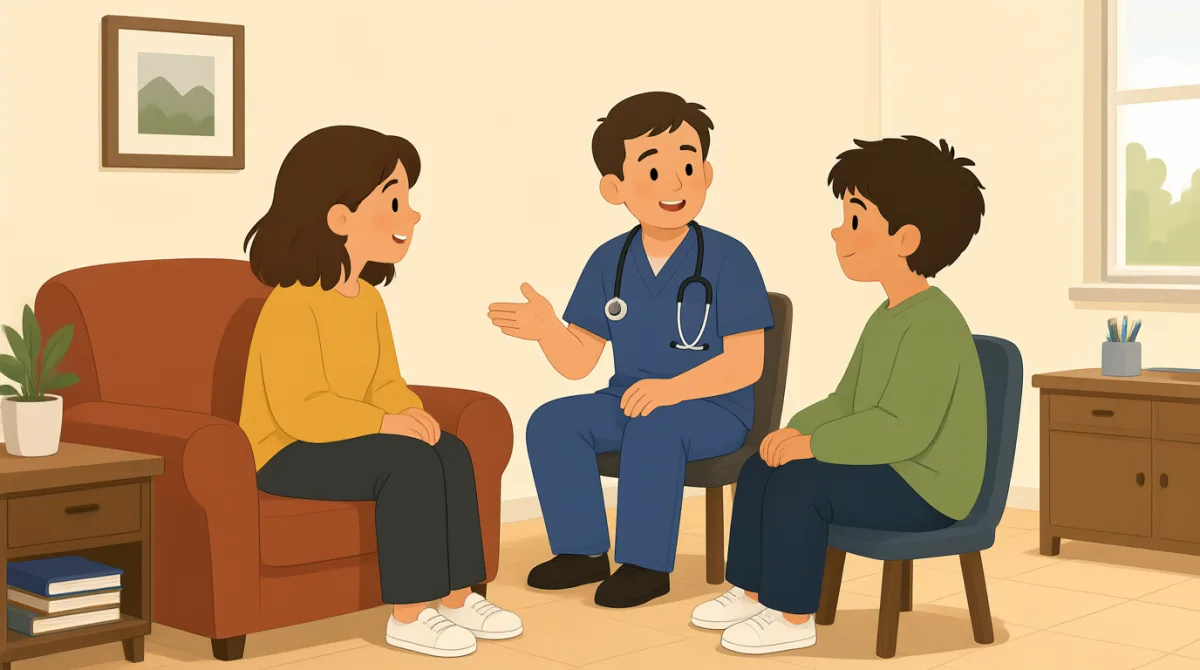

Grace, thank you for meeting with us. I’m Dr. Patel, and this is David Chen, our risk manager. We want to explain what we know about your father’s medication and answer your questions.

I appreciate that, but I need you to be direct. What happened to my father? I was told there may have been a medication error, and I don’t want a softened version.
You’re right to ask for a clear account. A medication was administered to your father at a higher dose than the one prescribed. We confirmed that this was an error.
How much higher? And when did this happen? I need facts, not just the word “error.”
The dose was twice the prescribed amount, and it was given yesterday morning. Once the discrepancy was identified, the team stopped further doses and began monitoring him closely.

We have verified the prescription, the medication record, and the amount administered. We’re still reviewing how the dose was selected and what checks were completed before it was given.
And what has it done to him? Is this why he’s been so drowsy? Could the extra medication have caused lasting damage?
He has been unusually drowsy, and the medication may have contributed. We can’t yet say with certainty how much it did. So far, his vital signs have remained stable.
“Stable” doesn’t tell me whether he suffered or whether he’ll recover. Why can’t you give me a straight answer?
Because we don’t yet have enough evidence to answer that honestly. I don’t want to reassure you with a guess. His doctor is assessing him, and we’ll explain any new findings as soon as we can.
I’m angry, and I’m scared. I also need to know whether you’re telling me everything you’ve confirmed, not just what feels safe to disclose.
That’s a fair concern. We’ve shared the confirmed facts we have today, and we’ll be clear about what remains unknown. We’ll keep reviewing the records and update you as the picture becomes clearer.
Vocabulary8
- a higher dose than the one prescribed
This means the patient received more medication than the doctor ordered. It is a clear, precise way to describe a dosing error.
- discrepancy
A discrepancy is a difference between pieces of information or records. Here, it refers to the mismatch between the prescribed dose and the dose given.
- monitoring him closely
This means watching the patient carefully and checking his condition regularly. It can be used to describe attentive observation in a medical or other safety-sensitive situation.
- contributed
In this context, it means the medication may have played a part in causing the drowsiness. It signals a possible connection without claiming certainty.
- with certainty
This means confidently and without doubt. It is useful when explaining that evidence is not yet strong enough to support a definite conclusion.
- reassure you with a guess
This means offering comfort by saying something that is not known to be true. The phrase emphasizes the importance of being honest rather than giving false confidence.
- confirmed facts
These are details that have been checked and established as true. The phrase helps distinguish reliable information from what is still under investigation.
- what remains unknown
This refers to questions that have not yet been answered. It is a transparent way to acknowledge uncertainty while explaining what is still being investigated.
Key Sentences7
- 1
You’re right to ask for a clear account.
This validates someone’s request for information without becoming defensive. Use it to acknowledge that a person deserves a direct explanation.
- 2
The dose was twice the prescribed amount, and it was given yesterday morning.
This sentence gives two concrete facts in a direct, easy-to-follow way. Reuse the structure to state the extent of an error and when it occurred.
- 3
Once the discrepancy was identified, the team stopped further doses and began monitoring him closely.
This explains what action was taken after a problem was discovered. The structure “Once [event] was identified, [action]” is useful for describing a response to an incident.
- 4
We’re still reviewing how the dose was selected and what checks were completed before it was given.
This clearly separates the facts already verified from questions still under review. Use “We’re still reviewing…” to describe an ongoing investigation without speculating.
- 5
We can’t yet say with certainty how much it did.
This communicates uncertainty carefully while still addressing the question. You can adapt “We can’t yet say with certainty…” when evidence is incomplete.
- 6
I don’t want to reassure you with a guess.
This explains why the speaker will not offer unsupported comfort. It is a useful phrase when honesty matters more than providing a quick answer.
- 7
We’ve shared the confirmed facts we have today, and we’ll be clear about what remains unknown.
This combines transparency about current knowledge with a commitment to acknowledge gaps. Use it when explaining what is known now and what still needs to be established.