Getting Instructions
Mia tells Emma about her child's meals, bedtime, and house rules before leaving. Emma asks a few questions to make sure she understands.
Dialogue8
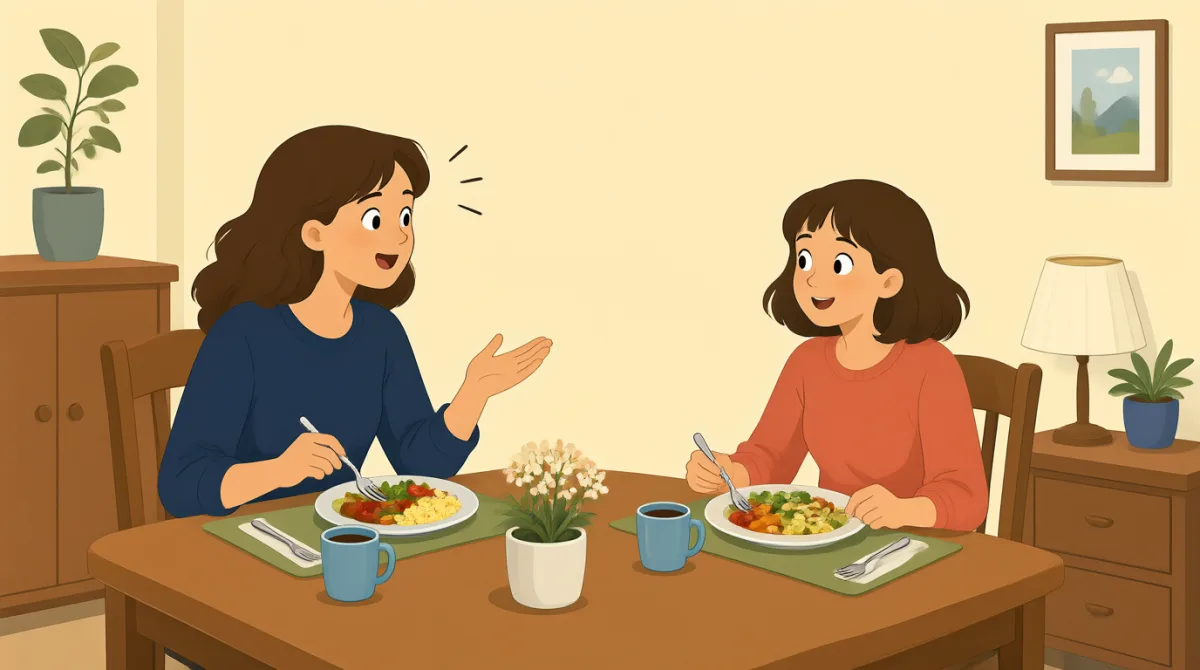

Thanks for watching my child tonight. Dinner is at six, and she likes pasta.

Sure. Should I heat up the pasta in the fridge?
Yes, please. She can have some fruit after dinner, but no sweets.
Got it. What time should she go to bed?
At eight. Please help her brush her teeth and read one short story.
Okay. Can she watch TV before bed?
No TV tonight. And please keep the front door locked.
Understood. I’ll lock the door and call you if I need anything.
Vocabulary8
- watching my child
Here, it means taking care of Mia’s child for a short time. You can use “watching” to talk about caring for someone’s child.
- heat up
To heat up food is to make it warm before eating. You can ask, “Should I heat up the dinner?”
- in the fridge
This means inside the refrigerator, where food is kept cold. You can say, “The milk is in the fridge.”
- after dinner
This means once the evening meal is finished. You can use it to say when something will happen, such as “We’ll have dessert after dinner.”
- go to bed
This means to get into bed and prepare to sleep. You can ask, “What time do you usually go to bed?”
- brush her teeth
This means clean her teeth with a toothbrush. You can use “brush your teeth” when reminding someone about this daily routine.
- keep the front door locked
This means make sure the main entrance stays locked. You can use “keep the door locked” as a safety instruction.
- if I need anything
This means if I need help or something else. You can use this phrase when telling someone you will contact them if a problem comes up.
Key Sentences7
- 1
Should I heat up the pasta in the fridge?
Use “Should I…?” to check what someone wants you to do. You can change the action and food, as in “Should I warm up the soup?”
- 2
She can have some fruit after dinner, but no sweets.
This sentence gives permission and then adds a limit. You can use “can have…, but no…” to explain what someone may and may not eat.
- 3
What time should she go to bed?
This is a polite way to ask about someone’s bedtime. You can replace “she” with another person, such as “What time should the children go to bed?”
- 4
Please help her brush her teeth and read one short story.
Use “Please” to give a polite instruction. You can list two simple tasks with “and.”
- 5
Can she watch TV before bed?
Use “Can she…?” to ask whether something is allowed. You can replace the activity, for example, “Can she play outside before dinner?”
- 6
Please keep the front door locked.
This is a polite way to give an important safety instruction. You can use “Please keep…” for other rules, such as “Please keep the gate closed.”
- 7
I’ll lock the door and call you if I need anything.
Use “I’ll” to say what you plan to do. The phrase “if I need anything” explains when you will call.