Come Visit My Hometown
Viens visiter ma ville natale
Mia invites Emma to visit her hometown and suggests what they can see and eat. Emma happily asks when they can go.
Mia invite Emma à visiter sa ville natale et lui suggère des endroits à voir et des plats à goûter. Emma est ravie et lui demande quand elles peuvent y aller.
Dialogue8
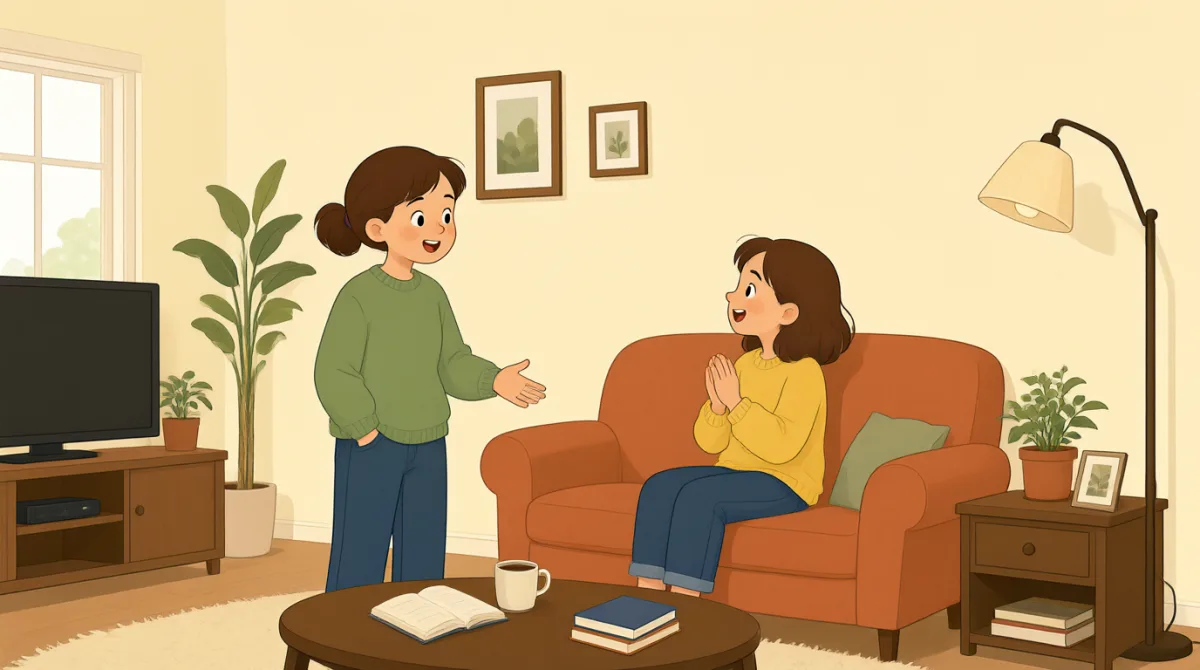

You should come visit my hometown sometime. I’d love to show you around.
Tu devrais venir visiter ma ville natale un de ces jours. J’adorerais te faire découvrir les environs.

That sounds wonderful! What should we see first?
Ça a l’air génial ! Qu’est-ce qu’on devrait voir en premier ?
We can walk through the old market and visit the big park nearby.
On peut se promener dans le vieux marché et visiter le grand parc juste à côté.
And what local food should I try while I’m there?
Et quel plat du coin est-ce que je devrais goûter quand j’y serai ?
You have to try our noodle soup. It’s warm, tasty, and easy to find.
Il faut absolument que tu goûtes notre soupe de nouilles. Elle est chaude, savoureuse et facile à trouver.
I love noodle soup! When can we go?
J’adore la soupe de nouilles ! On peut y aller quand ?
How about next month? The weather is usually nice, and we can stay for the weekend.
Et si on y allait le mois prochain ? Il fait généralement beau, et on peut y passer le week-end.
Perfect! I’ll check my calendar and let you know.
Parfait ! Je vais regarder mon agenda et je te tiens au courant.
Vocabulaire8
- come visitvenir visiter
This means to travel to a place where someone lives and spend time there. You can say, “Come visit me sometime.”
Cette expression signifie se rendre dans un endroit où quelqu’un habite et y passer du temps. Tu peux dire : “Come visit me sometime.”
- show you aroundfaire découvrir les environs
This means to take someone to see interesting places in an area. You can say, “I can show you around the city.”
Cette expression signifie emmener quelqu’un découvrir les endroits intéressants d’un lieu. Tu peux dire : “I can show you around the city.”
- walk throughparcourir à pied
This means to walk from one part of a place to another while looking around. You can say, “Let’s walk through the park.”
Cette expression signifie marcher d’un endroit à un autre tout en regardant autour de soi. Tu peux dire : “Let’s walk through the park.”
- nearbyà proximité
This means close to a place. Here, the park is close to the old market.
Cela signifie qu’un endroit est tout près d’un autre. Ici, le parc se trouve près du vieux marché.
- local foodspécialité locale
This means food that is special or common in a particular area. You can ask, “What local food should I try?”
Cela désigne un plat typique ou courant dans une région. Tu peux demander : “What local food should I try?”
- trygoûter
Here, this means to taste or eat something for the first time. You can say, “You should try this soup.”
Ici, cela signifie manger ou boire quelque chose pour en découvrir le goût. Tu peux dire : “You should try this soup.”
- stay for the weekendpasser le week-end
This means to spend Saturday and Sunday in a place. You can say, “We can stay for the weekend.”
Cela signifie passer le samedi et le dimanche dans un endroit. Tu peux dire : “We can stay for the weekend.”
- let you knowtenir au courant
This means to tell someone something when you have the information. You can say, “I’ll check and let you know.”
Cela signifie informer quelqu’un dès que tu as les renseignements nécessaires. Tu peux dire : “I’ll check and let you know.”
Phrases clés7
- 1
You should come visit my hometown sometime.
Tu devrais venir visiter ma ville natale un de ces jours.
Use this to invite someone to visit the place where you grew up or live. You can replace “my hometown” with another place, such as “my city.”
Utilise cette phrase pour inviter quelqu’un à visiter l’endroit où tu as grandi ou où tu habites. Tu peux remplacer “my hometown” par un autre lieu, comme “my city.”
- 2
I’d love to show you around.
J’adorerais te faire découvrir les environs.
This is a friendly way to offer to take someone to see a place. You can say, “I’d love to show you around the neighborhood.”
C’est une façon amicale de proposer à quelqu’un de lui faire découvrir un endroit. Tu peux dire : “I’d love to show you around the neighborhood.”
- 3
What should we see first?
Qu’est-ce qu’on devrait voir en premier ?
Use this to ask what place or attraction to visit before the others. You can replace “see” with “do” when asking about activities.
Utilise cette question pour demander quel lieu ou quelle attraction visiter en premier. Tu peux remplacer “see” par “do” pour parler d’activités.
- 4
And what local food should I try while I’m there?
Et quel plat du coin est-ce que je devrais goûter quand j’y serai ?
This is a useful question when visiting a new place and looking for something to eat. You can replace “local food” with a specific dish or type of food.
Cette question est utile quand tu visites un nouvel endroit et que tu cherches quelque chose à manger. Tu peux remplacer “local food” par le nom d’un plat ou d’un type de cuisine en particulier.
- 5
You have to try our noodle soup.
Il faut absolument que tu goûtes notre soupe de nouilles.
Use “You have to try…” to strongly recommend a food or activity. For example, “You have to try this cake.”
Utilise “You have to try…” pour recommander vivement un plat ou une activité. Par exemple : “You have to try this cake.”
- 6
How about next month?
Et si on y allait le mois prochain ?
Use this to suggest a possible time for a plan. You can replace “next month” with another time, such as “this weekend.”
Utilise cette phrase pour proposer une date ou une période pour un projet. Tu peux remplacer “next month” par un autre moment, comme “this weekend.”
- 7
I’ll check my calendar and let you know.
Je vais regarder mon agenda et je te tiens au courant.
Use this when you need to check your schedule before confirming a plan. You can also say, “I’ll check my calendar and call you.”
Utilise cette phrase quand tu dois vérifier ton emploi du temps avant de confirmer un projet. Tu peux aussi dire : “I’ll check my calendar and call you.”