My Keys Are Inside
Mes clés sont à l’intérieur
Emma calls her roommate and says she is locked out. Her keys are inside the apartment.
Emma appelle sa colocataire pour lui dire qu’elle est coincée dehors. Ses clés sont à l’intérieur de l’appartement.
Dialogue8
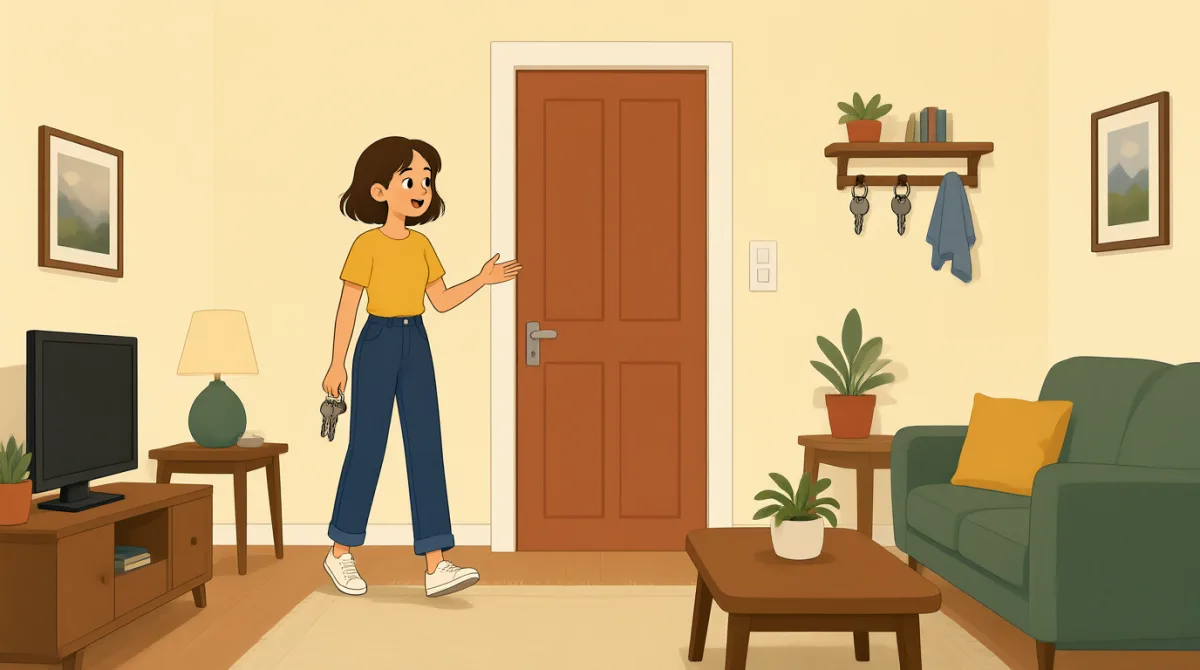

Hi, Mia. Are you at home?
Salut, Mia. Tu es chez toi ?

Yes. What’s wrong, Emma?
Oui. Qu’est-ce qui se passe, Emma ?
I’m locked out. My keys are inside.
Je suis coincée dehors. Mes clés sont à l’intérieur.
Oh no. Are you outside our apartment?
Oh non. Tu es devant notre appartement ?
Yes. I can’t get in. The door is locked.
Oui. Je n’arrive pas à entrer. La porte est verrouillée.
I’m sorry. Can you wait there?
Désolée. Tu peux attendre là ?
Yes, I can wait by the door.
Oui, je peux attendre près de la porte.
Okay. I’ll come home soon.
D’accord. Je rentre bientôt.
Vocabulaire8
- at homechez soi
This means in your house or apartment. You can ask, “Are you at home?” to check if someone is there.
Cela signifie être dans sa maison ou son appartement. Tu peux demander « Are you at home? » (Tu es chez toi ?) pour vérifier si quelqu’un est là.
- What’s wrong?Qu’est-ce qui se passe ?
This asks if there is a problem. You can use it when someone sounds worried.
Cette question sert à savoir s’il y a un problème. Tu peux l’utiliser quand quelqu’un a l’air inquiet.
- locked outcoincé dehors
This means you cannot get inside because the door is locked. You can say, “I’m locked out,” when you cannot enter your home.
Cela signifie que tu ne peux pas entrer parce que la porte est verrouillée. Tu peux dire « I’m locked out » (Je suis coincé dehors) quand tu ne peux pas entrer chez toi.
- insideà l’intérieur
Here, “inside” means in the apartment, not outside. You can say where your keys or other things are.
Ici, « inside » signifie dans l’appartement, et non dehors. Tu peux l’utiliser pour dire où se trouvent tes clés ou d’autres affaires.
- get inentrer
This means enter a place. You can say, “I can’t get in,” when you cannot open the door.
Cela signifie pénétrer dans un endroit. Tu peux dire « I can’t get in » (Je n’arrive pas à entrer) quand tu ne peux pas ouvrir la porte.
- wait thereattendre là
This means stay in that place until someone comes. You can use it to ask someone to stay where they are.
Cela signifie rester à cet endroit jusqu’à ce que quelqu’un arrive. Tu peux utiliser cette expression pour demander à quelqu’un de ne pas bouger.
- by the doorprès de la porte
This means next to the door. You can use it to say where you are waiting.
Cela signifie à côté de la porte. Tu peux utiliser cette expression pour dire où tu attends.
- come homerentrer chez soi
This means return to your home. You can say, “I’ll come home soon,” to tell someone you will return soon.
Cela signifie retourner chez soi. Tu peux dire « I’ll come home soon » (Je rentre bientôt) pour prévenir quelqu’un que tu vas revenir rapidement.
Phrases clés8
- 1
Are you at home?
Tu es chez toi ?
Use this to ask if someone is in their home now. You can change “at home” to another place, such as “at work.”
Utilise cette question pour savoir si quelqu’un est chez lui en ce moment. Tu peux remplacer « at home » par un autre lieu, comme « at work ».
- 2
What’s wrong, Emma?
Qu’est-ce qui se passe, Emma ?
Use this to ask someone what the problem is. You can replace “Emma” with the person’s name.
Utilise cette question pour demander à quelqu’un quel est le problème. Tu peux remplacer « Emma » par le prénom de la personne.
- 3
I’m locked out.
Je suis coincé dehors.
This is a simple way to say you cannot get into your home. You can use it when you are outside and the door is locked.
C’est une façon simple de dire que tu ne peux pas entrer chez toi. Tu peux l’utiliser quand tu es dehors et que la porte est verrouillée.
- 4
My keys are inside.
Mes clés sont à l’intérieur.
Use this to explain that your keys are in the place you cannot enter. You can replace “keys” with another item.
Utilise cette phrase pour expliquer que tes clés se trouvent dans l’endroit où tu ne peux pas entrer. Tu peux remplacer « keys » par le nom d’un autre objet.
- 5
I can’t get in.
Je n’arrive pas à entrer.
Use this when you cannot enter a place. You can replace “in” with “out” to talk about leaving.
Utilise cette phrase quand tu ne peux pas entrer quelque part. Tu peux remplacer « in » par « out » pour parler du fait de sortir.
- 6
Can you wait there?
Tu peux attendre là ?
Use this to ask someone to stay where they are. You can replace “there” with a specific place.
Utilise cette question pour demander à quelqu’un de rester où il se trouve. Tu peux remplacer « there » par un lieu précis.
- 7
I can wait by the door.
Je peux attendre près de la porte.
Use this to say that you can stay next to the door. You can replace “by the door” with another place.
Utilise cette phrase pour dire que tu peux rester à côté de la porte. Tu peux remplacer « by the door » par un autre lieu.
- 8
I’ll come home soon.
Je rentre bientôt.
Use this to tell someone you will return home in a short time. “I’ll” is a short form of “I will.”
Utilise cette phrase pour dire à quelqu’un que tu vas rentrer chez toi dans peu de temps. « I’ll » est la forme abrégée de « I will ».