Back Inside
De retour à l’intérieur
Grace helps Emma get back into her apartment. Emma thanks Grace and Jack for their help.
Grace aide Emma à rentrer dans son appartement. Emma remercie Grace et Jack de l’avoir aidée.
Dialogue7
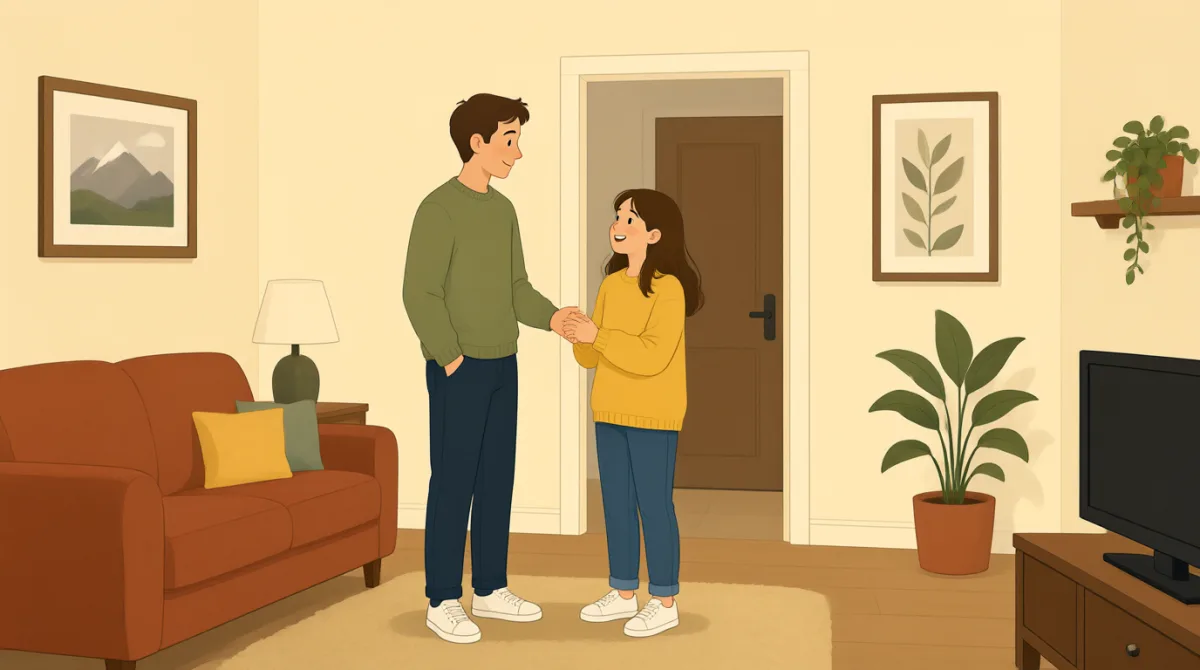

I’m here. Is this your apartment, Emma?
Je suis là. C’est ton appartement, Emma ?

Yes, it is. My keys are inside.
Oui, c’est ça. Mes clés sont à l’intérieur.
Okay. I can open the door for you.
D’accord. Je peux t’ouvrir la porte.

Thanks for coming so fast, Grace.
Merci d’être venue si vite, Grace.
You’re welcome. Emma, you can go in now.
De rien. Emma, tu peux entrer maintenant.
Great! Thank you both for helping me.
Super ! Merci à tous les deux de m’avoir aidée.
No problem. Keep your keys with you next time!
Pas de problème. Garde tes clés sur toi la prochaine fois !
Vocabulaire8
- I’m here.Je suis là.
This means the speaker has arrived. You can say it when you meet someone who is waiting for you.
Cela signifie que la personne qui parle est arrivée. Tu peux le dire quand tu retrouves quelqu’un qui t’attend.
- apartmentappartement
An apartment is a home in a building with other homes. You can use this word to talk about where you live.
Un appartement est un logement dans un immeuble qui en abrite plusieurs. Tu peux utiliser ce mot pour parler de l’endroit où tu habites.
- keysclés
Keys are small objects that open doors. You can say “my keys” when you talk about the keys you use.
Les clés sont de petits objets qui servent à ouvrir les portes. Tu peux dire “my keys” quand tu parles des clés que tu utilises.
- open the doorouvrir la porte
This means to make a door move so someone can go in or out. You can ask someone to open the door for you.
Cela signifie faire bouger une porte pour que quelqu’un puisse entrer ou sortir. Tu peux demander à quelqu’un de t’ouvrir la porte.
- You’re welcome.De rien.
This is a polite reply when someone says “thank you.”
C’est une réponse polie quand quelqu’un te dit “thank you.”
- go inentrer
This means to enter a place. You can say “You can go in now” when someone is ready to enter.
Cela signifie pénétrer dans un endroit. Tu peux dire “You can go in now” quand quelqu’un est prêt à entrer.
- No problem.Pas de problème.
This is a friendly way to say that helping was easy or okay. You can use it after someone thanks you.
C’est une façon amicale de dire que rendre service était facile ou ne posait pas de problème. Tu peux l’utiliser après que quelqu’un t’a remercié.
- Keep your keys with youGarde tes clés sur toi
This means to carry your keys and not leave them behind. You can use this reminder when someone forgets their keys.
Cela signifie emporter tes clés et ne pas les laisser derrière toi. Tu peux rappeler cela à quelqu’un qui oublie ses clés.
Phrases clés8
- 1
Is this your apartment, Emma?
C’est ton appartement, Emma ?
This is a simple way to check if a place belongs to someone. You can replace “your apartment” with another place, such as “your house.”
C’est une façon simple de vérifier si un endroit appartient à quelqu’un. Tu peux remplacer “your apartment” par un autre lieu, comme “your house.”
- 2
My keys are inside.
Mes clés sont à l’intérieur.
Use this sentence to say where your keys are. You can replace “my keys” with another thing, such as “my phone.”
Utilise cette phrase pour dire où se trouvent tes clés. Tu peux remplacer “my keys” par un autre objet, comme “my phone.”
- 3
I can open the door for you.
Je peux t’ouvrir la porte.
This is a useful way to offer help. You can replace “open the door” with another helpful action.
C’est une façon utile de proposer ton aide. Tu peux remplacer “open the door” par une autre action pour aider.
- 4
Thanks for coming so fast, Grace.
Merci d’être venue si vite, Grace.
This sentence thanks someone for arriving quickly. You can replace “coming” with another action, such as “calling.”
Cette phrase permet de remercier quelqu’un d’être arrivé rapidement. Tu peux remplacer “coming” par une autre action, comme “calling.”
- 5
You’re welcome.
De rien.
This is a polite reply to “thank you.” It works in many everyday situations.
C’est une réponse polie à “thank you.” Elle convient à de nombreuses situations du quotidien.
- 6
Emma, you can go in now.
Emma, tu peux entrer maintenant.
Use this sentence to tell someone they can enter. You can replace “go in” with another action they can do now.
Utilise cette phrase pour dire à quelqu’un qu’il peut entrer. Tu peux remplacer “go in” par une autre action que la personne peut faire maintenant.
- 7
Thank you both for helping me.
Merci à tous les deux de m’avoir aidée.
This is a polite way to thank two people for their help. You can change “both” to name the people you are thanking.
C’est une façon polie de remercier deux personnes pour leur aide. Tu peux remplacer “both” par le nom des personnes que tu remercies.
- 8
Keep your keys with you next time!
Garde tes clés sur toi la prochaine fois !
This is a reminder to carry your keys in the future. You can replace “your keys” with another important item.
C’est un rappel pour penser à emporter tes clés à l’avenir. Tu peux remplacer “your keys” par un autre objet important.