Calling the Building Manager
Appeler la gérante de l’immeuble
Jack calls the building manager, Grace, and explains the problem. Grace says she is on her way.
Jack appelle Grace, la gérante de l’immeuble, et lui explique le problème. Grace lui dit qu’elle arrive.
Dialogue7
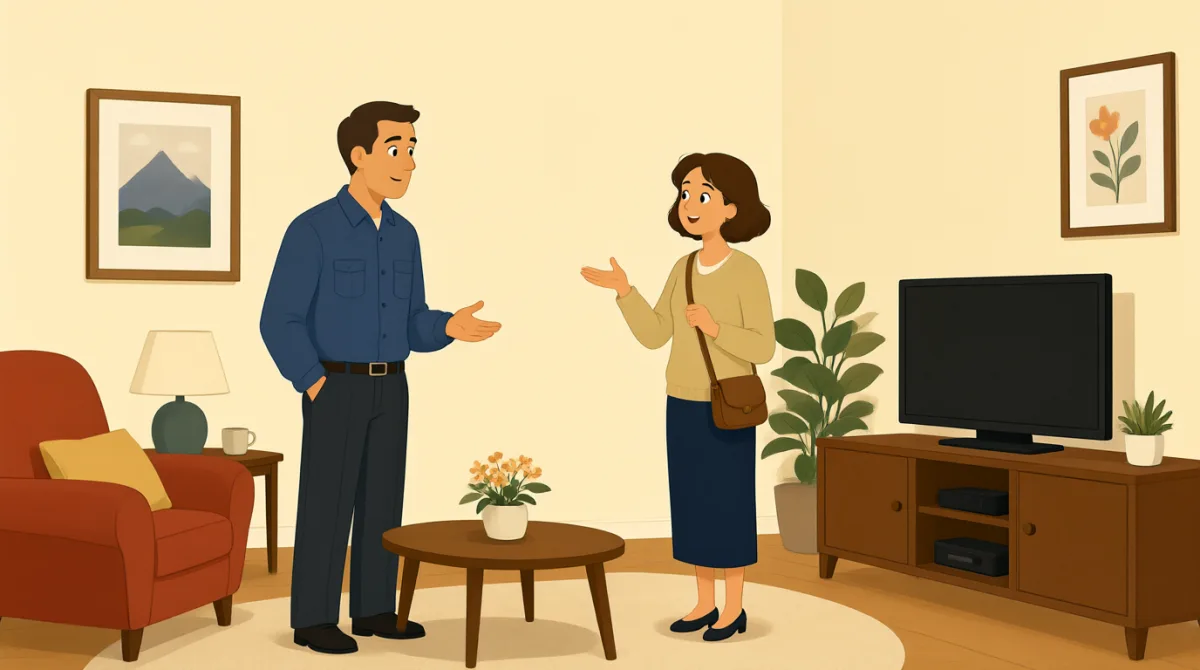

Hi, Grace. Emma is locked out of her apartment.
Salut, Grace. Emma est coincée dehors, elle ne peut pas entrer dans son appartement.

Oh no. Are her keys inside?
Oh non. Ses clés sont à l’intérieur ?
Yes, her keys are inside. The door is locked.
Oui, ses clés sont à l’intérieur. La porte est verrouillée.
Is Emma there with you now?
Emma est avec vous en ce moment ?
Yes, she is waiting by the door.
Oui, elle attend près de la porte.
Okay. I am on my way now.
D’accord. J’arrive tout de suite.
Thank you, Grace. We will wait here.
Merci, Grace. On va attendre ici.
Vocabulaire6
- locked outêtre coincé dehors
You are locked out when you cannot get into a place. Use “I’m locked out” to explain this problem.
On est « locked out » quand on ne peut pas entrer quelque part. Vous pouvez dire “I’m locked out” pour expliquer le problème (je suis coincé dehors et je ne peux pas entrer).
- keysles clés
Keys open a door or a lock. You can say “My keys are inside” to explain where they are.
Les clés servent à ouvrir une porte ou une serrure. Vous pouvez dire “My keys are inside” (Mes clés sont à l’intérieur) pour expliquer où elles se trouvent.
- insideà l’intérieur
Inside means in a place, not outside. Use it to say where something is.
“Inside” signifie « à l’intérieur », et non dehors. Utilisez ce mot pour indiquer où se trouve quelque chose.
- doorla porte
A door lets people enter or leave a room or building. You can say “The door is locked” when it will not open.
Une porte permet d’entrer dans une pièce ou un bâtiment, ou d’en sortir. Vous pouvez dire “The door is locked” (La porte est verrouillée) quand elle ne s’ouvre pas.
- waiting by the doorattendre près de la porte
This means staying near the door until something happens. Use it to tell someone where you are waiting.
“Waiting by the door” signifie rester près de la porte en attendant qu’il se passe quelque chose. Utilisez cette expression pour dire à quelqu’un où vous attendez.
- on my wayêtre en route
This means you are coming to a place now. You can say “I’m on my way” when someone is waiting for you.
“On my way” signifie qu’on est en train de venir quelque part. Vous pouvez dire “I’m on my way” (J’arrive) quand quelqu’un vous attend.
Phrases clés8
- 1
Emma is locked out of her apartment.
Emma ne peut pas entrer dans son appartement.
Use this sentence to explain that someone cannot get into their home. Replace “Emma” with the person’s name.
Utilisez cette phrase pour expliquer que quelqu’un ne peut pas entrer chez lui. Remplacez “Emma” par le nom de la personne.
- 2
Are her keys inside?
Ses clés sont à l’intérieur ?
Use this question to ask if someone’s keys are in a place. Replace “her” with “his” or “your” as needed.
Utilisez cette question pour demander si les clés de quelqu’un se trouvent à l’intérieur. Remplacez “her” par “his” ou “your” selon le cas.
- 3
Yes, her keys are inside.
Oui, ses clés sont à l’intérieur.
This is a simple way to answer where the keys are. Replace “her keys” with another person’s keys or an item.
C’est une façon simple de dire où se trouvent les clés. Remplacez “her keys” par les clés d’une autre personne ou par un objet.
- 4
The door is locked.
La porte est verrouillée.
Use this sentence to explain why someone cannot enter. Replace “door” with another thing that is locked.
Utilisez cette phrase pour expliquer pourquoi quelqu’un ne peut pas entrer. Remplacez “door” par le nom d’un autre objet verrouillé.
- 5
Is Emma there with you now?
Emma est avec vous en ce moment ?
Use this question to check if someone is with another person at this moment. Replace the names to fit your situation.
Utilisez cette question pour vérifier si quelqu’un est avec une autre personne à ce moment-là. Remplacez les noms en fonction de la situation.
- 6
She is waiting by the door.
Elle attend près de la porte.
Use this sentence to say where someone is waiting. Replace “She” and “the door” with the right person and place.
Utilisez cette phrase pour dire où quelqu’un attend. Remplacez “She” et “the door” par la personne et le lieu qui conviennent.
- 7
I am on my way now.
J’arrive tout de suite.
Use this sentence to tell someone you are coming soon. Replace “I” with another person, or say “I’m on my way” in casual speech.
Utilisez cette phrase pour dire à quelqu’un que vous arrivez bientôt. Remplacez “I” par une autre personne, ou dites “I’m on my way” dans un registre familier.
- 8
We will wait here.
On va attendre ici.
Use this sentence to say that a group will stay in one place. Replace “here” with another place if needed.
Utilisez cette phrase pour dire qu’un groupe va rester au même endroit. Remplacez “here” par un autre lieu si nécessaire.