My Keys Are Inside
Meine Schlüssel sind drinnen
Emma calls her roommate and says she is locked out. Her keys are inside the apartment.
Emma ruft ihre Mitbewohnerin an und sagt, dass sie ausgesperrt ist. Ihre Schlüssel liegen in der Wohnung.
Dialog8
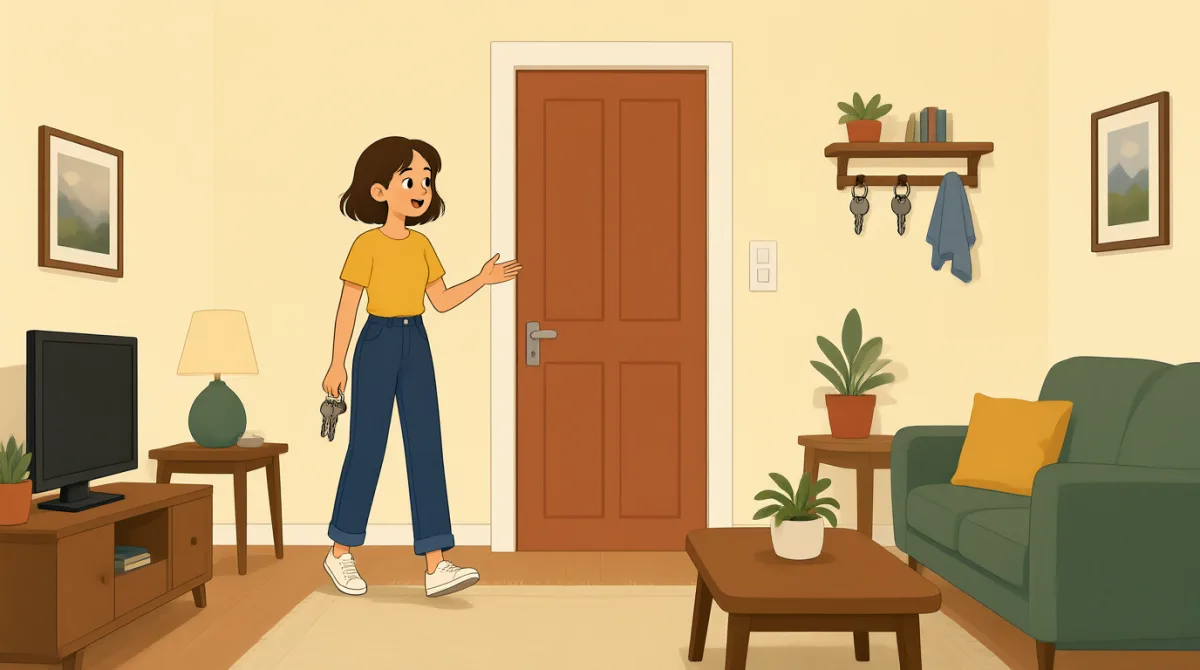

Hi, Mia. Are you at home?
Hi, Mia. Bist du zu Hause?

Yes. What’s wrong, Emma?
Ja. Was ist los, Emma?
I’m locked out. My keys are inside.
Ich bin ausgesperrt. Meine Schlüssel sind drinnen.
Oh no. Are you outside our apartment?
Oh nein. Bist du vor unserer Wohnung?
Yes. I can’t get in. The door is locked.
Ja. Ich komme nicht rein. Die Tür ist abgeschlossen.
I’m sorry. Can you wait there?
Tut mir leid. Kannst du dort warten?
Yes, I can wait by the door.
Ja, ich kann bei der Tür warten.
Okay. I’ll come home soon.
Okay. Ich komme bald nach Hause.
Wortschatz8
- at homezu Hause
This means in your house or apartment. You can ask, “Are you at home?” to check if someone is there.
Das bedeutet, dass du in deinem Haus oder deiner Wohnung bist. Du kannst fragen: „Are you at home?“ (Bist du zu Hause?), um herauszufinden, ob jemand da ist.
- What’s wrong?Was ist los?
This asks if there is a problem. You can use it when someone sounds worried.
Damit fragst du, ob es ein Problem gibt. Du kannst das sagen, wenn jemand besorgt klingt.
- locked outausgesperrt sein
This means you cannot get inside because the door is locked. You can say, “I’m locked out,” when you cannot enter your home.
Das bedeutet, dass du nicht hineinkommst, weil die Tür abgeschlossen ist. Du kannst sagen: „I’m locked out“ (Ich bin ausgesperrt), wenn du nicht in deine Wohnung kommst.
- insidedrinnen
Here, “inside” means in the apartment, not outside. You can say where your keys or other things are.
Hier bedeutet „inside“, dass etwas in der Wohnung und nicht draußen ist. Du kannst damit sagen, wo deine Schlüssel oder andere Dinge sind.
- get inreinkommen
This means enter a place. You can say, “I can’t get in,” when you cannot open the door.
Das bedeutet, einen Ort zu betreten. Du kannst sagen: „I can’t get in“ (Ich komme nicht rein), wenn du die Tür nicht öffnen kannst.
- wait theredort warten
This means stay in that place until someone comes. You can use it to ask someone to stay where they are.
Das bedeutet, an diesem Ort zu bleiben, bis jemand kommt. Du kannst damit jemanden bitten, dort zu bleiben, wo er gerade ist.
- by the doorbei der Tür
This means next to the door. You can use it to say where you are waiting.
Das bedeutet neben der Tür. Du kannst damit sagen, wo du wartest.
- come homenach Hause kommen
This means return to your home. You can say, “I’ll come home soon,” to tell someone you will return soon.
Das bedeutet, nach Hause zurückzukehren. Du kannst sagen: „I’ll come home soon“ (Ich komme bald nach Hause), um jemandem mitzuteilen, dass du bald zurück bist.
Wichtige Sätze8
- 1
Are you at home?
Bist du zu Hause?
Use this to ask if someone is in their home now. You can change “at home” to another place, such as “at work.”
Damit fragst du, ob jemand gerade zu Hause ist. Du kannst „at home“ durch einen anderen Ort ersetzen, zum Beispiel „at work“ (bei der Arbeit).
- 2
What’s wrong, Emma?
Was ist los, Emma?
Use this to ask someone what the problem is. You can replace “Emma” with the person’s name.
Damit fragst du jemanden, was das Problem ist. Du kannst „Emma“ durch den Namen der Person ersetzen.
- 3
I’m locked out.
Ich bin ausgesperrt.
This is a simple way to say you cannot get into your home. You can use it when you are outside and the door is locked.
So kannst du einfach sagen, dass du nicht in deine Wohnung kommst. Du kannst den Satz verwenden, wenn du draußen bist und die Tür abgeschlossen ist.
- 4
My keys are inside.
Meine Schlüssel sind drinnen.
Use this to explain that your keys are in the place you cannot enter. You can replace “keys” with another item.
Damit erklärst du, dass deine Schlüssel an dem Ort liegen, den du nicht betreten kannst. Du kannst „keys“ durch einen anderen Gegenstand ersetzen.
- 5
I can’t get in.
Ich komme nicht rein.
Use this when you cannot enter a place. You can replace “in” with “out” to talk about leaving.
Verwende diesen Satz, wenn du einen Ort nicht betreten kannst. Du kannst „in“ durch „out“ ersetzen, wenn du vom Hinausgehen sprichst.
- 6
Can you wait there?
Kannst du dort warten?
Use this to ask someone to stay where they are. You can replace “there” with a specific place.
Damit bittest du jemanden, dort zu bleiben, wo er gerade ist. Du kannst „there“ durch einen bestimmten Ort ersetzen.
- 7
I can wait by the door.
Ich kann bei der Tür warten.
Use this to say that you can stay next to the door. You can replace “by the door” with another place.
Damit sagst du, dass du neben der Tür warten kannst. Du kannst „by the door“ durch einen anderen Ort ersetzen.
- 8
I’ll come home soon.
Ich komme bald nach Hause.
Use this to tell someone you will return home in a short time. “I’ll” is a short form of “I will.”
Damit sagst du jemandem, dass du in kurzer Zeit nach Hause zurückkehrst. „I’ll“ ist die Kurzform von „I will“.