The Cat Is Hiding
Le chat se cache
Emma visits the house, but the cat is hiding. She calls Grace and asks where the cat likes to hide.
Emma passe à la maison, mais le chat se cache. Elle appelle Grace et lui demande où le chat aime se cacher.
Dialogue7
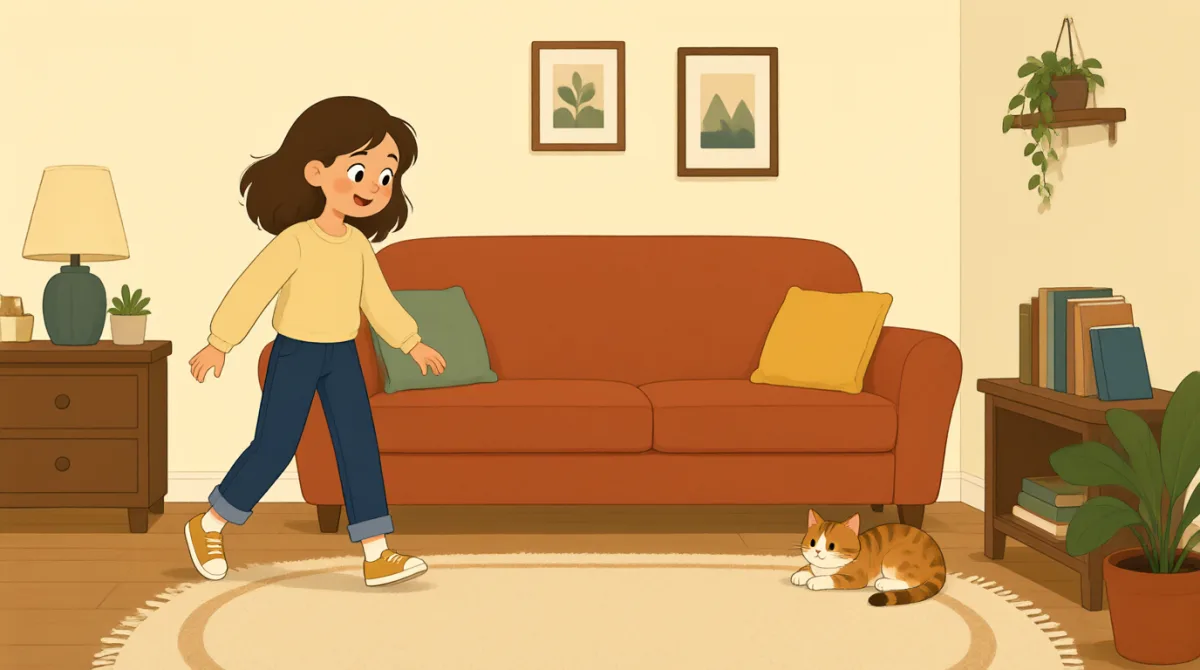

Hi, Grace. I’m at your house, but I can’t see the cat.
Salut, Grace. Je suis chez toi, mais je ne vois pas le chat.

Oh, she may be hiding. Where are you now?
Oh, elle se cache peut-être. Tu es où, là ?
I’m in the living room. Where does she like to hide?
Je suis dans le salon. Où est-ce qu’elle aime se cacher ?
Look under the bed or behind the sofa.
Regarde sous le lit ou derrière le canapé.
Okay. Does she come out if I call her?
D’accord. Est-ce qu’elle sort si je l’appelle ?
Yes. Say her name softly, and wait a little.
Oui. Dis son nom doucement et attends un peu.
I’ll look under the bed first. Thank you!
Je vais d’abord regarder sous le lit. Merci !
Vocabulaire8
- I can’t see the cat.Je ne vois pas le chat.
Emma says she cannot find the cat. Use “I can’t see…” when something is not in view.
Emma dit qu’elle ne trouve pas le chat. Utilise “I can’t see…” quand quelque chose n’est pas dans ton champ de vision.
- hidingse cacher
The cat is hiding when she is in a place where people cannot see her. You can say, “The dog is hiding.”
Le chat se cache quand il est dans un endroit où les gens ne peuvent pas le voir. Tu peux dire : “The dog is hiding.”
- living roomsalon
A living room is a room in a home where people sit and relax. You can say, “I’m in the living room.”
Le salon est une pièce de la maison où l’on s’assoit et où l’on se détend. Tu peux dire : “I’m in the living room.”
- under the bedsous le lit
This means below the bed. Use “under” to say that one thing is below another.
Cela signifie en dessous du lit. Utilise “under” pour dire qu’une chose se trouve en dessous d’une autre.
- behind the sofaderrière le canapé
This means at the back of the sofa, where it may be hard to see. Use “behind” to talk about something at the back of another thing.
Cela signifie à l’arrière du canapé, là où il peut être difficile de voir. Utilise “behind” pour parler de quelque chose qui se trouve à l’arrière d’un autre objet.
- come outsortir
Here, “come out” means to leave a hiding place. You can ask, “Will the cat come out?”
Ici, “come out” signifie sortir de sa cachette. Tu peux demander : “Will the cat come out?”
- call herl’appeler
This means say her name to get her attention. You can say, “I call her, and she comes.”
Cela signifie dire son nom pour attirer son attention. Tu peux dire : “I call her, and she comes.”
- softlydoucement
“Softly” means in a quiet, gentle way. You can speak softly to a cat or a baby.
“Softly” signifie d’une manière calme et douce. Tu peux parler doucement à un chat ou à un bébé.
Phrases clés8
- 1
I’m at your house, but I can’t see the cat.
Je suis chez toi, mais je ne vois pas le chat.
This sentence tells someone where you are and what the problem is. Use “I’m at…” to say where you are.
Cette phrase indique à quelqu’un où tu es et quel est le problème. Utilise “I’m at…” pour dire où tu te trouves.
- 2
Where are you now?
Tu es où, là ?
This is a simple way to ask someone’s location. You can also ask, “Where are you now?” on the phone.
C’est une façon simple de demander où se trouve quelqu’un. Tu peux aussi demander “Where are you now?” au téléphone.
- 3
Where does she like to hide?
Où est-ce qu’elle aime se cacher ?
Use this question to ask about a place someone or an animal often hides. Change “she” to “he” or “they” as needed.
Utilise cette question pour demander où une personne ou un animal a l’habitude de se cacher. Remplace “she” par “he” ou “they” si nécessaire.
- 4
Look under the bed or behind the sofa.
Regarde sous le lit ou derrière le canapé.
This gives two simple places to search. Use “look under” and “look behind” to say where to check.
Cette phrase propose deux endroits simples où chercher. Utilise “look under” et “look behind” pour indiquer où regarder.
- 5
Does she come out if I call her?
Est-ce qu’elle sort si je l’appelle ?
This asks if something happens when you do something. You can reuse “Does [someone]… if I…?” in other situations.
Cette question demande si quelque chose se produit quand tu fais quelque chose. Tu peux réutiliser “Does [someone]… if I…?” dans d’autres situations.
- 6
Say her name softly, and wait a little.
Dis son nom doucement et attends un peu.
This gives two simple instructions. Use “say [something] softly” when you want someone to speak gently.
Cette phrase donne deux consignes simples. Utilise “say [something] softly” quand tu veux demander à quelqu’un de parler doucement.
- 7
I’ll look under the bed first.
Je vais d’abord regarder sous le lit.
This tells someone what you plan to do next. Use “I’ll…” to talk about a future action.
Cette phrase indique à quelqu’un ce que tu comptes faire ensuite. Utilise “I’ll…” pour parler d’une action future.
- 8
Thank you!
Merci !
This is a short, polite way to show you are grateful. Use it when someone helps you.
C’est une façon courte et polie de montrer que tu es reconnaissant. Utilise cette expression quand quelqu’un t’aide.