The Cat Is Hiding
La gata está escondida
Emma visits the house, but the cat is hiding. She calls Grace and asks where the cat likes to hide.
Emma va a la casa, pero la gata está escondida. Llama a Grace y le pregunta dónde le gusta esconderse a la gata.
Diálogo7
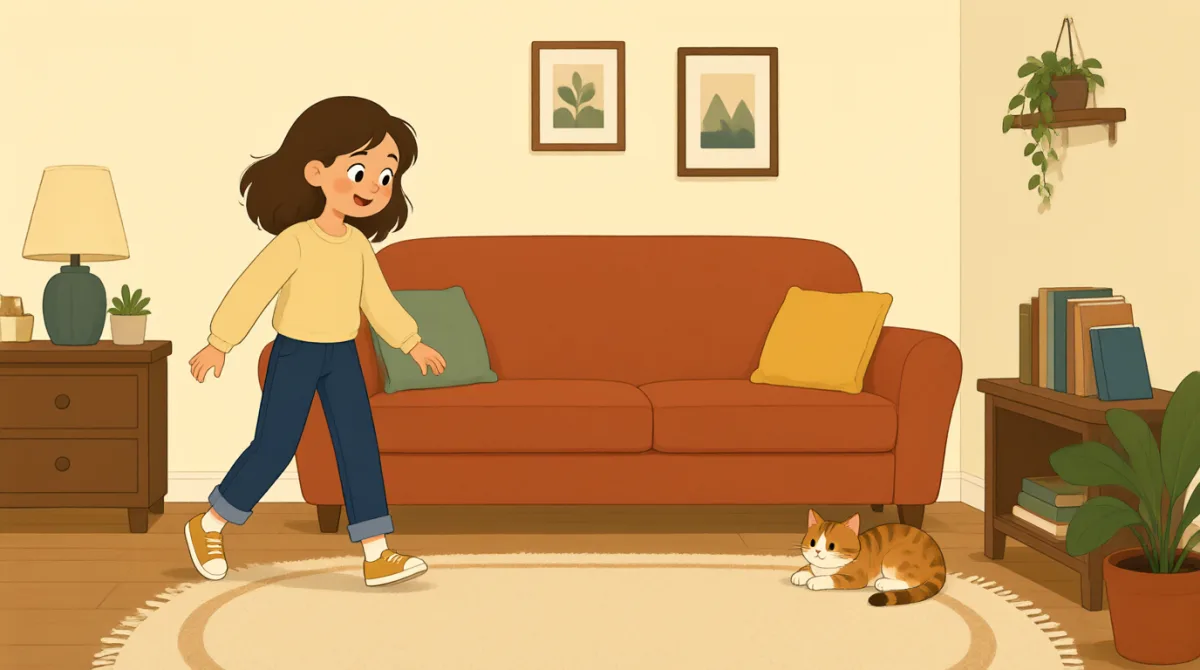

Hi, Grace. I’m at your house, but I can’t see the cat.
Hola, Grace. Estoy en tu casa, pero no veo a la gata.

Oh, she may be hiding. Where are you now?
Ah, puede que esté escondida. ¿Dónde estás ahora?
I’m in the living room. Where does she like to hide?
Estoy en la sala. ¿Dónde le gusta esconderse?
Look under the bed or behind the sofa.
Mira debajo de la cama o detrás del sofá.
Okay. Does she come out if I call her?
Está bien. ¿Sale si la llamo?
Yes. Say her name softly, and wait a little.
Sí. Di su nombre bajito y espera un poco.
I’ll look under the bed first. Thank you!
Primero voy a mirar debajo de la cama. ¡Gracias!
Vocabulario8
- I can’t see the cat.No veo a la gata.
Emma says she cannot find the cat. Use “I can’t see…” when something is not in view.
Emma dice que no encuentra a la gata. Usa “I can’t see…” cuando algo no está a la vista.
- hidingescondida
The cat is hiding when she is in a place where people cannot see her. You can say, “The dog is hiding.”
La gata está escondida cuando se encuentra en un lugar donde la gente no puede verla. Puedes decir: “The dog is hiding.”
- living roomsala
A living room is a room in a home where people sit and relax. You can say, “I’m in the living room.”
La sala es una habitación de la casa donde la gente se sienta y descansa. Puedes decir: “I’m in the living room.”
- under the beddebajo de la cama
This means below the bed. Use “under” to say that one thing is below another.
Significa que está abajo de la cama. Usa “under” para decir que algo está debajo de otra cosa.
- behind the sofadetrás del sofá
This means at the back of the sofa, where it may be hard to see. Use “behind” to talk about something at the back of another thing.
Significa que está en la parte de atrás del sofá, donde puede ser difícil verlo. Usa “behind” para hablar de algo que está detrás de otra cosa.
- come outsalir
Here, “come out” means to leave a hiding place. You can ask, “Will the cat come out?”
Aquí, “come out” significa salir de un escondite. Puedes preguntar: “Will the cat come out?”
- call herllamarla
This means say her name to get her attention. You can say, “I call her, and she comes.”
Significa decir su nombre para llamar su atención. Puedes decir: “I call her, and she comes.”
- softlyen voz baja
“Softly” means in a quiet, gentle way. You can speak softly to a cat or a baby.
“Softly” significa de manera tranquila y suave. Puedes hablar en voz baja a un gato o a un bebé.
Frases clave8
- 1
I’m at your house, but I can’t see the cat.
Estoy en tu casa, pero no veo a la gata.
This sentence tells someone where you are and what the problem is. Use “I’m at…” to say where you are.
Esta frase le dice a alguien dónde estás y cuál es el problema. Usa “I’m at…” para decir dónde estás.
- 2
Where are you now?
¿Dónde estás ahora?
This is a simple way to ask someone’s location. You can also ask, “Where are you now?” on the phone.
Es una forma sencilla de preguntarle a alguien dónde está. También puedes preguntar “Where are you now?” por teléfono.
- 3
Where does she like to hide?
¿Dónde le gusta esconderse?
Use this question to ask about a place someone or an animal often hides. Change “she” to “he” or “they” as needed.
Usa esta pregunta para preguntar por un lugar donde alguien o un animal suele esconderse. Cambia “she” por “he” o “they” según corresponda.
- 4
Look under the bed or behind the sofa.
Mira debajo de la cama o detrás del sofá.
This gives two simple places to search. Use “look under” and “look behind” to say where to check.
Esta frase da dos lugares sencillos para buscar. Usa “look under” y “look behind” para decir dónde hay que mirar.
- 5
Does she come out if I call her?
¿Sale si la llamo?
This asks if something happens when you do something. You can reuse “Does [someone]… if I…?” in other situations.
Esta pregunta sirve para saber si algo pasa cuando haces algo. Puedes reutilizar “Does [someone]… if I…?” en otras situaciones.
- 6
Say her name softly, and wait a little.
Di su nombre en voz baja y espera un poco.
This gives two simple instructions. Use “say [something] softly” when you want someone to speak gently.
Esta frase da dos instrucciones sencillas. Usa “say [something] softly” cuando quieras que alguien hable con suavidad.
- 7
I’ll look under the bed first.
Primero voy a mirar debajo de la cama.
This tells someone what you plan to do next. Use “I’ll…” to talk about a future action.
Esta frase le dice a alguien qué piensas hacer después. Usa “I’ll…” para hablar de una acción futura.
- 8
Thank you!
¡Gracias!
This is a short, polite way to show you are grateful. Use it when someone helps you.
Es una forma breve y amable de expresar agradecimiento. Úsala cuando alguien te ayude.