Giving the Key Back
Rendre la clé
Grace is home, and Emma gives her the key back. They talk briefly about how the cat is doing.
Grace est chez elle, et Emma lui rend la clé. Elles parlent brièvement de la santé du chat.
Dialogue8
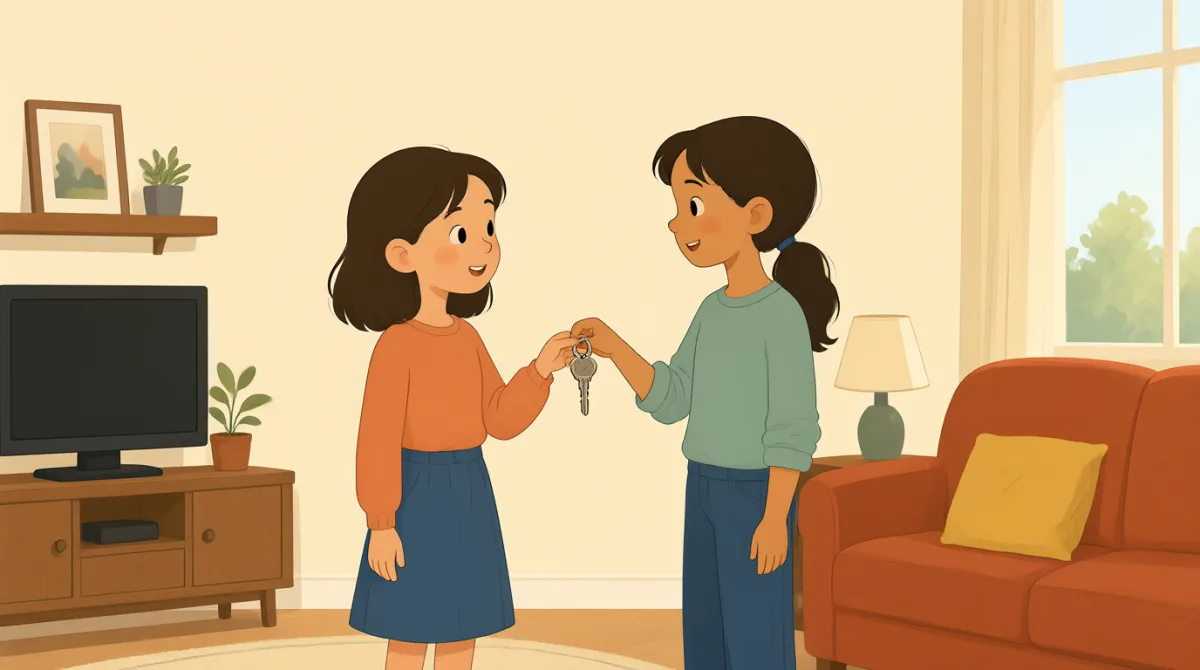

Hi, Emma. Thanks for feeding my cat.
Salut, Emma. Merci d’avoir nourri mon chat.

Of course. Here is your key.
Bien sûr. Voici ta clé.
Thanks. How is the cat doing?
Merci. Comment va le chat ?
She is fine. She ate all her food.
Elle va bien. Elle a tout mangé.
Great! Did you give her fresh water?
Super ! Tu lui as donné de l’eau fraîche ?
Yes, I did. Her water bowl is full.
Oui. Sa gamelle d’eau est pleine.
Thank you so much, Emma.
Merci beaucoup, Emma.
You're welcome. She is a sweet cat.
Je t’en prie. C’est un chat adorable.
Vocabulaire8
- Of course.Bien sûr.
This is a friendly way to say yes or that something is no problem. Use it when someone asks for help or thanks you.
C’est une façon amicale de dire oui ou de faire comprendre que ça ne pose aucun problème. Tu peux l’utiliser quand quelqu’un te demande de l’aide ou te remercie.
- Here is your key.Voici ta clé.
Use this when you give someone their key back. You can replace “key” with another item.
Utilise cette phrase quand tu rends sa clé à quelqu’un. Tu peux remplacer « key » par un autre objet.
- How is the cat doing?Comment va le chat ?
This asks how the cat is and if she is okay. You can use “How is [someone or something] doing?” to ask about their well-being.
Cette question demande comment va le chat et s’il se porte bien. Tu peux utiliser « How is [someone or something] doing? » pour prendre des nouvelles de quelqu’un ou de quelque chose.
- She ate all her food.Elle a tout mangé.
This means the cat finished all the food. Use “ate all” to say someone or an animal finished everything.
Cela signifie que le chat a fini toute sa nourriture. Utilise « ate all » pour dire qu’une personne ou un animal a tout terminé.
- fresh waterde l’eau fraîche
This means clean water that is new, not old. You can use “fresh” with food and drinks, too.
Cela désigne de l’eau propre et récemment changée, pas de l’eau qui a stagné. Tu peux aussi employer « fresh » pour parler de nourriture et de boissons.
- water bowlune gamelle d’eau
This is a bowl that holds water for an animal to drink. You can use “food bowl” for a bowl that holds pet food.
C’est un récipient où un animal peut boire de l’eau. Tu peux dire « food bowl » pour parler d’une gamelle contenant la nourriture d’un animal.
- You're welcome.Je t’en prie.
This is a polite reply when someone says “thank you.”
C’est une réponse polie quand quelqu’un dit « thank you ».
- sweet catun chat adorable
This means the cat is kind or nice. You can use “sweet” to describe a kind person or animal.
Cela signifie que le chat est gentil ou mignon. Tu peux utiliser « sweet » pour décrire une personne ou un animal gentil.
Phrases clés8
- 1
Thanks for feeding my cat.
Merci d’avoir nourri mon chat.
Use this to thank someone for giving your cat food. You can say “Thanks for [verb]-ing” to thank someone for an action.
Utilise cette phrase pour remercier quelqu’un d’avoir donné à manger à ton chat. Tu peux dire « Thanks for [verb]-ing » pour remercier quelqu’un d’avoir fait quelque chose.
- 2
Here is your key.
Voici ta clé.
Use this when you give someone their key back. Replace “key” with the item you are returning.
Utilise cette phrase quand tu rends sa clé à quelqu’un. Remplace « key » par l’objet que tu rends.
- 3
How is the cat doing?
Comment va le chat ?
This is a simple way to ask if the cat is okay. Replace “the cat” with a person or another thing you want to ask about.
C’est une façon simple de demander si le chat va bien. Remplace « the cat » par une personne ou une autre chose dont tu veux prendre des nouvelles.
- 4
She ate all her food.
Elle a tout mangé.
Use this to say that someone or an animal finished all the food. Replace “she” and “her food” to talk about someone else.
Utilise cette phrase pour dire qu’une personne ou un animal a fini toute sa nourriture. Remplace « she » et « her food » pour parler de quelqu’un d’autre.
- 5
Did you give her fresh water?
Tu lui as donné de l’eau fraîche ?
Use this to ask if someone gave the cat clean water. “Did you” is useful for asking about a past action.
Utilise cette phrase pour demander si quelqu’un a donné de l’eau propre au chat. « Did you » sert à poser une question sur une action passée.
- 6
Her water bowl is full.
Sa gamelle d’eau est pleine.
This tells someone that the cat has plenty of water. Replace “water bowl” with another thing to describe what is full.
Cette phrase indique que le chat a suffisamment d’eau. Remplace « water bowl » par un autre objet pour dire qu’il est plein.
- 7
Thank you so much, Emma.
Merci beaucoup, Emma.
This is a warm way to say thank you. You can use it when you feel very grateful.
C’est une façon chaleureuse de remercier quelqu’un. Tu peux l’utiliser quand tu lui es très reconnaissant.
- 8
She is a sweet cat.
C’est un chat adorable.
Use this to say the cat is kind or nice. Replace “cat” with another person or animal.
Utilise cette phrase pour dire que le chat est gentil ou mignon. Remplace « cat » par une autre personne ou un autre animal.