The Cat Is Hiding
Die Katze versteckt sich
Emma visits the house, but the cat is hiding. She calls Grace and asks where the cat likes to hide.
Emma kommt zu Grace nach Hause, aber die Katze versteckt sich. Sie ruft Grace an und fragt, wo sich die Katze gern versteckt.
Dialog7
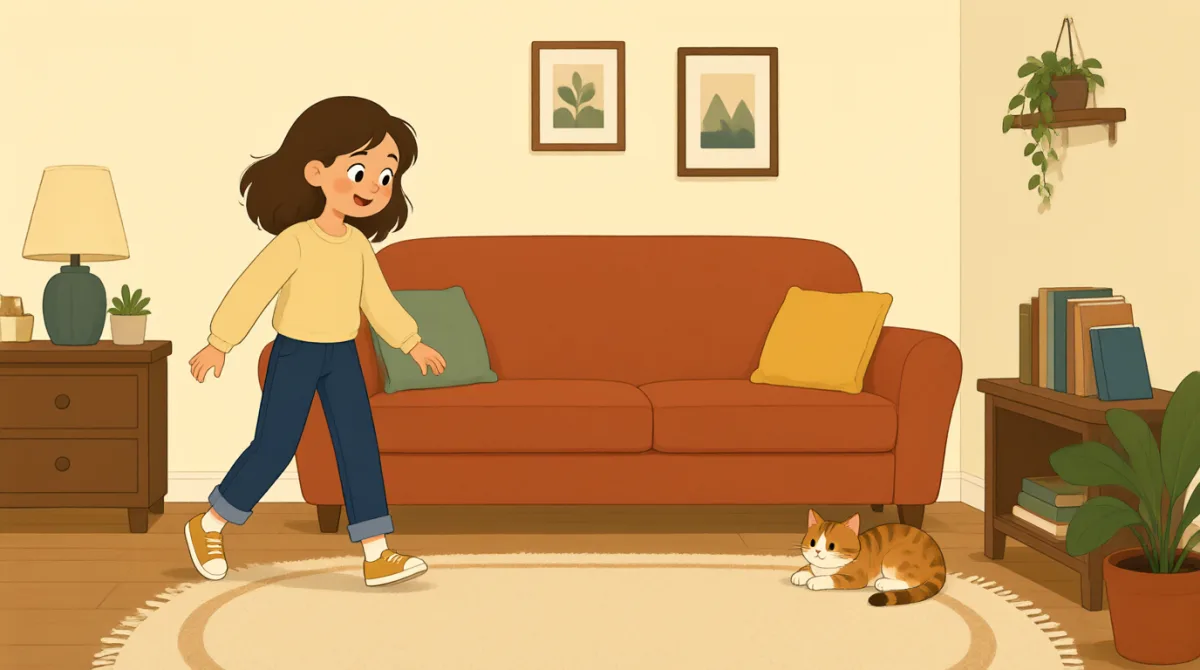

Hi, Grace. I’m at your house, but I can’t see the cat.
Hi, Grace. Ich bin bei dir zu Hause, aber ich sehe die Katze nicht.

Oh, she may be hiding. Where are you now?
Oh, vielleicht versteckt sie sich. Wo bist du gerade?
I’m in the living room. Where does she like to hide?
Ich bin im Wohnzimmer. Wo versteckt sie sich gern?
Look under the bed or behind the sofa.
Schau unter dem Bett oder hinter dem Sofa nach.
Okay. Does she come out if I call her?
Okay. Kommt sie raus, wenn ich sie rufe?
Yes. Say her name softly, and wait a little.
Ja. Sag leise ihren Namen und warte ein bisschen.
I’ll look under the bed first. Thank you!
Ich schaue zuerst unter dem Bett nach. Danke!
Wortschatz8
- I can’t see the cat.Ich sehe die Katze nicht.
Emma says she cannot find the cat. Use “I can’t see…” when something is not in view.
Emma sagt, dass sie die Katze nicht finden kann. Mit “I can’t see…” (Ich kann … nicht sehen) sagst du, dass etwas nicht zu sehen ist.
- hidingsich verstecken
The cat is hiding when she is in a place where people cannot see her. You can say, “The dog is hiding.”
Die Katze versteckt sich, wenn sie an einem Ort ist, wo Menschen sie nicht sehen können. Du kannst zum Beispiel sagen: “The dog is hiding.” (Der Hund versteckt sich.)
- living roomWohnzimmer
A living room is a room in a home where people sit and relax. You can say, “I’m in the living room.”
Ein Wohnzimmer ist ein Raum in einem Zuhause, in dem man sitzt und sich entspannt. Du kannst sagen: “I’m in the living room.” (Ich bin im Wohnzimmer.)
- under the bedunter dem Bett
This means below the bed. Use “under” to say that one thing is below another.
Das bedeutet: unterhalb des Bettes. Mit “under” sagst du, dass sich etwas unter einer anderen Sache befindet.
- behind the sofahinter dem Sofa
This means at the back of the sofa, where it may be hard to see. Use “behind” to talk about something at the back of another thing.
Das bedeutet: an der Rückseite des Sofas, wo man etwas vielleicht nur schwer sehen kann. Mit “behind” sprichst du davon, dass sich etwas hinter einer anderen Sache befindet.
- come outherauskommen
Here, “come out” means to leave a hiding place. You can ask, “Will the cat come out?”
Hier bedeutet “come out”, einen Ort zu verlassen, an dem man sich versteckt. Du kannst fragen: “Will the cat come out?” (Kommt die Katze heraus?)
- call hersie rufen
This means say her name to get her attention. You can say, “I call her, and she comes.”
Das bedeutet, ihren Namen zu sagen, um ihre Aufmerksamkeit zu bekommen. Du kannst sagen: “I call her, and she comes.” (Ich rufe sie, und sie kommt.)
- softlyleise
“Softly” means in a quiet, gentle way. You can speak softly to a cat or a baby.
“Softly” bedeutet auf ruhige, sanfte Weise. Du kannst leise mit einer Katze oder einem Baby sprechen.
Wichtige Sätze8
- 1
I’m at your house, but I can’t see the cat.
Ich bin bei dir zu Hause, aber ich sehe die Katze nicht.
This sentence tells someone where you are and what the problem is. Use “I’m at…” to say where you are.
Mit diesem Satz sagst du jemandem, wo du bist und was das Problem ist. Mit “I’m at…” kannst du sagen, wo du dich befindest.
- 2
Where are you now?
Wo bist du gerade?
This is a simple way to ask someone’s location. You can also ask, “Where are you now?” on the phone.
So kannst du einfach fragen, wo jemand gerade ist. Du kannst am Telefon auch fragen: “Where are you now?”
- 3
Where does she like to hide?
Wo versteckt sie sich gern?
Use this question to ask about a place someone or an animal often hides. Change “she” to “he” or “they” as needed.
Mit dieser Frage erkundigst du dich, an welchem Ort sich jemand oder ein Tier oft versteckt. Ändere “she” bei Bedarf zu “he” oder “they”.
- 4
Look under the bed or behind the sofa.
Schau unter dem Bett oder hinter dem Sofa nach.
This gives two simple places to search. Use “look under” and “look behind” to say where to check.
Hier werden zwei einfache Orte genannt, an denen man suchen kann. Mit “look under” und “look behind” sagst du, wo jemand nachschauen soll.
- 5
Does she come out if I call her?
Kommt sie raus, wenn ich sie rufe?
This asks if something happens when you do something. You can reuse “Does [someone]… if I…?” in other situations.
Damit fragst du, ob etwas passiert, wenn du etwas tust. Du kannst “Does [someone]… if I…?” auch in anderen Situationen verwenden.
- 6
Say her name softly, and wait a little.
Sag leise ihren Namen und warte ein bisschen.
This gives two simple instructions. Use “say [something] softly” when you want someone to speak gently.
Das sind zwei einfache Anweisungen. Mit “say [something] softly” bittest du jemanden, etwas sanft zu sagen.
- 7
I’ll look under the bed first.
Ich schaue zuerst unter dem Bett nach.
This tells someone what you plan to do next. Use “I’ll…” to talk about a future action.
Damit sagst du jemandem, was du als Nächstes vorhast. Mit “I’ll…” sprichst du über eine Handlung in der Zukunft.
- 8
Thank you!
Danke!
This is a short, polite way to show you are grateful. Use it when someone helps you.
Das ist eine kurze, höfliche Art, sich zu bedanken. Verwende den Ausdruck, wenn dir jemand hilft.