Bringing a Gift
Llevar un regalo
Emma brings Leo a small gift and checks with the nurse that it is okay to take it into his room.
Emma le lleva a Leo un pequeño libro de pasatiempos y le pregunta a la enfermera si puede llevarlo a su habitación.
Diálogo8
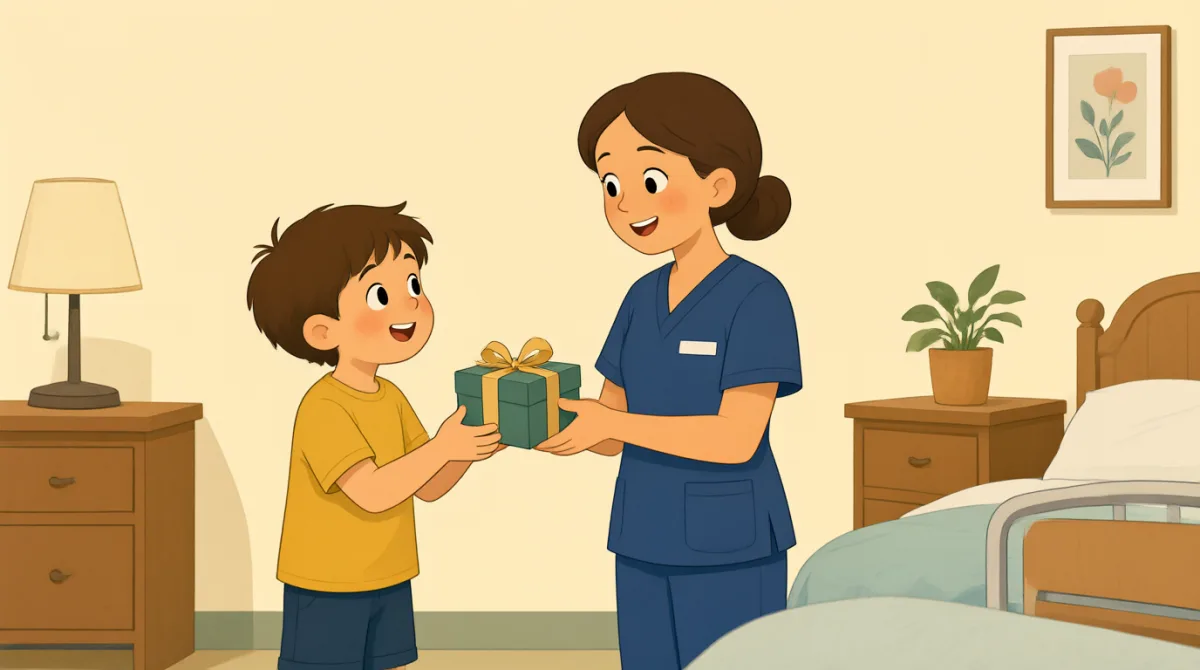

I brought Leo a small puzzle book. Can I take it into his room?
Le traje a Leo un pequeño libro de pasatiempos. ¿Puedo llevarlo a su habitación?

That should be fine. What kind of puzzle book is it?
No debería haber problema. ¿Qué tipo de libro de pasatiempos es?
It has simple word games. I thought it might help him pass the time.
Tiene juegos de palabras sencillos. Pensé que quizá le ayudaría a pasar el rato.
That sounds nice. Just check that it doesn't tire him out.
Suena bien. Solo asegúrate de que no lo canse.
Of course. Is there anything else I should know before I go in?
Claro. ¿Hay algo más que deba saber antes de entrar?
Please keep the room quiet, and don't bring in any food or drinks.
Por favor, mantenga la habitación en silencio y no traiga comida ni bebidas.
Got it. I'll give him the book and stay for a short visit.
Entendido. Le daré el libro y me quedaré un rato.
Great. I hope he enjoys it. You can go in now.
Muy bien. Espero que le guste. Ya puede entrar.
Vocabulario7
- take it into his roomllevarlo a su habitación
This means carry the book into Leo’s hospital room. Use “take something into a room” when asking about bringing an item inside.
Significa llevar el libro a la habitación del hospital de Leo. Usa “take something into a room” cuando preguntes si puedes llevar algo adentro.
- That should be fine.No debería haber problema.
This is a polite way to say something is probably okay. You can use it when giving permission or answering a request.
Es una forma cortés de decir que algo probablemente está bien. Puedes usarla para dar permiso o responder a una petición.
- pass the timepasar el rato
This means do something to make a wait feel shorter. You can pass the time by reading, playing a game, or talking.
Significa hacer algo para que la espera se haga más corta. Puedes pasar el rato leyendo, jugando o conversando.
- tire him outcansarlo
This means make him feel tired. Use “tire someone out” when an activity takes a lot of energy.
Significa hacer que se sienta cansado. Usa “tire someone out” cuando una actividad requiere mucha energía.
- go inentrar
Here, this means enter the hospital room. “Go in” is a common phrasal verb for entering a place.
Aquí significa entrar en la habitación del hospital. “Go in” es un verbo frasal muy común para hablar de entrar en un lugar.
- keep the room quietmantener la habitación en silencio
This means make sure there is not much noise in the room. You can use “keep [a place] quiet” when asking people to be quiet.
Significa procurar que no haya mucho ruido en la habitación. Puedes usar “keep [a place] quiet” cuando pides que mantengan silencio en un lugar.
- stay for a short visitquedarse un rato
This means remain for only a little while when visiting someone. You can use this phrase to explain that your visit will be brief.
Significa quedarse solo un poco de tiempo cuando visitas a alguien. Puedes usar esta expresión para explicar que tu visita será breve.
Frases clave8
- 1
I brought Leo a small puzzle book.
Le traje a Leo un pequeño libro de pasatiempos.
Use this sentence to say what you brought someone. You can replace “a small puzzle book” with another gift or item.
Usa esta oración para decir qué le llevaste a alguien. Puedes reemplazar “a small puzzle book” por otro regalo u objeto.
- 2
Can I take it into his room?
¿Puedo llevarlo a su habitación?
This is a polite way to ask permission to bring something into a room. Replace “it” and “his room” with the item and place you mean.
Es una forma cortés de pedir permiso para llevar algo a una habitación. Reemplaza “it” y “his room” por el objeto y el lugar que quieras decir.
- 3
I thought it might help him pass the time.
Pensé que quizá le ayudaría a pasar el rato.
Use this sentence to explain why you chose something for someone. “Might help” expresses a possible benefit.
Usa esta oración para explicar por qué elegiste algo para alguien. “Might help” expresa un posible beneficio.
- 4
Just check that it doesn't tire him out.
Solo asegúrate de que no lo canse.
This is a gentle way to remind someone to make sure an activity is not too tiring. You can use “check that” to give a simple precaution.
Es una forma amable de recordar a alguien que se asegure de que una actividad no sea demasiado agotadora. Puedes usar “check that” para dar una precaución sencilla.
- 5
Is there anything else I should know before I go in?
¿Hay algo más que deba saber antes de entrar?
Use this question to ask for important information before entering or doing something. You can replace “go in” with another action.
Usa esta pregunta para pedir información importante antes de entrar o hacer algo. Puedes reemplazar “go in” por otra acción.
- 6
Please keep the room quiet, and don't bring in any food or drinks.
Por favor, mantenga la habitación en silencio y no traiga comida ni bebidas.
This sentence gives two clear, polite instructions. Use “Please” for a request and “don’t” to say what someone should avoid.
Esta oración da dos instrucciones claras y corteses. Usa “Please” para hacer una petición y “don’t” para indicar qué debe evitar alguien.
- 7
I'll give him the book and stay for a short visit.
Le daré el libro y me quedaré un rato.
Use this sentence to describe what you plan to do. “I’ll” is a natural short form of “I will” for a future plan.
Usa esta oración para describir lo que planeas hacer. “I’ll” es una forma abreviada y natural de “I will” para hablar de un plan futuro.
- 8
You can go in now.
Ya puede entrar.
This is a simple way to give someone permission to enter. You can replace “go in” with another action, such as “start now.”
Es una forma sencilla de dar permiso para entrar. Puedes reemplazar “go in” por otra acción, como “start now.”