Bringing a Gift
Emma brings Leo a small gift and checks with the nurse that it is okay to take it into his room.
Dialogue8
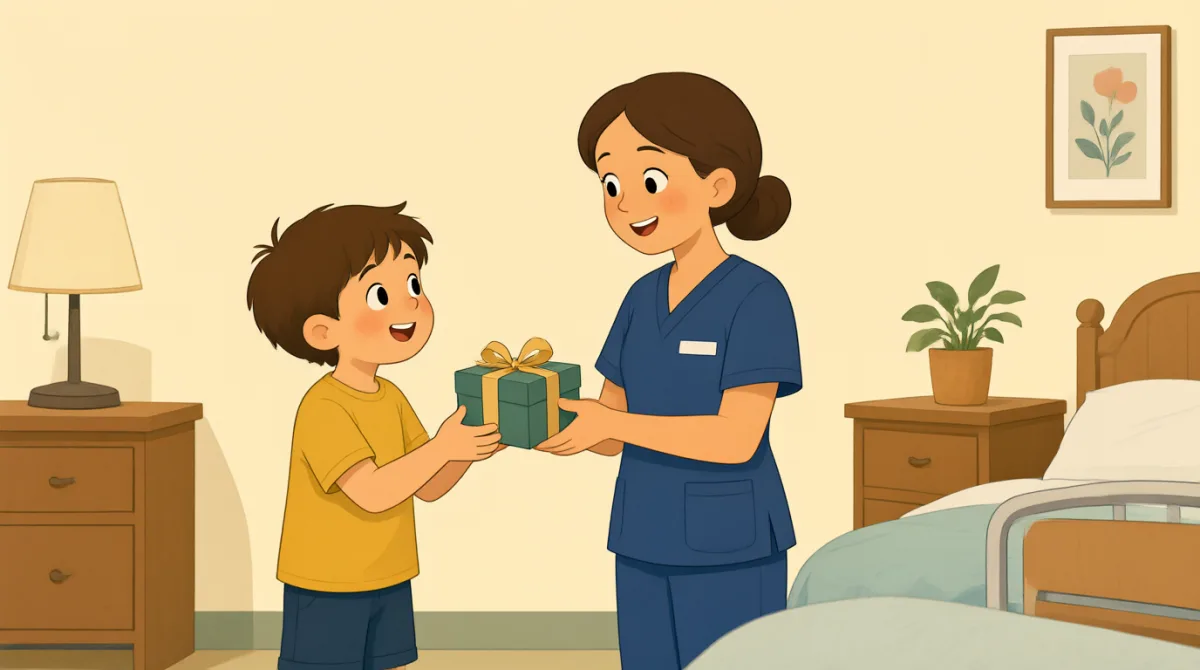

I brought Leo a small puzzle book. Can I take it into his room?

That should be fine. What kind of puzzle book is it?
It has simple word games. I thought it might help him pass the time.
That sounds nice. Just check that it doesn't tire him out.
Of course. Is there anything else I should know before I go in?
Please keep the room quiet, and don't bring in any food or drinks.
Got it. I'll give him the book and stay for a short visit.
Great. I hope he enjoys it. You can go in now.
Vocabulary7
- take it into his room
This means carry the book into Leo’s hospital room. Use “take something into a room” when asking about bringing an item inside.
- That should be fine.
This is a polite way to say something is probably okay. You can use it when giving permission or answering a request.
- pass the time
This means do something to make a wait feel shorter. You can pass the time by reading, playing a game, or talking.
- tire him out
This means make him feel tired. Use “tire someone out” when an activity takes a lot of energy.
- go in
Here, this means enter the hospital room. “Go in” is a common phrasal verb for entering a place.
- keep the room quiet
This means make sure there is not much noise in the room. You can use “keep [a place] quiet” when asking people to be quiet.
- stay for a short visit
This means remain for only a little while when visiting someone. You can use this phrase to explain that your visit will be brief.
Key Sentences8
- 1
I brought Leo a small puzzle book.
Use this sentence to say what you brought someone. You can replace “a small puzzle book” with another gift or item.
- 2
Can I take it into his room?
This is a polite way to ask permission to bring something into a room. Replace “it” and “his room” with the item and place you mean.
- 3
I thought it might help him pass the time.
Use this sentence to explain why you chose something for someone. “Might help” expresses a possible benefit.
- 4
Just check that it doesn't tire him out.
This is a gentle way to remind someone to make sure an activity is not too tiring. You can use “check that” to give a simple precaution.
- 5
Is there anything else I should know before I go in?
Use this question to ask for important information before entering or doing something. You can replace “go in” with another action.
- 6
Please keep the room quiet, and don't bring in any food or drinks.
This sentence gives two clear, polite instructions. Use “Please” for a request and “don’t” to say what someone should avoid.
- 7
I'll give him the book and stay for a short visit.
Use this sentence to describe what you plan to do. “I’ll” is a natural short form of “I will” for a future plan.
- 8
You can go in now.
This is a simple way to give someone permission to enter. You can replace “go in” with another action, such as “start now.”