Choosing a Trail
Elegir un sendero
Emma and Jack look at the trail map and choose a route that fits their time and experience. They pack water and a few snacks before setting off.
Emma y Jack miran el mapa de senderos y eligen una ruta que se ajuste al tiempo que tienen y a su experiencia. Preparan agua y algunos bocadillos antes de ponerse en marcha.
Diálogo8
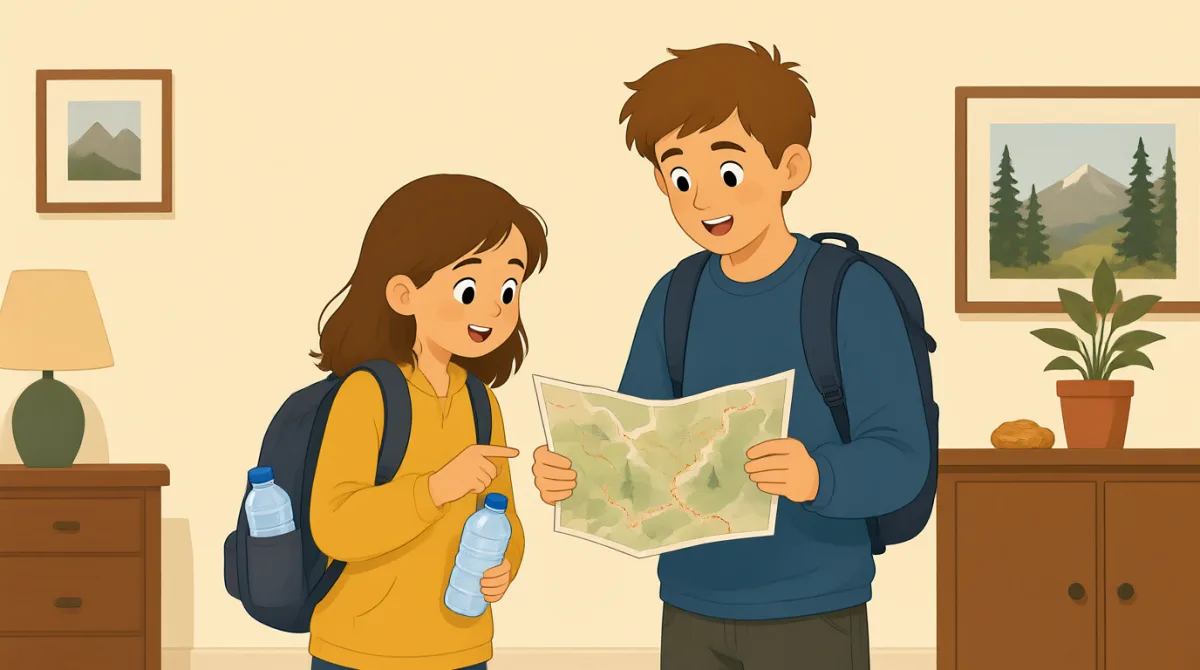

Jack, how much time do we have for the hike?
Jack, ¿cuánto tiempo tenemos para la caminata?

About two hours. Let's check the trail map before we choose.
Unas dos horas. Revisemos el mapa de senderos antes de elegir.
This loop is four miles. Is that too far for us?
Este circuito tiene cuatro millas. ¿Será demasiado para nosotros?
It looks a little hard, and it may take three hours.
Parece un poco difícil y quizá nos lleve tres horas.
What about the shorter trail? It says one and a half miles.
¿Y el sendero más corto? Dice que tiene una milla y media.
That sounds good. It should take about an hour, and the view looks nice.
Suena bien. Debería llevarnos como una hora, y la vista parece bonita.
Great! I'll pack water and some snacks. Do you have the map?
¡Genial! Voy a preparar agua y algunos bocadillos. ¿Tienes el mapa?
Yes. I've got the map. Let's pack up and set off.
Sí, tengo el mapa. Preparemos todo y pongámonos en marcha.
Vocabulario6
- trail mapmapa de senderos
A map that shows paths in a natural area. You can check it to choose a route.
Un mapa que muestra los caminos de una zona natural. Puedes consultarlo para elegir una ruta.
- loopcircuito
A route that goes around and returns to where it started. You can use “loop” when talking about a walking or hiking path.
Una ruta que da la vuelta y regresa al punto de partida. Puedes usar “loop” para hablar de un camino para caminar o hacer senderismo.
- a little hardun poco difícil
Somewhat difficult. Use “a little” before an adjective to describe something as slightly difficult or different.
Algo difícil, pero no demasiado. Usa “a little” antes de un adjetivo para describir algo como ligeramente difícil o diferente.
- shorter trailsendero más corto
A trail that is not as long as another one. Use “shorter” to compare the lengths of two routes.
Un sendero que no es tan largo como otro. Usa “shorter” para comparar la longitud de dos rutas.
- pack waterllevar agua
To put water in your bag to take with you. You can use “pack” with other things you need for a trip, like snacks or clothes.
Poner agua en la mochila para llevarla contigo. Puedes usar “pack” con otras cosas que necesites para una salida, como bocadillos o ropa.
- set offponerse en marcha
To begin a journey or trip. You can say “set off” when you start walking, driving, or traveling.
Empezar un viaje o una salida. Puedes decir “set off” cuando empiezas a caminar, conducir o viajar.
Frases clave7
- 1
How much time do we have for the hike?
¿Cuánto tiempo tenemos para la caminata?
This is a useful way to ask how much time is available for an activity. You can replace “the hike” with another event or task.
Esta es una forma útil de preguntar cuánto tiempo hay disponible para una actividad. Puedes reemplazar “the hike” por otro evento o tarea.
- 2
Let's check the trail map before we choose.
Revisemos el mapa de senderos antes de elegir.
Use “Let’s” to suggest doing something together. You can replace “check the trail map” with another action and “choose” with a decision.
Usa “Let’s” para proponer hacer algo juntos. Puedes reemplazar “check the trail map” por otra acción y “choose” por una decisión.
- 3
Is that too far for us?
¿Será demasiado para nosotros?
This is a simple way to ask whether something is beyond your group’s ability or comfort. You can replace “far” with an adjective like “hard” or “expensive.”
Esta es una forma sencilla de preguntar si algo supera las capacidades o la comodidad de tu grupo. Puedes reemplazar “far” por un adjetivo como “hard” o “expensive.”
- 4
It may take three hours.
Quizá nos lleve tres horas.
Use “may” to say that something is possible but not certain. You can change the activity or the amount of time.
Usa “may” para decir que algo es posible, pero no seguro. Puedes cambiar la actividad o la cantidad de tiempo.
- 5
That sounds good.
Suena bien.
This is a friendly way to agree with an idea or plan. You can use it in everyday conversations when someone makes a suggestion.
Esta es una forma amigable de aceptar una idea o un plan. Puedes usarla en conversaciones cotidianas cuando alguien hace una sugerencia.
- 6
I'll pack water and some snacks.
Voy a llevar agua y algunos bocadillos.
Use “I’ll” to talk about a decision or plan you are making now. You can replace “water and some snacks” with other things you will bring.
Usa “I’ll” para hablar de una decisión o un plan que estás haciendo en ese momento. Puedes reemplazar “water and some snacks” por otras cosas que vayas a llevar.
- 7
Let's pack up and set off.
Preparemos todo y pongámonos en marcha.
This suggests getting your things ready and then starting a journey. You can use “Let’s” to invite someone to do both actions with you.
Esta frase propone preparar tus cosas y luego empezar un viaje. Puedes usar “Let’s” para invitar a alguien a hacer ambas cosas contigo.