Explaining Where It Hurts
Explicar dónde duele
At the spa, Emma tells Mia, her therapist, that her shoulders and back feel sore. Mia asks a few simple questions.
En el spa, Emma le cuenta a Mia, su masajista, que le duelen los hombros y la espalda. Mia le hace algunas preguntas sencillas.
Diálogo8
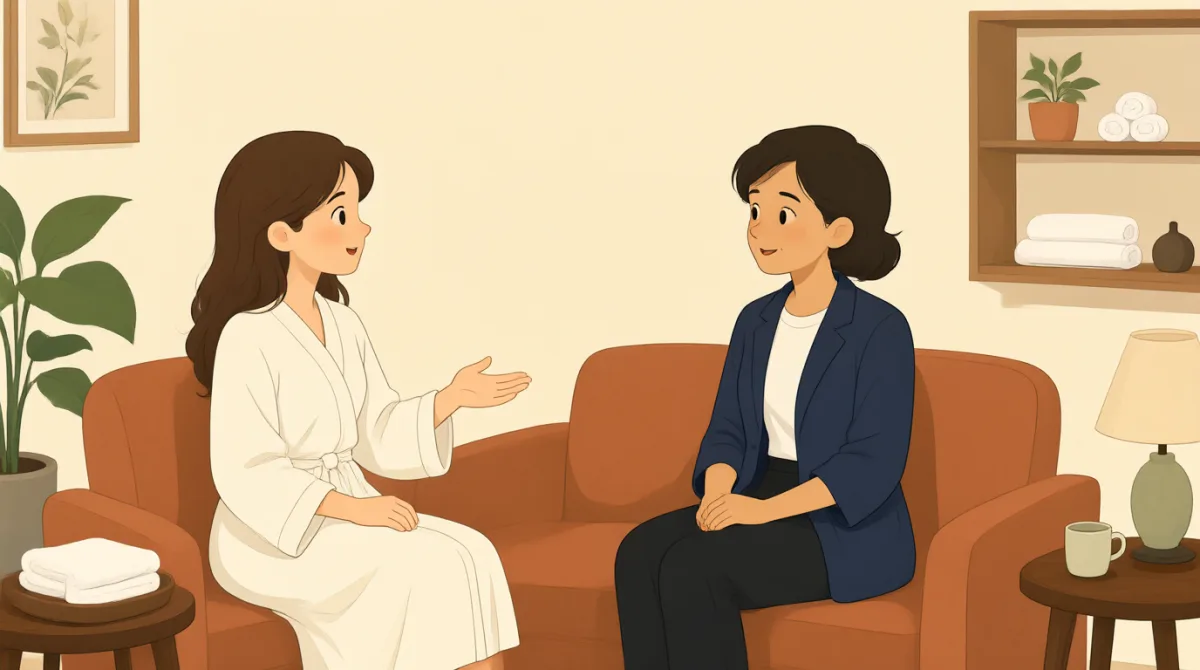

Hi, Mia. My shoulders and upper back feel sore today.
Hola, Mia. Hoy me duelen los hombros y la parte alta de la espalda.

I’m sorry to hear that. When did the soreness start?
Siento que te pase. ¿Cuándo empezó el dolor?
It started yesterday after I worked at my desk all day.
Empezó ayer, después de trabajar todo el día en mi escritorio.
Does the pain feel sharp, or is it more like a dull ache?
¿El dolor es punzante o más bien sordo?
It’s a dull ache, mostly around my shoulders and neck.
Es un dolor sordo, sobre todo en los hombros y el cuello.
Okay. Do you have any pain or injuries I should know about?
De acuerdo. ¿Tienes algún dolor o alguna lesión que deba saber?
No injuries. My lower back feels a little tight, too.
No tengo lesiones. También siento un poco tensa la parte baja de la espalda.
Thanks for telling me. I’ll check in with you during the massage.
Gracias por decírmelo. Durante el masaje, iré preguntándote cómo te sientes.
Vocabulario7
- feel soredoler
To feel sore means to have pain or discomfort in your body. Use it to describe aching muscles.
“Feel sore” significa tener dolor o molestias en el cuerpo. Se usa para describir músculos adoloridos.
- sorenessdolor
Soreness is pain or discomfort in part of your body. You can say when the soreness started.
“Soreness” es dolor o molestia en una parte del cuerpo. Puedes decir cuándo empezó el dolor.
- dull achedolor sordo
A dull ache is a steady, mild pain. Use this phrase to describe what your pain feels like.
“Dull ache” es un dolor leve y constante. Usa esta expresión para describir cómo se siente el dolor.
- sharppunzante
Sharp describes a sudden, strong kind of pain. You can use it to explain how pain feels.
“Sharp” describe un dolor repentino e intenso, como un pinchazo. Puedes usar esta palabra para explicar cómo se siente el dolor.
- lower backparte baja de la espalda
Your lower back is the part of your back near your waist. Use this phrase to say where you feel pain or tightness.
“Lower back” es la parte de la espalda que queda cerca de la cintura. Usa esta expresión para indicar dónde sientes dolor o tensión.
- tighttenso
When a muscle feels tight, it feels stiff or tense. You can use this word to describe how your back or shoulders feel.
Cuando un músculo se siente “tight”, está rígido o tenso. Puedes usar esta palabra para describir cómo sientes la espalda o los hombros.
- check in with youpreguntarte cómo te sientes
To check in with someone means to ask how they are doing. A therapist can check in with you during a massage.
“Check in with you” significa preguntarle a alguien cómo está. Durante un masaje, el terapeuta puede preguntarte cómo te sientes.
Frases clave8
- 1
My shoulders and upper back feel sore today.
Hoy me duelen los hombros y la parte alta de la espalda.
Use this sentence to tell someone which parts of your body hurt. You can replace the body parts or change “today” to another time.
Usa esta frase para decir qué partes del cuerpo te duelen. Puedes cambiar las partes del cuerpo o reemplazar “today” por otro momento.
- 2
When did the soreness start?
¿Cuándo empezó el dolor?
This is a simple way to ask when someone’s pain began. You can replace “the soreness” with another problem, such as “the headache.”
Esta es una forma sencilla de preguntar cuándo comenzó el dolor de alguien. Puedes reemplazar “the soreness” por otro problema, como “the headache”.
- 3
It started yesterday after I worked at my desk all day.
Empezó ayer, después de trabajar todo el día en mi escritorio.
Use this sentence to explain when a problem began and what happened before it. Replace “yesterday” and the activity with your own details.
Usa esta frase para explicar cuándo empezó un problema y qué pasó antes. Cambia “yesterday” y la actividad por tus propios detalles.
- 4
Does the pain feel sharp, or is it more like a dull ache?
¿El dolor es punzante o más bien sordo?
This question asks someone to describe their pain. You can use “Does it feel sharp?” to ask about a different kind of pain.
Esta pregunta le pide a alguien que describa su dolor. Puedes usar “Does it feel sharp?” para preguntar si el dolor es de otro tipo.
- 5
It’s a dull ache, mostly around my shoulders and neck.
Es un dolor sordo, sobre todo en los hombros y el cuello.
Use this sentence to describe both the kind and location of your pain. Replace the pain description or body parts as needed.
Usa esta frase para describir tanto el tipo como la ubicación del dolor. Cambia la descripción del dolor o las partes del cuerpo según sea necesario.
- 6
Do you have any pain or injuries I should know about?
¿Tienes algún dolor o alguna lesión que deba saber?
This is a useful question when asking about someone’s health before an activity. You can replace “pain or injuries” with other important information.
Esta pregunta es útil para preguntar por la salud de alguien antes de una actividad. Puedes reemplazar “pain or injuries” por otra información importante.
- 7
My lower back feels a little tight, too.
También siento un poco tensa la parte baja de la espalda.
Use this sentence to mention another body part that feels stiff or tense. Replace “my lower back” with a different body part.
Usa esta frase para mencionar otra parte del cuerpo que se siente rígida o tensa. Puedes reemplazar “my lower back” por otra parte del cuerpo.
- 8
I’ll check in with you during the massage.
Durante el masaje, iré preguntándote cómo te sientes.
Use this sentence to tell someone you will ask how they are feeling later. Replace “during the massage” with another activity or time.
Usa esta frase para decirle a alguien que más tarde le preguntarás cómo se siente. Puedes reemplazar “during the massage” por otra actividad o momento.