Explaining Where It Hurts
At the spa, Emma tells Mia, her therapist, that her shoulders and back feel sore. Mia asks a few simple questions.
Dialogue8
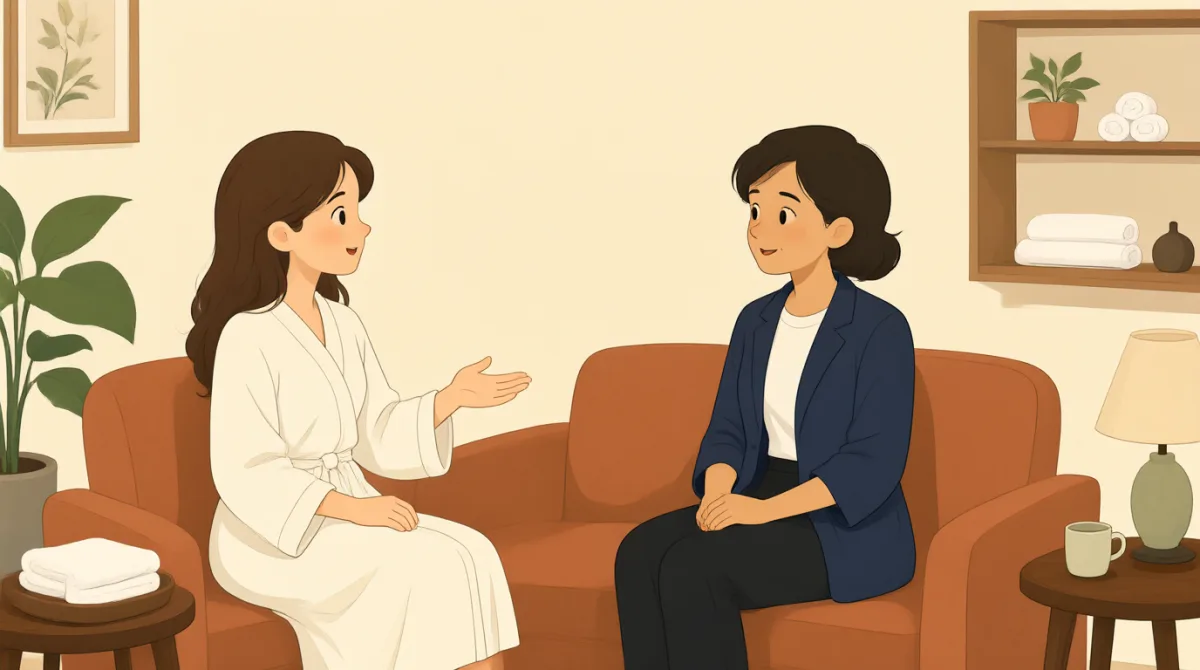

Hi, Mia. My shoulders and upper back feel sore today.

I’m sorry to hear that. When did the soreness start?
It started yesterday after I worked at my desk all day.
Does the pain feel sharp, or is it more like a dull ache?
It’s a dull ache, mostly around my shoulders and neck.
Okay. Do you have any pain or injuries I should know about?
No injuries. My lower back feels a little tight, too.
Thanks for telling me. I’ll check in with you during the massage.
Vocabulary7
- feel sore
To feel sore means to have pain or discomfort in your body. Use it to describe aching muscles.
- soreness
Soreness is pain or discomfort in part of your body. You can say when the soreness started.
- dull ache
A dull ache is a steady, mild pain. Use this phrase to describe what your pain feels like.
- sharp
Sharp describes a sudden, strong kind of pain. You can use it to explain how pain feels.
- lower back
Your lower back is the part of your back near your waist. Use this phrase to say where you feel pain or tightness.
- tight
When a muscle feels tight, it feels stiff or tense. You can use this word to describe how your back or shoulders feel.
- check in with you
To check in with someone means to ask how they are doing. A therapist can check in with you during a massage.
Key Sentences8
- 1
My shoulders and upper back feel sore today.
Use this sentence to tell someone which parts of your body hurt. You can replace the body parts or change “today” to another time.
- 2
When did the soreness start?
This is a simple way to ask when someone’s pain began. You can replace “the soreness” with another problem, such as “the headache.”
- 3
It started yesterday after I worked at my desk all day.
Use this sentence to explain when a problem began and what happened before it. Replace “yesterday” and the activity with your own details.
- 4
Does the pain feel sharp, or is it more like a dull ache?
This question asks someone to describe their pain. You can use “Does it feel sharp?” to ask about a different kind of pain.
- 5
It’s a dull ache, mostly around my shoulders and neck.
Use this sentence to describe both the kind and location of your pain. Replace the pain description or body parts as needed.
- 6
Do you have any pain or injuries I should know about?
This is a useful question when asking about someone’s health before an activity. You can replace “pain or injuries” with other important information.
- 7
My lower back feels a little tight, too.
Use this sentence to mention another body part that feels stiff or tense. Replace “my lower back” with a different body part.
- 8
I’ll check in with you during the massage.
Use this sentence to tell someone you will ask how they are feeling later. Replace “during the massage” with another activity or time.